
Options strategies have some unusual names, from butterflies and condors to straddles and strangles. The Batman trading strategy belongs on that list for a very visual reason.
Plot its profit and loss at expiry, and you can get two distinct profit peaks separated by a lower middle section. The shape resembles the pointed ears of Batman’s mask, which is where the strategy gets its name.
Behind that interesting payoff graph, however, is a fairly aggressive options structure. The commonly described four-leg Batman strategy combines a call ratio spread with a put ratio spread, usually by buying one option and selling two further out-of-the-money options on each side. It is commonly described as a neutral strategy for a range-bound market.
That extra short option on each side is important. It can help generate premium and create the two profit peaks, but it also introduces significant tail risk.
This guide explains how the Batman options strategy works, how its payoff is calculated, where its risks lie, and why traders should look beyond the attractive shape of its P&L graph.
Disclaimer: This article is for educational purposes only and does not constitute investment or trading advice. Options involve substantial risk. SEBI’s FY2024-25 study found that about 91% of individual traders in the equity derivatives segment incurred net losses.
What Is the Batman Trading Strategy?
The Batman trading strategy is a multi-leg options strategy generally constructed when the trader has a neutral or range-bound view of the underlying.
The standard four-leg version combines:
- A call ratio spread above the current market price
- A put ratio spread below the current market price
The commonly used 1:2 construction involves purchasing one OTM option and selling two options farther OTM on each side. Both Sensibull and Samco describe the Batman strategy using this basic structure.
The four positions are:
| Leg | Action | Option |
| 1 | Buy 1 | OTM Call |
| 2 | Sell 2 | Further OTM Calls |
| 3 | Buy 1 | OTM Put |
| 4 | Sell 2 | Further OTM Puts |
All four options normally have the same underlying and expiry, while their strike prices differ.
Suggested Read: 4 Powerful XABCD Harmonic Patterns Explained: Master Gartley, Butterfly, Bat & Crab
Why Is It Called the Batman Strategy?
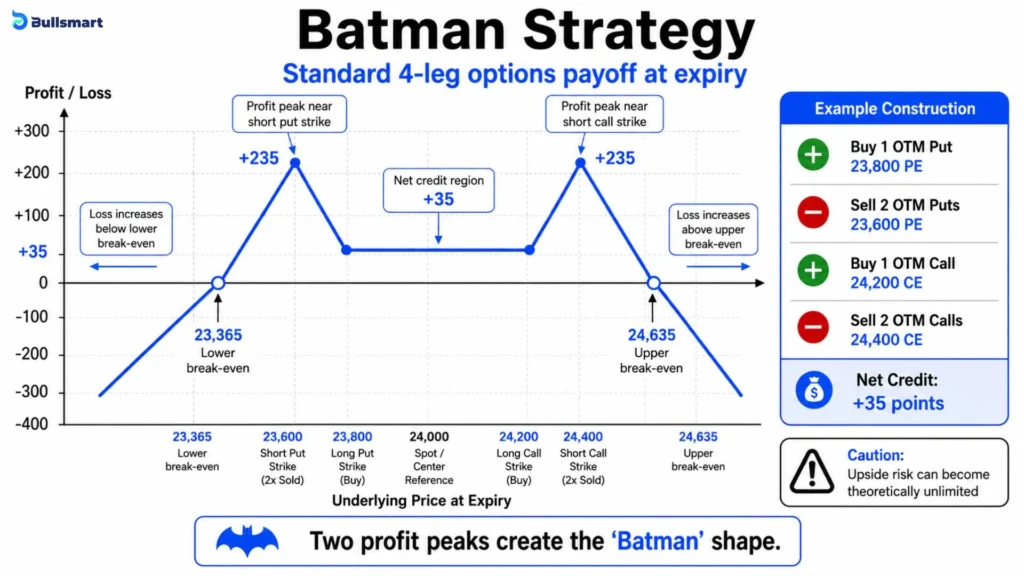
Consider the call side first.
The long call starts gaining value once the underlying moves above its strike. Profit continues to rise until the price reaches the strike where two calls have been sold. Beyond that point, the extra short call begins working against the position.
The put side creates a mirror-like effect.
As the underlying falls below the long put strike, the position gains value until the short put strike is reached. Below that level, the additional short put starts increasing losses.
The result is: Lower profit peak + middle region + upper profit peak
Those two peaks resemble Batman’s ears, giving the strategy its name.
Suggested visual: Batman strategy payoff graph showing the lower profit peak, central region, upper profit peak and outer loss zones.
How Is the Batman Strategy Constructed?
The Batman strategy combines two ratio spreads around the current market price:
- Call side: Buy 1 OTM call and sell 2 further OTM calls.
- Put side: Buy 1 OTM put and sell 2 further OTM puts.
Together, these form a 1:2 call ratio spread and a 1:2 put ratio spread with the same expiry. The long options sit closer to the current market price, while the two short options are placed farther away on each side.
Suggested Read: Can the 100-Year-Old Gann Square of 9 Really Map Nifty Levels With Surprising Accuracy?
Why Sell Two Options Against One?
On the call side, the trader buys one OTM call and sells two further OTM calls.
The long call starts gaining value if the underlying rises above its strike, while the two short calls help collect premium. At expiry, the call-side payoff generally reaches its highest point near the short call strike.
However, once the underlying moves beyond the short call strike, both short calls begin gaining intrinsic value against only one long call.
Effectively, the long call offsets only one of the short calls, leaving the second short call uncovered.
This is what creates the significant upside risk in the call ratio spread.
The put side works in the opposite direction. The long put can gain as the market falls, but once price moves sufficiently below the short put strike, losses on the two short puts can begin to outweigh the gain from the single long put.
How Does the Batman Trading Strategy Make or Lose Money?
The easiest way to understand the Batman strategy is to divide its expiry payoff into five zones.
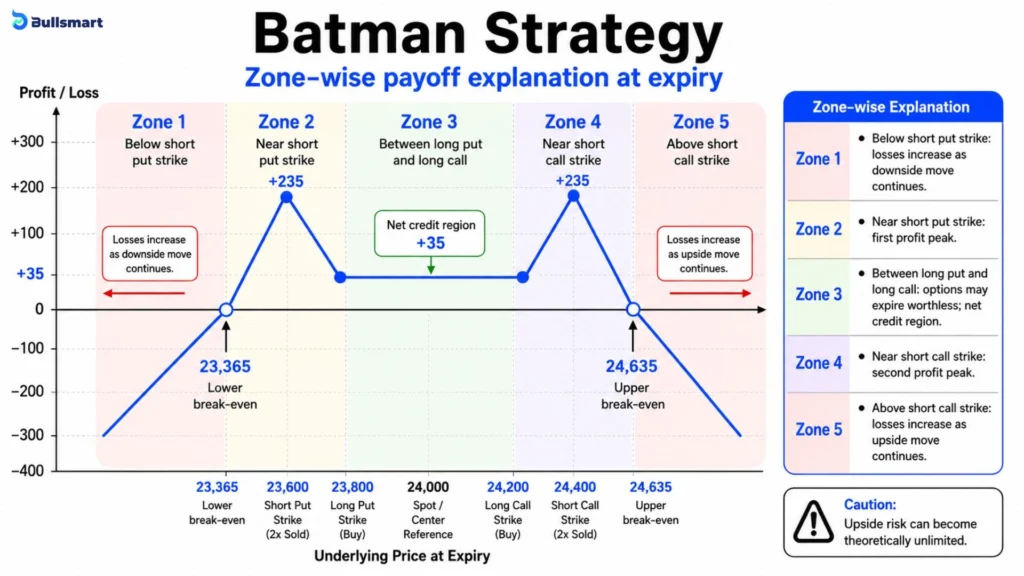
Zone 1: Price Falls Below the Short Put Strike
If the underlying falls below the short put strike, both short puts begin gaining intrinsic value.
The long put also gains value, but because there are two short puts against one long put, the losses on the short puts can eventually outweigh the gain from the long put.
As the market falls further, the overall loss increases.
Zone 2: Price Is Near the Short Put Strike
The lower profit peak generally appears near the short put strike.
At this level, the long put has intrinsic value, while the short puts may still have little or no intrinsic value at expiry.
This creates the first major profit peak, or the first “ear” of the Batman-shaped payoff.
Zone 3: Price Remains Between the Long Put and Long Call
If the underlying expires between the two long-option strikes, all four options may expire out of the money.
In that case, the final result mainly depends on whether the strategy was opened for a net credit or net debit.
If it was established for a net credit, that premium may be retained, creating the lower middle portion of the payoff chart.
Zone 4: Price Is Near the Short Call Strike
The second profit peak generally appears near the short call strike.
At this level, the long call has intrinsic value, while the two short calls may still have little or no intrinsic value at expiry.
This creates the second “ear” of the Batman payoff.
Zone 5: Price Rises Above the Short Call Strike
Once the underlying moves above the short call strike, both short calls begin gaining intrinsic value.
The single long call offsets only part of this exposure.
As the market rises further, the losses from the two short calls can increasingly outweigh the gain from the long call.
This is why the standard Batman strategy can carry significant upside risk.
Suggested Read: How to Hedge an Open Nifty Options Position: 5 Questions to Ask
Maximum Profit in the Batman Strategy
For a Batman strategy opened for a net credit, the maximum profit generally occurs near either of the two short strikes.
Call-Side Peak Profit
Call-Side Peak Profit = Short Call Strike – Long Call Strike + Net Credit
Put-Side Peak Profit
Put-Side Peak Profit = Long Put Strike – Short Put Strike + Net Credit
If the strike distances are equal on both sides, the two profit peaks can be similar in size.
However, if the strike distances or option premiums differ, the two peaks may not be equal. This means the Batman payoff does not always have perfectly symmetrical “ears.”
Break-Even Points of the Batman Strategy
For a Batman strategy opened for a net credit, there are generally two outer break-even points.
These are the price levels where the strategy’s expiry payoff moves from profit to loss.
Upper Break-Even
Upper BE = Short Call Strike + Call Strike Difference + Net Credit
Where:
Call Strike Difference = Short Call Strike – Long Call Strike
If the underlying moves above this level at expiry, losses on the extra short call begin to exceed the profit generated by the strategy.
Lower Break-Even
Lower BE = Short Put Strike – Put Strike Difference – Net Credit
Where:
Put Strike Difference = Long Put Strike – Short Put Strike
If the underlying falls below this level at expiry, losses on the extra short put begin to outweigh the strategy’s gains.
Therefore, for a net-credit Batman strategy, the profitable expiry range generally lies between the lower and upper break-even points.
Does a Batman Strategy Always Have Two Break-Even Points?
No.
This is an important detail that simple explanations can miss.
Our example begins with a net credit, so the central portion of the payoff is already profitable. That produces two outer break-even points.
But a Batman strategy can also be established for a net debit.
If the debit is large enough to make the middle region negative while the two ears remain profitable, additional inner break-even points can appear. In such a structure, the strategy may have four break-even points instead of two.
Sensibull therefore describes Batman break-even levels as dependent on whether premium is received or paid rather than treating two break-even points as universal.
What Is the Maximum Loss in a Batman Strategy?
This is where the attractive Batman-shaped graph deserves closer attention.
Upside Loss
On the upside, the position contains:
- 1 long call
- 2 short calls
Once the market has moved sufficiently above all three call strikes, one long call effectively offsets only one of the two short calls.
The remaining short call is uncovered.
Because there is theoretically no upper limit to how far an underlying can rise, the upside loss is theoretically unlimited. The Options Industry Council makes the same point for a 1:2 short call ratio spread.
Downside Loss
The put side contains:
- 1 long put
- 2 short puts
Loss can become extremely large if the underlying collapses.
Unlike the call side, however, the downside is technically bounded because an underlying price cannot fall below zero.
So the downside risk is substantial but finite, while the upside risk is theoretically unlimited. This distinction is also made by the Options Industry Council when comparing short call and short put ratio spreads.
When Is the Batman Strategy Generally Considered?
The Batman options strategy is generally associated with a neutral or range-bound market expectation.
Sensibull describes it as a neutral strategy for situations where the trader expects the market to remain within a range.
The basic idea is understandable.
Higher option premiums may allow the two short options on each side to generate enough premium to offset or exceed the cost of the long options.
But there is a catch.
High IV Is Usually High for a Reason
Implied volatility can rise because the market expects uncertainty.
That could involve:
- Earnings
- Economic announcements
- Policy decisions
- Elections
- Company-specific developments
- Global market shocks
- Other scheduled or unscheduled events
If that uncertainty turns into a sharp directional move, the same market condition that produced attractive premiums can expose the ratio structure to large losses.
High premium should therefore never be confused with low risk.
How Does Time Decay Affect the Batman Strategy?
Options lose time value as expiry approaches, although the rate and effect differ across strikes and market conditions.
A Batman strategy usually contains four short option quantities against two long option quantities.
As a result, the position can generally benefit from time decay when the underlying remains within a limited range.
Both short ratio call and short ratio put spreads are described by the Options Industry Council as structures for which the passage of time will generally have a positive effect, all else being equal.
But Theta Is Not Free Money
Suppose a strategy earns small amounts from time decay on many quiet days.
One large directional move can still create a loss that exceeds several earlier gains.
This is why evaluating a strategy purely on premium collection can be misleading.
The question is not simply: “How much theta am I earning?”
It is also:“How much risk am I carrying to earn that theta?”
Why a 90% Win Rate Can Still Lose Money
Consider a hypothetical strategy that produces:
- 9 winning trades
- ₹1,000 profit on each winner
- 1 losing trade
- ₹15,000 loss on the loser
Its win rate is: 9 ÷ 10 × 100 = 90%
Total winning amount: ₹9,000
Total losing amount: ₹15,000
Net result: ₹9,000 – ₹15,000 = -₹6,000
The trader has a 90% win rate and still loses money overall.
This is particularly relevant when analysing options strategies with asymmetric tail risk.
Instead of looking only at win rate, an evaluation should consider:
- Average profit
- Average loss
- Size of extreme losses
- Maximum possible loss
- Probability of different outcomes
- Transaction costs
- Expected value
A visually high probability of profit is not the same thing as a favourable risk-reward structure.
The farther the market drops below the lower break-even, the larger the loss becomes, although downside loss ultimately remains bounded by zero in the underlying.
Gap Risk
A further challenge is that markets do not always move gradually.
An overnight gap can move the underlying across a break-even level before a trader has an opportunity to react.
For a strategy containing uncovered short-option exposure, this can cause the position’s risk profile to change rapidly.
Batman Strategy and Option Greeks
The payoff chart shows what happens at expiry.
Before expiry, however, option prices are also affected by time, volatility and changes in the underlying.
That makes the Greeks important.
Delta
Delta measures how sensitive an option’s price is to changes in the underlying.
A Batman strategy can be constructed so that its initial directional exposure is relatively balanced.
But that does not mean it remains delta-neutral.
As price approaches or passes different strikes, the deltas of the six option quantities change.
The position can therefore become increasingly directional as the underlying moves away from the centre.
Theta
Theta measures the impact of time decay.
Because the standard Batman structure has more option quantities sold than bought, time decay can generally help when price stays in a favourable range.
However, theta varies with strike, expiry, spot price and volatility.
The whole Batman position should not simply be labelled “positive theta” under every possible condition.
Vega
Vega measures sensitivity to changes in implied volatility.
For the individual short ratio call and put spreads, the combined vega of the two short options will generally exceed that of the single long option, making rising implied volatility unfavourable in many configurations.
That helps explain why the structure is often discussed when IV is relatively high and a decline in volatility is expected.
Again, the exact vega of the complete position depends on the chosen strikes, expiry and current market level.
Gamma
Gamma measures how quickly delta changes as the underlying moves.
This becomes especially important as expiry gets closer and price moves near option strikes.
The Batman strategy may begin looking relatively neutral, but its directional exposure can change quickly when the market moves toward or beyond one of its short strikes.
Batman Strategy vs Iron Condor
Both strategies may be associated with a neutral market view, but their risk structures are very different.
| Feature | Batman Strategy | Iron Condor |
| Typical market view | Neutral/range-bound | Neutral/range-bound |
| Main payoff | Two profit peaks | Central profit zone |
| Ratio structure | Usually 1:2 | Usually 1:1 |
| Outer protection | Not present in standard four-leg version | Long wings provide protection |
| Maximum upside loss | Theoretically unlimited | Defined |
| Downside risk | Large | Defined |
| Number of basic legs | 4 strike positions | 4 |
| Complexity | High | Moderate |
| Margin sensitivity | Can be significant | Risk is capped by wings |
A conventional iron condor sells an OTM put and call while buying farther OTM options for protection. Those long outer wings define the strategy’s maximum risk.
The standard four-leg Batman strategy does not contain those extra protective wings.
So two strategies can both express a neutral view while having very different worst-case outcomes.
Is There More Than One Batman Strategy?
Yes, and this can cause considerable confusion when researching the strategy online.
Version 1: Four-Leg Ratio-Spread Batman
This is the version discussed throughout this article:
- Buy 1 OTM call
- Sell 2 farther OTM calls
- Buy 1 OTM put
- Sell 2 farther OTM puts
This is the version described by Sensibull and Samco.
Version 2: Defined-Risk Batman or Double Butterfly
Some options educators use the name Batman spread for another structure built by combining put and call butterflies.
A typical version adds farther-out long options after the short strikes.
Conceptually, it may contain:
- Long options toward the centre
- Two short options around each profit peak
- Additional long options farther outside
Those additional long wings cap the tail risk.
One educational description calls this a variation of a double long butterfly and constructs it using a long straddle, double short OTM strangle and farther OTM long strangle.
The two structures may produce similar Batman-like payoff shapes, but they are not economically identical.
Advantages and Limitations of the Batman Strategy
| Potential Advantages | Limitations |
| Can express a range-bound market view | Standard version carries major tail risk |
| Creates two separate peak-profit zones | Upside risk is theoretically unlimited |
| May be established for a net credit | Requires multiple option positions |
| Can generally benefit from time decay in a suitable range | Margin requirement can be significant |
| Strikes can be adjusted for different expected ranges | Strong directional moves can create large losses |
| May benefit if IV falls after entry | Rising IV can hurt the position |
| Provides flexibility in strike selection | Execution costs and slippage affect real results |
The underlying call and put ratio spreads are generally associated with limited profit potential and adverse exposure if the market moves too far through their short strikes.
Common Batman Strategy Mistakes
1. Looking Only at the Two Profit Peaks
The “ears” are visually attractive, but the more important part of the graph may be what happens beyond them. The majority of times the profit will be in the range between the two ears of the bat. Also, always inspect the outer loss regions.
2. Assuming Neutral Means Safe
A neutral market view is not the same as a low-risk strategy.
The standard Batman structure can carry very large directional risk.
3. Ignoring the Break-Even Points
Profit at the short strike tells only part of the story.
The trader also needs to know where losses begin if price continues moving.
4. Choosing Strikes Only for Higher Premium
Farther or closer strikes can materially change:
- Peak profit
- Break-even levels
- Greeks
- Margin
- Probability distribution
- Tail exposure
Premium alone should not define the structure.
5. Assuming High IV Guarantees an Advantage
High IV means options are pricing greater expected movement or uncertainty.
If the underlying actually makes a large move, the strategy’s short-option exposure can become the bigger issue.
6. Ignoring Transaction Costs
A Batman strategy involves multiple positions.
The actual result can therefore differ from the theoretical payoff after accounting for:
- Brokerage
- Exchange charges
- Taxes and statutory charges
- Bid-ask spreads
- Slippage
7. Ignoring Margin Changes
Because the standard strategy includes uncovered option exposure, required margin can be significant and may change as market conditions change.
8. Assuming the Greeks Stay Constant
Delta, gamma, theta and vega change as:
- Price moves
- Time passes
- IV changes
A payoff graph taken at entry is not a complete picture of how the position will behave before expiry.
Checklist for Analysing a Batman Strategy
Before evaluating any Batman options setup, check:
- Underlying price: Note where the underlying is trading relative to all four strikes.
- Expected price range: Estimate the range within which you expect the underlying to move before expiry.
- Expiry date: Check how much time is left, since time decay and price sensitivity change as expiry approaches.
- Implied volatility: Assess whether option premiums are relatively expensive or cheap compared with expected movement.
- Long call strike: Identify the call strike where the long call position begins affecting the payoff.
- Short call strike: Note the strike where the short call leg contributes to the call-side profit peak and tail exposure.
- Long put strike: Identify the put strike where the long put position starts shaping the downside payoff.
- Short put strike: Note the strike where the short put leg contributes to the put-side profit peak and tail exposure.
- Number of contracts on each leg: Confirm the exact ratio between long and short options on both sides.
- Net credit or debit: Calculate whether the entire strategy begins with premium received or premium paid.
- Upper break-even: Identify the price above which the strategy begins moving into loss on the upside.
- Lower break-even: Identify the price below which the strategy begins moving into loss on the downside.
- Peak profit on each side: Calculate the highest possible profit around the call-side and put-side profit peaks.
- Upside tail exposure: Check what happens if the underlying rises far beyond the upper strikes.
- Downside tail exposure: Check what happens if the underlying falls sharply below the lower strikes.
- Current Greeks: Review Delta, Gamma, Theta and Vega to understand how the position may react to price, time and volatility changes.
- Margin requirement: Check how much capital or collateral the broker requires to maintain the complete position.
- Scheduled event risk: Look for earnings, policy decisions, economic data or other events that could cause unusually large moves.
- Liquidity and bid-ask spread: Check whether each option leg has enough trading activity and reasonable spreads for efficient execution.
- Estimated transaction costs: Include brokerage, exchange charges, taxes and slippage when estimating the strategy’s actual payoff.
Most importantly, do not evaluate a complex strategy only by its maximum profit or probability of profit.
Look at the full distribution of possible outcomes.
Bottom Line
The Batman trading strategy gets attention because its expiry payoff looks unusual, but the name and shape are not the most important things to understand.
The standard four-leg Batman options strategy combines a 1:2 call ratio spread with a 1:2 put ratio spread. This creates two potential profit peaks, usually around the short call and short put strikes, while the middle of the payoff depends on the net premium paid or received.
The main trade-off appears outside those peaks.
A strong upward move can expose the uncovered short call and create theoretically unlimited losses. A severe downward move can also produce substantial losses through the extra short put.
That is why the two Batman “ears” should never be viewed in isolation.
Before analysing such a strategy, the more useful questions concern break-even levels, tail risk, implied volatility, Greeks, margin, transaction costs and the consequences of a move outside the expected range.
In options trading, a clever-looking payoff graph does not remove risk. Understanding what happens when the market does something unexpected is often the more important part of understanding the strategy.
Disclaimer: Investments in securities market are subject to market risks. Read all the related documents carefully before investing.
Bullsmart is publishing this article strictly for educational and awareness purposes and does not endorse or recommend the Batman options strategy or any other trading strategy. Options and derivatives involve significant risk, including substantial losses and, in some structures, theoretically unlimited loss. Nothing here constitutes investment, trading, financial or legal advice.
FAQs
Is the Batman strategy bullish or bearish?
The Batman strategy is generally classified as a neutral or range-bound options strategy. It combines a call ratio spread above spot and a put ratio spread below spot.
Is the Batman strategy suitable for sideways markets?
Its payoff is generally designed around an expectation that the underlying will remain within a defined range rather than making a large directional move. However, being designed for a sideways outlook does not make it low risk.
Is the maximum loss in the Batman strategy unlimited?
For the standard four-leg version, upside loss is theoretically unlimited because the call side ultimately leaves one uncovered short call. Downside loss from the put ratio spread can be extremely large but is technically limited because the underlying cannot fall below zero.
Why is it called the Batman strategy?
Its expiry profit-and-loss diagram can create two prominent profit peaks resembling Batman’s pointed ears.
Is Batman the same as an Iron Condor?
No. Both can express a neutral view, but an iron condor uses outer long options to cap losses. The standard four-leg Batman ratio strategy does not provide the same tail protection.
Is the Batman strategy the same as the Batman chart pattern?
No. The Batman options strategy gets its name from the shape of its payoff diagram. The Batman chart pattern is a separate technical-analysis formation seen directly on a price chart.