
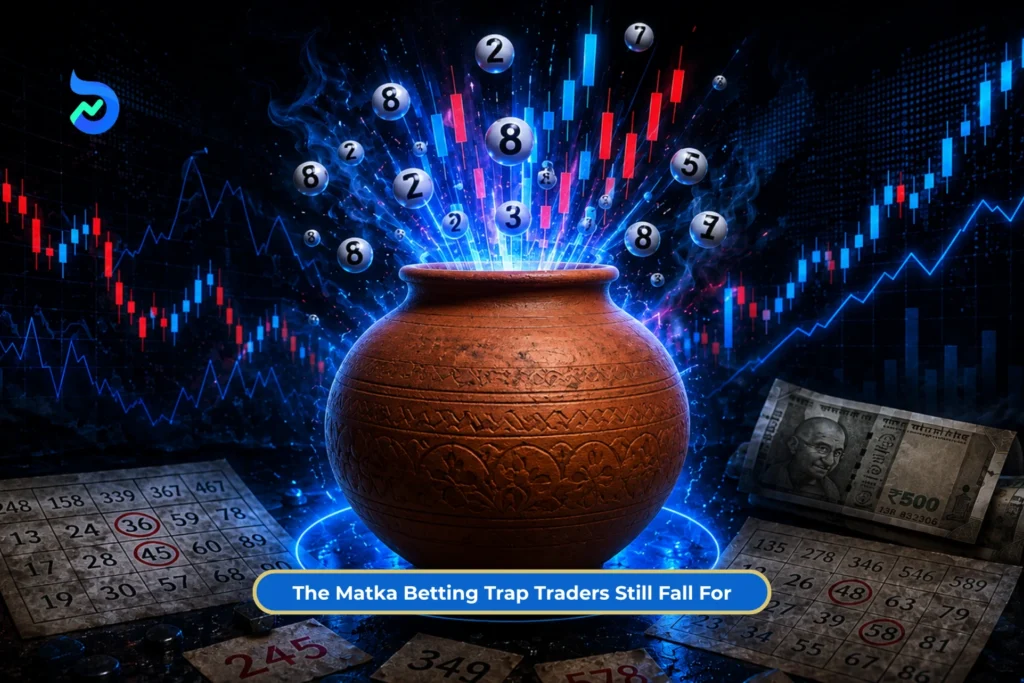
Bet Rs. 100 on the right Matka number, and if it hits, that small amount could supposedly turn into thousands.
Sounds like easy money, right?
No waiting for a breakout. No company results. No long chart study. You pick your numbers, wait for the open and close, and hope the result goes your way.
And if you trade, some of these words may sound very familiar: Market. Open. Close. Rate. Chart. Tip.
That is Satta-Matka. Years ago, numbers were actually drawn from a matka, or earthen pot. The pot may have changed, but the big hook is still the same: put in a little, hope to get back a lot.
But here is the catch.
Nothing is actually being traded.
No stock. No contract. No exchange order. No real price discovery. It is simply money placed on an uncertain result.
Still, people study old Matka charts, look for patterns and think, “Wait… I think I’ve cracked this.”
But can you really find an edge in a game built on chance?
Let’s dive into the world of matka!
What Is Matka?
Matka, commonly called Satta-Matka, is a number-based wagering format in which people place money on specific numbers or number combinations and wait for a declared result. If the chosen number matches the outcome, the bettor receives a payout based on the game’s rules. If it does not, the amount staked is lost.
The format may use terms such as open, close, market, rate and chart, which can make it sound similar to trading. But unlike stock-market trading, there is no security being bought or sold and no exchange matching orders. At its core, Matka is a bet on an uncertain numerical outcome.
Suggested Read: 11 Smart Money Concepts for Indian Traders for a Practical Analysis Framework
Where Did Satta Matka Come From?
Its connection with financial markets comes from its early history.
Early Satta-Matka involved bets on the opening and closing cotton rates sent from the New York Cotton Exchange to the Bombay Cotton Exchange through teleprinters. People would wager on the last digits of those rates.
Later, the format moved away from cotton prices and shifted towards number-based draws. Kalyan Matka emerged in the early 1960s, followed by New Worli Matka, associated with Rattan Khatri.
Example: How Matka Works
Take a simple open-and-close-Matka-result.
Suppose the open number is 5 and the close number is 7. Put them together and the final pair becomes 57. Matka results are commonly divided into an open and a close, with two-digit pairs running from 00 to 99.
Now suppose someone has placed Rs. 100 on 57.
- Open: 5
- Close: 7
- Final result: 57
- Amount staked: Rs. 100
If 57 is the declared result, the person receives the operator’s predetermined payout. If the result is 58, 67, 42 or anything else, the Rs. 100 stake is lost.
And this is where the difference from trading becomes clear.
The Rs. 100 did not buy a stock, commodity or contract. There was no price movement that created the return. The money was simply wagered on whether the chosen number would match the declared result. Indian Express similarly describes Satta Matka as guessing the correct number for a predetermined monetary reward.
Suggested Read: Elder’s Triple Screen System: The 3 Timeframe Check Before Every Trade
Is Matka Like Regular Trading?
No.
This is the important distinction: The cotton price may have supplied the number, but that did not make the bet a cotton trade.
There was:
- No cotton being bought
- No cotton contract being sold
- No exchange trade taking place
- No participation in cotton price discovery
The cotton rate was simply being used as the number people were betting on.
Why Does Matka Sound Similar To Trading?
Because the format changed, but much of the market-style language stayed.
Words like open, close, market and rate continued to be used.
That is where the confusion starts.
Matka may borrow the language of markets, but underneath it, it is still a wager on an uncertain outcome.
Types of Matka Trading
Matka does not have just one format. Different bets are built around single digits, two-digit pairs and three-digit combinations. Because Matka is unregulated, names and rules can vary between operators, but these are some of the commonly used terms documented in descriptions of the game.
Before looking at the types, remember that a Matka result is generally divided into two parts: Open and Close.
1. Single Matka
A Single is simply one digit from 0 to 9.
For example, suppose the declared Open digit is:
Open: 6
A bet linked to 6 matches that Single result. A number such as 4 or 8 does not.
This is the simplest form because only one digit matters.
2. Jodi or Pair
A Jodi combines two digits and can range from 00 to 99.
For example:
Open: 5; Close: 7
The Jodi becomes: 57
So 57 is the final two-digit pair. A result of 56, 47 or 75 would be a different Jodi.
3. Patti or Panna
A Patti, also called a Panna, is a three-digit result.
For example: 128
Here, the entire three-digit combination matters, not just one digit.
Pattis are further described as:
- Single Patti: all three digits are different, such as 123
- Double Patti: two digits are the same, such as 112
- Triple Patti: all three digits are the same, such as 111
A Quick Example
Suppose a Matka result contains: Open Patti: 128
Adding the digits gives: 1 + 2 + 8 = 11
The last digit is 1, which becomes the Open digit.
Later, suppose the Close digit is 7.
The resulting Jodi would therefore be: 17
This is why this gambling can look more complicated than simply choosing one random number. Singles, Pattis and Jodis can all appear within the same result structure.
But none of these combinations represents a financial asset or market price. They are simply different ways of wagering on a numerical outcome.
Suggested Read: How to Build an Old Money Lifestyle? Explore 7 Financial Habits of the Wealthy!
Matka vs. Equity Trading
The easiest way to see the difference between matka and regular trading is to compare what is happening underneath the screen.
| Feature | Matka | Regulated Securities Trading |
| What happens? | Money is wagered on an uncertain outcome | A security or regulated market contract is bought or sold |
| Market infrastructure | Outside recognised securities-market infrastructure | Uses recognised exchanges and regulated intermediaries |
| Price or result | Comes from the betting format | Market prices emerge through demand, supply and order matching |
| Trade execution | No recognised stock-exchange execution | Orders are executed through exchange infrastructure |
| Clearing and settlement | No securities-market clearing mechanism | Clearing corporations and depositories support settlement |
| Investor grievance framework | Not part of securities-market grievance mechanisms | Eligible complaints can access intermediary, exchange and SEBI mechanisms |
| Risk | Money can be lost on the wager | Capital can also be lost because market prices fluctuate |
SEBI notes that regulated securities-market infrastructure exists to support trading, clearing, settlement, transparency and investor protection. Its SCORES system also provides a grievance-redressal route for complaints involving SEBI-regulated entities.
But there is an equally important warning here.
Regulated does not mean profitable.
Stock-market trading can result in losses. Regulation tells you something about how the market operates, not what your return will be.
Matka on Screen: The Matka King Web Series
Matka-gambling has even made its way into pop culture.
The 2026 Prime Video series Matka King, directed by Nagraj Manjule and starring Vijay Varma, is set in 1960s Mumbai. It follows an ambitious cotton trader who starts a gambling game called Matka and watches it grow across the city.
The series is especially relevant because it shows how Matka could appeal beyond traditional gambling circles. A small stake, simple numbers and the hope of a big payout made the format easy to understand and easy to spread.
But Matka King is a fictional drama, not a guide to how Matka works or a historical source. It is better viewed as a pop-culture portrayal of the world surrounding the game.
Why Do People Do Matka Gambling?
The main attraction is simple: a small stake can appear to offer a much larger payout. But psychology also plays a big role.
1. It Feels Predictable
People may study old results, choose their own numbers or follow patterns. This can create an illusion of control, where a random outcome starts to feel more predictable than it really is.
2. Past Results Look Important
If a number has not appeared for some time, people may feel it is more likely to appear next.
This is known as the gambler’s fallacy. In independent random outcomes, previous results do not make a particular future result more likely.
3. Near Misses Encourage Another Try
Missing by a small margin can feel different from a complete loss.
Research on gambling shows that near misses can increase the urge to continue, even though the result is still a loss.
4. The Format Looks Simple
Matka can seem much easier than actual trading.
There are no company results, valuations or market analysis to study. The process appears simple: pick a number, place a bet and wait for the result.
That simplicity is part of the appeal, but it does not make the outcome easier to predict.
Is Matka Betting Legal in India?
The legal position depends on how Matka is played and where it takes place. Gambling laws in India have traditionally been handled at the state level, while online money gaming now also comes under a central law.
Offline-Matka and State Laws
Maharashtra is especially relevant because this type of gambling has strong historical links with Mumbai.
Under the Maharashtra Prevention of Gambling Act, “gaming” includes wagering and betting, subject to certain exceptions. The law also covers gaming connected with:
- Cotton and other commodity prices
- Stock or share prices
- Numbers and number combinations
- Uncertain future events
- Draws and similar outcomes
So, Matka-style betting in Maharashtra falls within the state’s gambling-law framework.
What About Online Matka?
Online money gaming is now also covered by the Promotion and Regulation of Online Gaming Act, 2025, which came into force on 1 May 2026.
The law broadly covers online games where users put in money or other stakes with the expectation of receiving monetary or other gains. This applies whether the game involves skill, chance or a mix of both, subject to specified exclusions such as qualifying e-sports.
The Act prohibits:
- Offering online money gaming services
- Advertising or promoting online money games
- Facilitating payments for prohibited online money gaming services
What Are the Penalties?
The penalties depend on the specific offence.
- Offering a prohibited online money gaming service can attract up to 3 years of imprisonment, a fine of up to Rs. 1 crore, or both.
- Advertising such services can attract up to 2 years of imprisonment and a fine of up to Rs. 50 lakh.
- Facilitating prohibited payments can attract up to 3 years of imprisonment and a fine of up to Rs. 1 crore.
However, this does not mean that everyone associated with every Matka-related activity automatically faces these penalties. The applicable law depends on the activity, platform, location and specific offence involved.
For any case-specific legal question, the relevant law should be checked separately.
Bottom Line
Matka can look tempting because the entry feels small and the possible payout looks huge. Add words like market, open, close, rate and chart, and suddenly it starts sounding a lot more like trading than betting.
But strip away the labels and the picture is very different.
There is no stock being bought, no contract changing hands, no exchange order and no real price discovery. The money is riding on an uncertain numerical result.
That is also why this betting can feel so convincing. Old results start looking like patterns. Near misses feel important. A few correct guesses can make the whole thing seem more predictable than it really is.
And yes, regular trading has risk too. Losses happen there as well. The difference is that regulated trading runs through recognised market infrastructure with proper execution, settlement and investor-protection systems.
So while Matka may borrow the language of trading, the mechanics underneath tell a very different story.
Disclaimer: Investments in securities market are subject to market risks. Read all the related documents carefully before investing. Bullsmart is publishing this article strictly for educational and awareness purposes. It does not promote, endorse, recommend or encourage Matka, Satta, gambling, betting or any other unregulated activity. Any examples of Matka formats, numbers or payouts are included only to explain how such activities work.
Nothing in this article should be considered investment, trading, financial or legal advice. Laws relating to gambling, betting and online money gaming may vary by jurisdiction and may change over time. Readers should verify the applicable legal position and seek appropriate professional advice where required.
FAQs
Is Matka the Same as Stock Trading?
No. Matka involves wagering money on an uncertain numerical result. Stock trading involves buying or selling securities through regulated market infrastructure. In Matka, there is no stock, exchange order or market-based price discovery. The words market, open, close and rate may sound familiar, but the underlying activity is completely different.
Is Matka Legal in India?
The legal position depends on the format and location. Gambling is also regulated through state laws. In Maharashtra, the Prevention of Gambling Act covers wagering and betting. Online money gaming is additionally restricted under the Promotion and Regulation of Online Gaming Act, 2025, which prohibits offering online money games, related advertising and payment facilitation.
Is Matka the Same as Dabba Trading?
No. Matka is a number-based wagering activity. Dabba trading involves securities deals that appear like stock-market trades but are never executed on a recognised exchange. Instead, the dabba operator records and settles them internally. SEBI explicitly describes dabba trading as illegal and unregulated. The two work differently, even though both operate outside normal regulated market infrastructure.
Is Matka legal in India?
Matka-betting is generally not recognised as legal trading in India. Its legality depends on the format and applicable state law. In Maharashtra, gambling law covers wagering and betting. Online money games are also prohibited under the Promotion and Regulation of Online Gaming Act, 2025. Therefore, Matka should not be treated as a lawful or regulated securities-market activity in India.