

Pick a colour, double your money, and the app calls it trading.
That is the pitch behind many so-called color trading or colour prediction platforms. The interface may show a wallet, changing numbers, countdowns, returns and other market-like elements. But the activity underneath is very different from buying or selling a security.
Colour prediction has been documented in India as a gambling format in which users place money on a colour or combination of colours. If the prediction is declared correct, the user receives a payout. No share is purchased. No ownership in a company is created. No securities trade needs to take place on a recognised stock exchange.
That distinction matters even more today. India now has a central law prohibiting online money games, while SEBI has separately warned investors about unauthorised virtual trading and gaming platforms that imitate parts of the securities market.
So what exactly is color trading, how does it work, and why should it not be confused with stock-market trading?
Disclaimer: Color trading is a form of gambling, not genuine stock market trading or investing. Users should avoid participating in such platforms, as they can involve significant financial and fraud-related risks.
What Is Color Trading?
Color trading, also known as colour prediction, is a form of online betting in which users stake money on a colour or combination of colours and receive a payout if the platform declares their selected outcome as the winner.
Despite the word “trading,” the activity does not involve buying or selling shares, securities or any other recognised financial instrument.
What Does Color Trading Involve?
The activity generally involves:
- Depositing real money into an app or website
- Choosing a colour or colour combination
- Placing a monetary stake before the round closes
- Waiting for the platform to declare the result
- Receiving a platform-defined payout for a winning prediction
- Losing the stake when the prediction is incorrect
Some platforms may also use referral rewards, bonuses, wallet balances and repeated short-duration rounds to keep users participating.
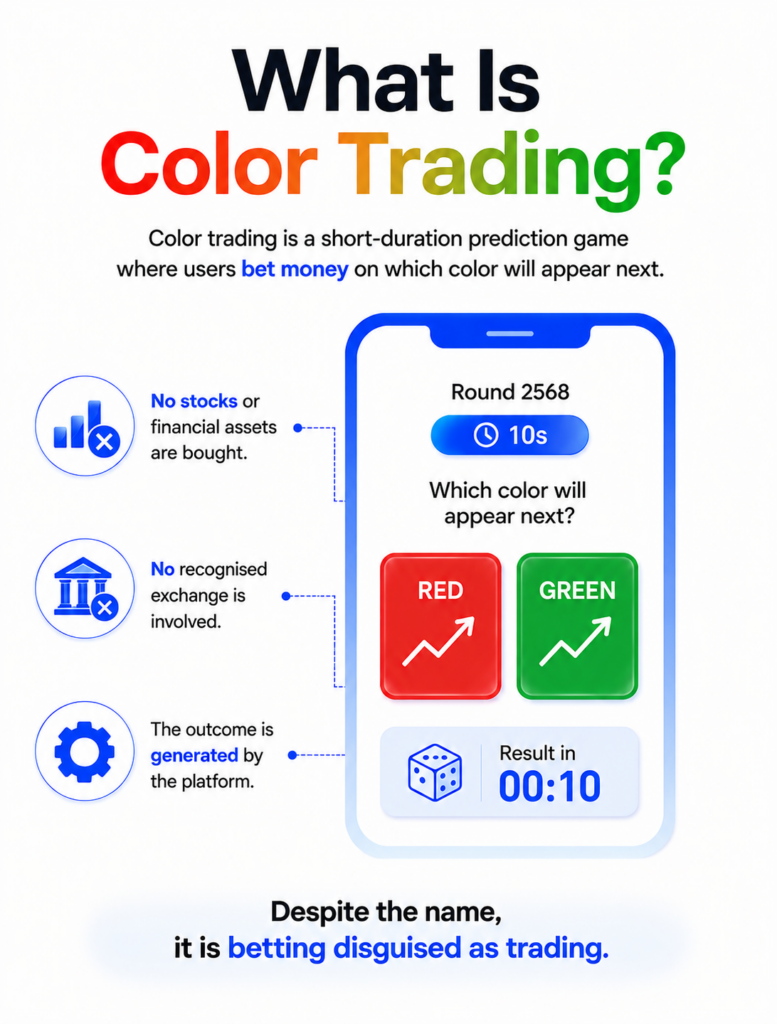
How Does Color Trading Work?
Color trading is usually conducted through short, time-bound prediction rounds. The user deposits money, selects a colour or number, places a stake and waits for the platform to declare the result.
1. Money Is Added to the Platform
The user first deposits real money into the app or website. The deposited amount appears in an in-app wallet and is then used to place bets during individual rounds.
2. The User Chooses a Colour or Number
A common color-prediction format uses red, green and violet, along with numbers from 0 to 9.
In one widely used format:
- Green: 1, 3, 7 and 9
- Red: 2, 4, 6 and 8
- Violet: 0 and 5
Some versions may treat 0 and 5 as special outcomes involving violet together with another colour, while others may use different mappings. The exact rules and payouts depend on the platform.
3. A Bet Is Placed Before the Timer Ends
Each round usually has a countdown. The user selects the outcome and decides how much money to stake before the betting window closes.
For example, the bet may be placed on red, green, violet or a specific number between 0 and 9, depending on the options offered by the platform.
4. The Platform Declares the Result
Once the countdown ends, a number or colour is displayed as the result. The platform then determines whether the user’s selected outcome matches that result according to its stated game rules.
Unlike stock-market trading, this result does not come from buying or selling a security on a recognised exchange.
5. The Bet Is Settled
If the selected outcome wins, the platform credits a predetermined payout to the user’s in-app wallet. If the prediction is incorrect, the amount staked is lost.
The payout can vary depending on whether the user selected a colour, violet outcome or exact number.
6. Another Round Begins
Color trading platforms generally run repeated rounds within short intervals, allowing users to place another bet almost immediately.
The interface may show features such as wallet balances, profit figures, charts, bonuses, countdown timers and referral rewards, which can make the activity appear similar to an online trading platform.
However, no share or other recognised security is being bought or sold. The user is simply betting money on a platform-defined outcome, which makes color trading a form of gambling rather than genuine stock-market trading.
Suggested Read: What is Matka Betting? Why Traders Still Fall for the Lottery-Style Illegal Betting in 2026?
Color Trading vs Stock Market Trading
Both may appear on a smartphone screen, but the similarity can end there.
| Factor | Color Trading | Stock Market Trading |
| What you do | Bet on a colour or platform-defined outcome | Buy or sell securities |
| Ownership | No company ownership is created by the colour bet | Equity shares can represent ownership in a company |
| Intermediary | May operate without a SEBI-registered intermediary | Trading is conducted through regulated intermediaries |
| Trading venue | Operator-controlled app or website | Recognised securities-market infrastructure |
| Return | Depends on the result and payout rules of the game | Depends on market price movements and other market factors |
| Settlement | Withdrawal depends on the platform honouring the displayed balance | Exchange trades follow formal clearing and settlement processes |
| Investor protection | Unauthorised platforms may sit outside securities-market protection | SEBI and exchange grievance mechanisms apply to eligible regulated transactions |
| Nature of activity | Real-money prediction or betting | Securities-market transaction |
SEBI says the public should undertake securities-market trading only through registered intermediaries. NSE’s equity market operates through a formal settlement framework, including T+1 rolling settlement.
Suggested Read: 11 Smart Money Concepts for Indian Traders for a Practical Analysis Framework
Is Color Trading Legal in India?
No, real-money color trading is not legal in India. A color trading app typically asks users to stake money on a colour, number or similar outcome for the chance to win a monetary payout. This makes color trading a form of online money gaming or gambling, not legitimate stock market trading.
India’s legal framework for real-money online games changed with the Promotion and Regulation of Online Gaming Act, 2025, followed by the Promotion and Regulation of Online Gaming Rules, 2026.
What Does Indian Law Say About Color Trading?
The Promotion and Regulation of Online Gaming Act prohibits online money games, including games in which users deposit or stake money with the expectation of receiving monetary winnings.
The prohibition applies whether the game is based on skill, chance or a combination of both.
The Act does not specifically define a separate activity called “color trading.” However, a typical color prediction game involves three key elements:
- A user deposits or stakes real money
- The user predicts a colour, number or other outcome
- A monetary payout is offered if the prediction wins
Because of this structure, real-money color prediction betting falls within the type of online money gaming covered by the law.
Calling the activity “trading” does not make it a legitimate or SEBI-regulated form of investment.
Is Color Trading Regulated by SEBI?
No. Color trading is not a recognised form of securities trading regulated by SEBI.
In genuine stock market trading, investors buy or sell recognised securities through registered intermediaries and regulated market infrastructure. A color trading platform does not become a stock market platform simply because it uses terms such as “trade,” “profit,” “return” or “wallet.”
Users should therefore not confuse a color trading app with a SEBI-registered broker or recognised securities trading platform.
Suggested Read: Supertrend Indicator’s 2 Core Components & the Powerful Setting Behind Clearer Signals
What Activities Related to Online Money Games Are Prohibited?
Under India’s online gaming framework, restrictions extend beyond operating the game itself. The law prohibits or restricts activities such as:
- Offering or facilitating online money games
- Advertising or promoting online money games
- Facilitating financial transactions connected with prohibited money games
This means the legal framework targets not only the operation of real-money games but also their promotion and payment ecosystem.
Suggested Read: The Most Expensive Games Ever Made: GTA 6 Budget, Rare Collectibles & What It All Means
Real Color Trading Cases in India
The risks are not hypothetical. Indian investigations have documented how these platforms have operated.
Hyderabad Color-Prediction Racket
In 2020, two complaints involving reported losses of ₹97,000 and ₹1.64 lakh led Hyderabad police to a much larger online gambling network.
Police reported that:
- Users were recruited through Telegram groups.
- Entry could involve referrals.
- Members received commissions for bringing in other users.
- Players placed bets on colours and colour combinations.
- Investigators encountered more than 500 websites connected with the operation.
- The websites were frequently changed.
The investigation also traced nearly ₹1,100 crore in inward transactions through two bank accounts.
That number requires careful wording.
₹1,100 crore was the value of inward transactions traced through the accounts. It was not established as ₹1,100 crore of victim losses.
Bengaluru Color-Prediction Scam
The 2021 Bengaluru case shows the problem on an individual level.
The user:
- Started with ₹10,000
- Was shown an initial ₹20,000 win
- Eventually deposited around ₹5.5 lakh
- Saw ₹7.67 lakh displayed in his app wallet
- Was unable to withdraw it
- Was asked to deposit another ₹50,000 before withdrawal
There is no reliable nationwide dataset identified here that isolates total Indian losses specifically from color-trading or colour-prediction scams. Broader cyberfraud numbers should therefore not be presented as color-trading losses.
For context only, the Ministry of Home Affairs reported more than 65.89 lakh financial-fraud complaints involving over ₹55,050 crore reported on NCRP between 2021 and 2025. Those figures cover financial cyberfraud generally, not colour prediction.
Suggested Read: Why Telegram Trading Channels Are Risky for F&O Traders in 2026
10 Warning Signs of a Color Trading Scam
A color trading scam may look like a genuine trading opportunity, but several warning signs can help users identify suspicious color trading apps and color prediction platforms before they lose money.
- Guaranteed or unusually high returns: Claims of fixed profits, assured winnings or fast returns are major red flags in color trading.
- No SEBI-registered intermediary: A color trading platform may use stock-market language without being connected to any SEBI-registered broker or recognised securities market.
- Links shared through WhatsApp, Telegram or social media: Many suspicious color prediction games are promoted through unsolicited messages, private groups, social-media ads or referral links.
- Pressure to join private groups: Users may be encouraged to follow Telegram or WhatsApp groups that provide so-called color trading tips, signals or winning predictions.
- Referral rewards for adding more users: Some color trading apps offer commissions, bonuses or extra wallet credits for bringing new participants onto the platform.
- Small early wins followed by larger deposit requests: A platform may initially show winning bets and then encourage users to increase the amount they deposit or stake.
- Profits exist only inside the app wallet: A large displayed balance does not necessarily mean the money can actually be withdrawn.
- Color trading withdrawal problems: Delayed, rejected or blocked withdrawals are a serious warning sign, especially when customer support provides no clear explanation.
- More money is demanded before withdrawal: A suspicious platform may ask users to pay an additional tax, processing fee, security deposit or recharge amount before releasing their supposed winnings.
- The color trading website or app keeps changing: Frequently changing URLs, unknown APK files, disappearing websites or platforms with no verifiable company details can indicate a fraudulent operation.
SEBI also identifies assured returns, quick high-return promises, unregistered entities, inadequate documentation and pressure to invest quickly as common signs of investment fraud. These warning signs are particularly relevant when a color trading platform tries to present itself as genuine financial trading.
What to Do If You Lose Money in a Color Trading Scam
If you suspect that you have been cheated through a color trading app or color prediction scam, avoid sending any more money.
Preserve all available evidence, including:
- Screenshots of the color trading app or website
- Payment receipts and transaction IDs
- Bank or UPI records
- WhatsApp or Telegram conversations
- Website URLs and app details
- Withdrawal requests and payment demands
Report suspected color trading fraud as quickly as possible through India’s National Cyber Crime Reporting system or by calling 1930.
Quick reporting can improve the chances of authorities and financial institutions identifying or stopping fraudulent transactions.
Bottom Line
Color trading may look like a quick and simple way to make money, but the structure behind it is very different from genuine stock market trading. You are not buying a share, owning a security or trading through a recognised exchange. You are placing money on a platform-controlled outcome, which makes it a form of gambling rather than investing.
That difference matters because color trading apps can also expose users to serious financial risks. Suspicious platforms may use guaranteed-return claims, referral rewards, early wins, blocked withdrawals or additional payment demands to keep users depositing more money.
So, if a platform asks you to bet on red, green, violet or a number and calls it “trading,” do not let the name confuse you. Genuine investing is built around regulated intermediaries, recognised market infrastructure and verifiable transactions. Color trading is not. If you come across such a platform, the safest choice is simple: do not participate, do not deposit money, and report suspicious activity promptly.
Disclaimer: This article is for educational and awareness purposes only. Color trading or colour prediction is a form of gambling and should not be treated as investing or stock market trading. Users should avoid participating in such platforms. Bullsmart does not promote or endorse color trading, gambling, betting, or any unauthorised financial activity. Always use SEBI-registered intermediaries for securities market transactions and verify platforms before transferring money.
FAQs
What is color trading?
Color trading, also called colour prediction, is a form of online gambling where users stake money on colours or numbers and receive a payout if their prediction matches the platform-declared result. Despite the term “trading,” it does not involve buying shares, securities or any recognised financial instrument.
Is colour trading legal in India?
No. Real-money colour trading is not legal in India. Since users stake money on a colour or number for the chance of winning money, it falls under online money gaming rather than legitimate securities trading. It is also not recognised or regulated by SEBI as a form of stock market trading.
Can I earn money from color trading?
You may occasionally see winning payouts on a color trading app, but this should not be considered a reliable way to earn money. Users are gambling on platform-defined outcomes, and suspicious platforms may also show profits that cannot actually be withdrawn. Color trading should not be treated as an investment or income source.
Which one is better, color trading or stock market trading?
Stock market trading is the legitimate option. It involves buying and selling recognised securities through regulated intermediaries and market infrastructure. Color trading involves betting money on platform-defined outcomes and does not provide ownership of securities or normal securities-market protections. The two activities should not be treated as equivalent.