
It’s 9:15 AM.
The opening bell rings. The index gaps up exactly the way you predicted after a major quarterly result. Telegram groups explode. Financial Twitter celebrates. Your call option instantly turns green.
For a moment, it feels like the perfect trade.
Then something strange happens.
The index keeps moving in your direction… but your option premium barely rises. A few minutes later, it starts falling. Confusion turns into panic. By noon, the market is still above your entry level, yet your position is now in loss.
Welcome to earnings season.
This is where many index option traders learn that markets are not driven only by direction. During result weeks, volatility, overnight gaps, expensive premiums, and rapid time decay can become far more dangerous than simply being “wrong” about the market.
That’s why experienced traders approach earnings season differently. They focus less on prediction and more on understanding how option pricing behaves around uncertainty.
This article breaks down the real mechanics behind earnings-season trading in index options, the traps that catch most retail traders, and the practical observations that can help avoid unnecessary damage during high-volatility weeks.
What Exactly Happens During Earnings Season?
Earnings season is the period when listed companies announce their quarterly financial results.
In India, these result cycles are usually concentrated around January, April, July, and October. For markets, this becomes one of the most sensitive phases of the quarter because investors, institutions, analysts, and traders closely track these numbers to understand how businesses and sectors are performing.
But earnings season is not just about results day. The market behaviour changes even before the announcements begin.
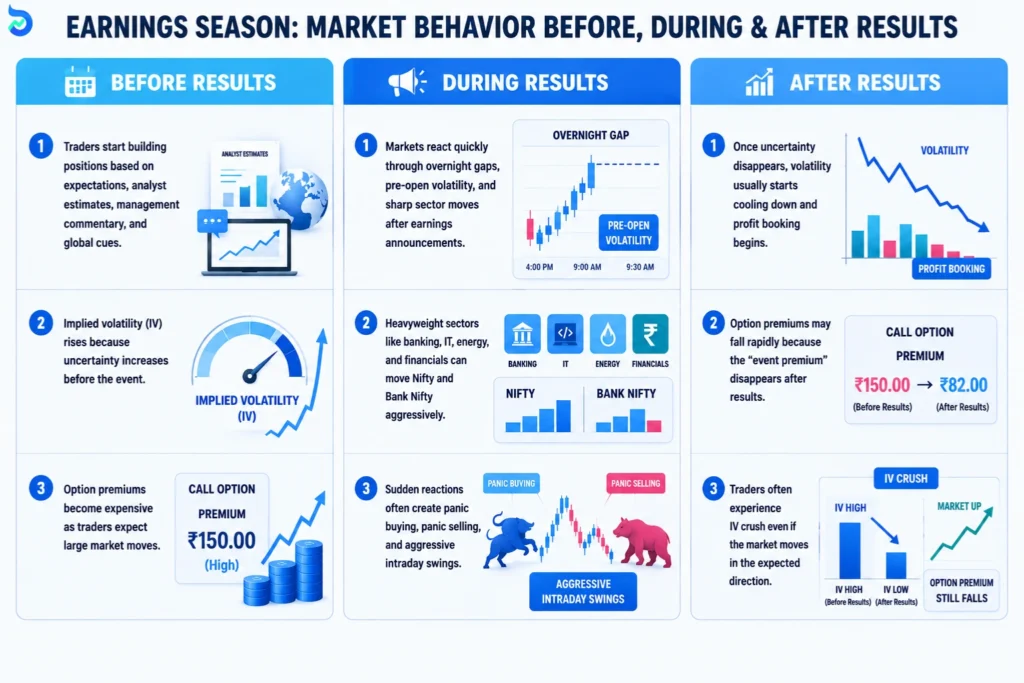
Before Results: Expectations Start Building
A few days before major results, the market enters a speculation phase. Traders start building positions based on expectations, analyst estimates, management commentary, and global market cues.
This is also when implied volatility starts rising.
Why?
Because uncertainty increases. Nobody knows whether the numbers will beat expectations, disappoint the market, or simply match estimates. As a result, option premiums become more expensive as traders rush to buy protection or take directional bets.
During Results: Volatility Explodes
Once results are announced, markets react quickly. Sometimes the move happens overnight. Sometimes it appears in the pre-open session itself.
This is where sudden gaps become common.
A strong result from a heavyweight sector player can lift the entire sector. A disappointing result can trigger panic across related stocks and even drag indices lower. Banking, IT, energy, and financial sectors often have the biggest influence on index movement because of their high weightage.
For index option traders, this becomes extremely important. A cluster of major results from heavyweight sectors can move Nifty or Bank Nifty far more aggressively than many traders expect.
After Results: The Market Changes Again
Once the uncertainty disappears, volatility usually starts cooling down.
This is where many option buyers get trapped.
Even if the market moves in the expected direction, option premiums may start falling because the “event premium” disappears after the announcement. Traders call this volatility crush or IV crush.
At the same time, profit booking starts emerging as institutions reduce short-term event positions. Depending on the overall market environment, this cooling-off phase can continue for several sessions after the result cycle ends.
Why Index Options Become Dangerous During Earnings Season
Earnings season does not just increase market movement. It completely changes how index options behave.
This is where many traders discover that simply predicting the market direction correctly is not always enough to make money.
During result-heavy weeks, three major traps tend to dominate index options trading.
1. The Direction Trap
This is the most obvious trap.
Traders expect the index to rally after strong earnings, but the market falls instead. Sometimes a reaction from a heavyweight sector can overpower broader positive sentiment.
For example, even if several companies report healthy numbers, disappointment from a major banking or financial heavyweight can drag the entire index lower. The reverse can happen too. A strong cluster of earnings can suddenly lift market sentiment even when traders were positioned defensively.
During earnings season, markets often react not to the results alone, but to the difference between expectations and reality.
2. The Timing Trap
Sometimes traders are directionally correct, but too early.
The index eventually moves exactly as expected, yet the chosen strike or expiry fails to benefit from the move. Time decay starts eroding option premiums rapidly, especially during weekly expiries.
This is one of the most frustrating experiences for retail traders. The market eventually validates the original view, but the position still loses value because the move arrived too late.
In index options trading, timing can matter just as much as direction.
3. The Volatility Trap
This is the most misunderstood trap during earnings season.
The index moves in the expected direction, yet the option premium still declines.
Why?
Because implied volatility often drops sharply once results are announced. Before earnings, premiums become expensive because uncertainty is high. After the event, that uncertainty disappears quickly, causing option prices to cool down even if the spot movement supports the trade.
This phenomenon is commonly called IV crush.
Markets usually price an “expected move” before major results using implied volatility levels. If the actual move turns out smaller than what the option market had already anticipated, buyers often get trapped despite correctly predicting direction.
A simple way to understand this is to imagine paying extra for a concert ticket after the entire market already expects a massive performance. Much of the excitement has already been built into the price before the event even begins.
Understanding Implied Volatility Without Complicated Jargon
Imagine buying a Nifty call option before a major earnings announcement.
The next morning, the index jumps exactly as expected. Everything looks perfect.
But instead of exploding upward, your option premium barely moves.
That confusing moment is usually a trader’s first real introduction to implied volatility, or IV.
What Is Implied Volatility?
In simple terms, IV reflects how much movement the index options market expects in the future.
When uncertainty rises before earnings, option premiums become expensive because traders expect sharp moves in the index.
Think of it like surge pricing during heavy rain. The ride is the same, but the price increases because demand and uncertainty increase.
Index options behave in a very similar way.
Why IV Rises Before Earnings
Before major results, traders rush to position themselves for a possible breakout or breakdown.
- Buyers purchase index options expecting large moves
- Sellers demand higher premiums for taking additional risk
- Option prices inflate across the chain
The more uncertainty the market expects, the higher the IV becomes.
The Trap Called IV Crush
Once results are announced, uncertainty disappears almost instantly.
This causes implied volatility to fall sharply, a phenomenon known as IV crush.
As a result, even if the index moves in the expected direction, the option premium may not rise much because volatility starts collapsing at the same time.
Why Traders Get Confused
Most beginners focus only on direction.
They assume: “If the market goes up, the call option should make money.”
But during earnings season, option pricing depends on much more than just market direction.
Volatility changes and rapid time decay can become equally important. That is why a big move on the chart does not always translate into a profitable index options trade.
Why Certain Result Days Move Entire Indices
Many traders think index movement depends on the overall market mood.
But during earnings season, a few large companies can move the entire index on their own.
Why?
Because indices like Nifty and Bank Nifty are not made up of all companies equally. Bigger companies carry more weight. This means their movement affects the index much more than smaller companies.
For example, banking and financial companies have a huge influence on Bank Nifty and also hold major weight in Nifty. The IT sector also affects market sentiment strongly because foreign investors actively track it.
So when several large companies from the same sector announce results together, the entire index can suddenly become very volatile.
And it is not just retail traders reacting.
Big institutions, FIIs, hedge funds, and ETFs also adjust their positions during result periods. This creates even bigger moves in the market.
Case Study 1: Banking Results Triggering Index Panic
In January 2024, banking sector results created massive pressure on the market.
Before the results, traders were already very bullish on the banking sector. Option premiums had become expensive because the market was expecting strong numbers.
Then came the surprise.
HDFC Bank reported weaker-than-expected numbers on some important banking metrics. The stock fell sharply after the announcement.
Since the company carries heavy weight in banking indices, the impact spread quickly across Bank Nifty and even Nifty itself.
The result?
- Sharp overnight gaps
- Panic selling
- Heavy losses for call option buyers
- Sudden volatility spikes
Many traders who bought calls before results got trapped immediately.
At the same time, some traders rushed to buy puts after the market had already fallen sharply. But when selling pressure started slowing down, even late put buyers got trapped.
This is what makes earnings season dangerous.
The market can move violently in both directions within a short period.
What Traders Learned From This
- A single heavyweight sector can control index direction
- Overnight positions become risky during result weeks
- Expensive option premiums make trading harder
- Even correct trades can struggle because of IV crush and time decay
Case Study 2: IT Results and Sector-Wide Selling
The IT sector has created similar situations many times.
When major IT companies give weak future guidance or disappointing growth numbers, the entire sector often falls together. Since IT companies have strong influence on market sentiment and foreign investor flows, weakness in the sector can affect broader indices too.
One common mistake traders make is chasing the first big move after results.
For example:
- Market gaps down sharply
- Traders panic and aggressively buy puts after the fall
- Selling pressure slows down later
- Market stabilizes or rebounds
- Late put buyers get trapped
The opposite can happen during gap-up openings too.
This is why experienced traders avoid blindly chasing the first reaction after earnings announcements.
The first move may look exciting, but it is not always the safest move to trade.
The Most Common Earnings-Season Mistakes in Index Options
- Buying Cheap Out-of-the-Money (OTM) Options: Cheap OTM options attract many traders because the premium looks affordable and the profit potential appears huge. It feels like risking a small amount for a possible big reward. But during earnings season, these options usually suffer the most from time decay and IV crush. Even if the index moves slightly in the expected direction, the premium may still fail to rise meaningfully because the move is not large enough to justify the already-expensive pricing.
- Ignoring the Earnings Calendar: Many traders unknowingly carry positions overnight without checking which major results are scheduled. During earnings season, one important announcement can trigger large overnight gaps before the market even opens. Since traders cannot react during closed market hours, positions can suddenly move into heavy losses without any chance to exit early.
- Trading Expiry Week Alongside Results: Expiry week is already highly volatile because option premiums decay rapidly near expiry. When earnings announcements are added to the mix, the market becomes even more unpredictable. Small index movements can suddenly create exaggerated swings in option prices, trapping both buyers and sellers in fast-moving whipsaws.
- Using Too Much Capital on One Event: Earnings season often creates overconfidence. Traders become convinced that a particular result will move the market strongly in one direction and start deploying large portions of their capital on a single trade. The problem is that event reactions are unpredictable. One unexpected move can damage trading capital far more quickly than normal market conditions.
- Averaging Losing Option Positions: Averaging losing positions works very differently in options compared to stocks. After results, option premiums often lose value rapidly because volatility cools down and time decay accelerates. Adding more quantity to a losing trade during this phase can increase losses instead of improving the average entry price.
- Chasing Gap-Up or Gap-Down Moves: A sharp opening gap creates excitement and urgency. Traders rush to buy calls after a gap-up or puts after a gap-down expecting the move to continue throughout the day. But earnings reactions often cool down after the first move. Profit booking, short covering, or simple consolidation can trap late entries very quickly.
- Blindly Following Social Media Calls: During earnings season, social media becomes filled with aggressive option calls, overnight predictions, and “sure-shot” expiry trades. Many traders follow these positions emotionally without understanding volatility conditions, position sizing, or risk management. Copying trades without a personal plan becomes especially dangerous during high-volatility event weeks.
- Selling Naked Options During Event Risk: Premium selling may look attractive before major results because option prices become expensive. However, sudden gaps and explosive market reactions can create losses far larger than expected if positions are left unhedged. During earnings season, one unexpected move can quickly turn a small premium collection strategy into a very large loss.
- Revenge Trading After One Loss: After one bad trade, many traders immediately try to recover losses by increasing quantity or taking impulsive trades. This emotional reaction usually creates even bigger mistakes. Earnings season moves extremely fast, and emotional trading often turns one manageable loss into multiple uncontrolled losses.
- Believing “This Time Will Be Different”: Every earnings season, traders convince themselves that a particular setup cannot fail. Strong conviction, excitement, and fear of missing out create overconfidence. But markets regularly behave differently from expectations. Many of the same mistakes repeat every quarter simply because emotions become stronger during high-volatility events.
Why Expiry Weeks Become Even More Dangerous During Earnings Season
Expiry weeks are already intense for option traders.
Now add earnings season on top of that, and the market can start behaving unpredictably very quickly.
In India, weekly index expiries create fast-moving environments where option premiums change aggressively within minutes. As expiry gets closer, even small movements in Nifty or Bank Nifty can create surprisingly large swings in option prices.
This is why traders often see premiums suddenly doubling, collapsing, or reversing sharply during expiry sessions.
At the same time, time decay becomes extremely aggressive near expiry. Index options start losing value much faster as the contract approaches expiration. So traders are not just fighting market direction anymore. They are also fighting the clock.
Earnings announcements make this environment even more unstable.
A result announcement can suddenly increase volatility, trigger sharp opening gaps, or completely reverse market sentiment intraday. Traders rapidly adjust positions, institutions hedge aggressively, and retail participation spikes because many people are chasing quick expiry profits.
This creates frequent whipsaws where the market moves sharply in one direction and then suddenly reverses.
For beginners, expiry weeks often look exciting because small index moves can generate large percentage moves in index options. But this same speed punishes mistakes much faster too.
A position that looks manageable during normal market conditions can suddenly become highly volatile once expiry pressure and earnings-related uncertainty combine together.
What Professional Traders Observe Before Taking Index Options Trades
Professional traders usually approach earnings season very differently from beginners.
Instead of trying to predict every market move, they focus on understanding the environment first. Most experienced traders follow a structured checklist before entering any position.
They Track the Earnings Calendar Carefully
The first thing professionals check is the event calendar.
They want to know:
- Which major sectors are announcing results this week?
- Are multiple heavyweight companies reporting together?
- Could one sector dominate market sentiment?
If several important companies from banking, IT, or financial sectors report results in the same period, market volatility can increase sharply.
They Study the Volatility Environment
Experienced traders pay close attention to volatility before taking positions.
They observe:
- India VIX levels
- Implied volatility across strikes
- IV rank or percentile
- Whether premiums already look expensive
If IV is already very high, many traders become cautious because premiums may collapse quickly after the event. This helps them understand whether the market has already priced in a large move.
They Analyse the Overall Market Structure
Professional traders also study how the market is behaving technically.
They check:
- Is the market trending or moving sideways?
- Where are the important support and resistance levels?
- Has the market been reacting strongly to gaps recently?
- Are buyers or sellers controlling momentum?
This helps them avoid forcing trades during uncertain conditions.
They Watch the Option Chain Closely
The option chain provides important clues during earnings season.
Traders observe:
- Open interest concentration
- Unusual call or put writing
- Sudden premium expansion
- Liquidity across strikes
Large positioning changes can reveal where market participants expect volatility or strong movement.
They Respect Global Market Cues
Indian markets do not move in isolation during earnings season.
Professional traders also monitor:
- US market behaviour
- Bond yields
- Oil prices
- Currency movement
- Global risk sentiment
Even strong domestic results can get overshadowed by major global events.
Suggested Read: Nifty Options Trading Strategy: The 4-Step Framework Used by Consistent Traders
They Reduce Position Size During Event Weeks
One of the biggest differences between professional and emotional traders is position sizing.
Experienced traders often reduce exposure during earnings-heavy weeks because uncertainty becomes higher. Protecting capital becomes more important than aggressively chasing profits.
Most professionals understand a simple reality: Long-term survival matters more than winning one exciting trade.
Safer Ways Traders Reduce Risk Around Earnings Season
Use Defined-Risk Positions
Many experienced traders prefer setups where the maximum possible loss is known in advance. This helps avoid uncontrolled damage during sudden earnings-related moves.
Reduce Overnight Exposure
Result announcements can trigger large opening gaps. Carrying positions overnight during earnings season increases risk because traders cannot react while markets are closed.
Trade the Reaction, Not Just the Prediction
Instead of guessing the outcome beforehand, some traders wait for the market reaction after results. This allows volatility to settle before entering trades.
Use Proper Position Sizing
Professional traders often reduce trade size during event-heavy weeks. Smaller exposure helps manage emotional pressure and protects capital during unpredictable sessions.
Follow Stop-Loss Discipline
Earnings-season volatility can reverse trades very quickly. Defined stop losses help prevent small mistakes from turning into large losses.
Avoid FOMO Entries
Chasing sudden gap-ups, gap-downs, or social media hype often leads to emotional trades. Experienced traders focus on clarity instead of excitement.
Accept That “No Trade” Is Also a Position
Not every earnings event offers a good setup. Sometimes avoiding uncertain trades becomes the smartest risk-management decision.
Suggested Read: The #1 Hidden Trap Behind Options Buying During Big Market Moves
A Simple Earnings-Season Framework Beginners Can Follow
Earnings season becomes much easier to navigate when traders follow a structured routine instead of reacting emotionally to every market move.
This simple framework can help beginners reduce avoidable mistakes and approach event-driven volatility with more discipline:
| Steps | What Beginners Should Do | Why It Matters |
| Step 1 | Check the earnings calendar before trading | Major results can suddenly increase volatility in Nifty and Bank Nifty. |
| Step 2 | Identify high-impact sectors like banking, IT, financials, and energy | These sectors carry heavy index weight and can strongly influence market direction. |
| Step 3 | Observe India VIX and implied volatility (IV) levels | High IV usually means option premiums are already expensive before the event. |
| Step 4 | Avoid random overnight positions around key announcements | Earnings-related gaps can create sharp moves before markets reopen. |
| Step 5 | Define the maximum acceptable loss before entering a trade | Predefined risk helps avoid emotional decision-making during volatile sessions. |
| Step 6 | Wait for some confirmation after results | Initial market reactions can reverse quickly during earnings season. |
| Step 7 | Maintain a trading journal for every event-related trade | Recording setups, emotions, and mistakes helps improve consistency over time. |
Suggested Read: How to Trade an Iron Condor on Nifty: The Exact Conditions, Strikes, and Exit Rules
Why Regulators Are Concerned About Event-Driven Derivatives Trading
F&O trading has grown massively in India over the last few years, especially among retail traders. The problem is that many people enter highly leveraged trades during earnings season, expiry week, or major news events without fully understanding how risky these periods can become.
And the numbers are worrying.
According to Securities and Exchange Board of India, more than 90% of individual F&O traders lost money between FY22 and FY24, with total retail losses crossing Rs. 1.81 lakh crore during those three years.
The situation became even worse in FY25.
SEBI‘s latest study showed that over 90% of individual traders still incurred net losses in equity derivatives, while total retail losses jumped to nearly Rs. 1.05 lakh crore in FY25 alone, a sharp 41% increase compared to the previous year.
So what is causing so much damage during event-driven trading?
One major reason is that earnings season creates an environment where retail traders are fighting multiple risks at the same time.
- IV Crush: Before major results, option premiums become expensive because uncertainty is high. But once the event is over, volatility cools down rapidly. This can cause option premiums to collapse even if the trader correctly predicted market direction.
- Overnight Gaps: Most major earnings announcements happen after market hours. This can create large opening gaps the next day, leaving traders stuck in positions before they even get a chance to react.
- High Transaction Costs: Many traders underestimate how much brokerage charges, exchange fees, and taxes slowly eat into profitability. During frequent F&O trading, these costs become significant even before consistent profits are achieved.
- Leverage and Emotional Trading: Leverage magnifies both profits and losses. During volatile earnings weeks, this often leads to panic exits, oversized positions, revenge trading, and emotional decision-making.
This is why regulators have started tightening rules around derivatives trading in recent years. Measures like limiting expiry contracts, increasing lot sizes, and strengthening margin requirements are aimed at reducing excessive speculation and protecting retail investors from uncontrolled risk.
How Index Options Trading Differs from Other Types of Options Trading
Index options trading, particularly on instruments like Nifty 50 and Bank Nifty in India, differs significantly from stock (equity) options trading. While both fall under derivatives, their underlying mechanics, risk profiles, liquidity, and trader suitability vary. Understanding these differences helps traders choose the right vehicle based on their goals, capital, and risk appetite.
1. Underlying Asset
- Index Options: Represent a basket of stocks (e.g., Nifty tracks 50 large companies). Movements reflect broader market or sector sentiment rather than one company.
- Stock Options: Tied to a single company’s share price. They are directly impacted by company-specific news such as earnings, management changes, or product launches.
This makes index options more suitable for macro views, while stock options allow precise bets on individual firms.
2. Volatility and Risk Profile
Index options tend to be less volatile due to diversification. Sharp moves in one stock are often offset by others in the index. Stock options can experience extreme swings from isolated events, leading to higher potential rewards but also higher risk.
Index options face gap risk from heavyweight sectors (e.g., banking results affecting Bank Nifty), but they are generally less prone to sudden single-stock shocks like corporate scandals.
3. Settlement Method (Important in India)
- Index Options (Nifty, Bank Nifty): Always cash-settled. No delivery of shares; profit/loss is settled in cash on expiry.
- Stock Options: Physically settled for in-the-money contracts at expiry. This requires traders to handle actual share delivery, demanding higher capital and planning.
Cash settlement in indices simplifies trading and avoids delivery-related margin issues.
4. Liquidity and Trading Volume
Index options on popular contracts like Nifty and Bank Nifty usually offer significantly higher liquidity, tighter bid-ask spreads, and better execution. Stock options liquidity varies widely — high for large-cap stocks but low for mid and small caps, which can lead to slippage.
5. Expiry Structure
- India offers weekly expiries for major index options, creating frequent opportunities but also faster time decay (theta).
- Most stock options have only monthly expiries, making them less suitable for very short-term trades.
This makes index options popular for intraday and short-term strategies.
6. Capital and Margin Requirements
Index options often require lower margins relative to exposure because of their diversified nature. Stock options, especially when physically settled, can demand higher margins near expiry for in-the-money positions.
7. Strategy Suitability
- Index Options: Preferred for hedging portfolios, trading broad market direction, volatility plays, and strategies like straddles/strangles around events. Ideal for beginners seeking market exposure without picking stocks.
- Stock Options: Better for event-driven trading (earnings, mergers) and strategies targeting specific company catalysts. They can offer higher premiums due to elevated implied volatility.
8. Implied Volatility Behaviour
Index IV (tracked via India VIX) tends to be lower and more stable. Individual stock options often show higher IV, especially before company results, leading to stronger IV crush potential after events.
Key Takeaways for Traders
| Aspect | Index Options | Stock Options |
| Underlying | Basket of stocks | Single company |
| Volatility | Generally lower | Higher, event-driven |
| Settlement | Cash only | Physical (ITM at expiry) |
| Liquidity | Very high (major indices) | Varies widely |
| Best For | Market direction, hedging | Company-specific bets |
| Risk | Systemic/sector risk | Company-specific risk |
Index options suit traders who want broad market exposure with relatively smoother behaviour and easier cash settlement. Stock options appeal to those comfortable with deeper company research and higher volatility. Many experienced traders use both: indices for core positioning and stocks for tactical opportunities.
Remember: Options trading involves substantial risk and is not suitable for all investors. Trade only with capital you can afford to lose. This is for educational purposes and not trading advice. Always assess your risk tolerance and market conditions.
The Psychological Side of Earnings Season Nobody Talks About
Earnings season does not just affect the market. It affects trader psychology too.
Fast-moving markets create excitement, adrenaline, and fear of missing out. Seeing screenshots of massive profits on social media often pushes traders into impulsive decisions without fully understanding the risk behind those trades.
The problem is that social media usually highlights only the winning trades. Small losses, repeated mistakes, and failed trades rarely get posted publicly.
This creates a false impression that everyone else is making easy money during earnings season.
Volatile markets also encourage emotional behaviour. After one loss, traders often try to recover money quickly through revenge trading or oversized positions. A few fast profits can also create overconfidence, making traders believe they have complete control over unpredictable market conditions.
In reality, many trading losses happen not because markets are impossible to understand, but because emotions start controlling decisions during high-pressure situations. Recognizing these psychological patterns is often the first step toward building better discipline.
Bottom Line
Earnings season is one of the most exciting periods in the market. Premiums move fast, indices become highly reactive, and social media starts looking like a nonstop highlight reel of massive profits.
But behind all that excitement, earnings season is also where many option traders quietly learn some of their most expensive lessons.
The biggest mistake traders make is thinking earnings trading is only about predicting direction. In reality, option pricing during these weeks is influenced by volatility, time decay, overnight gaps, liquidity shifts, and emotional decision-making all at the same time.
That is why experienced traders approach earnings season differently. They focus less on chasing every move and more on protecting capital, controlling risk, and understanding how the market is behaving beneath the surface.
The goal is not to trade every earnings event perfectly.
The goal is to avoid getting trapped by excitement, leverage, and impulsive decisions.
Because in index options trading, survival matters more than one lucky expiry trade. And over time, disciplined traders usually last much longer than emotional ones.
Investments in securities market are subject to market risks, read all related documents carefully before investing.
Options trading involves substantial risk and may not be suitable for all investors. This content is intended purely for educational and informational purposes and should not be considered investment advice, trading advice, or a recommendation to buy or sell any securities or derivatives products.
FAQs
How to trade options around earnings?
Trading options around earnings requires caution due to high volatility and gap risk. Many traders reduce position sizes, use defined-risk strategies, and avoid large overnight directional bets. It is common to wait for post-result clarity when possible, as premiums can drop sharply after events. Always assess your risk tolerance carefully.
What is the 9:20 strategy?
The 9:20 strategy is an intraday approach where some traders sell an at-the-money straddle (call and put) on indices like Nifty around 9:20 AM. The idea is to benefit from time decay if the market stays range-bound. It carries significant risk, especially during volatile openings, and typically includes strict stop-loss levels.
When to buy options before earnings?
Buying options right before earnings can be challenging because of elevated premiums and potential rapid volatility decline after results. Some traders prefer entering earlier when volatility is building or wait until after announcements for potentially lower premiums and clearer direction. Event risk remains high.
What is the best time to buy options?
There is no universal best time. Buying options when implied volatility is relatively low and market conditions show confirmation may offer relatively better value. Post-event periods or low-volatility environments are often considered by traders. Success depends on individual risk management and market structure.