
The iron condor sounds complicated when you first hear the name. But in reality, it is one of the simplest ways traders try to make money from a market that is moving calmly instead of wildly.
Think about those days when Nifty keeps moving up and down in a small range. It is not crashing. It is not rallying hard either. Just hovering around the same zone for hours or even days. Most traders get frustrated in this kind of market because there is “no big move” to trade.
But the iron condor is built exactly for this situation.
Instead of trying to predict whether Nifty will skyrocket or collapse, this strategy works on a different idea: the market will probably stay within a certain range till expiry. If that happens, the trader earns from time decay and keeps the premium collected at the beginning of the trade.
What makes the iron condor popular among experienced options traders is that everything is defined in advance. Your maximum profit is known. Your maximum loss is known. Even your adjustment and exit rules can be planned before entering the trade.
That does not mean it is risk-free. One sharp move, rising volatility, or poor strike selection can quickly damage the position.
This blog will break the strategy down step by step. You will learn the exact market conditions suitable for an iron condor, how to choose strikes on Nifty, how the real risk-reward works, and the exit rules traders use to protect capital when the trade goes wrong.
Let’s dive in!
What Is an Iron Condor? The Four Legs Explained
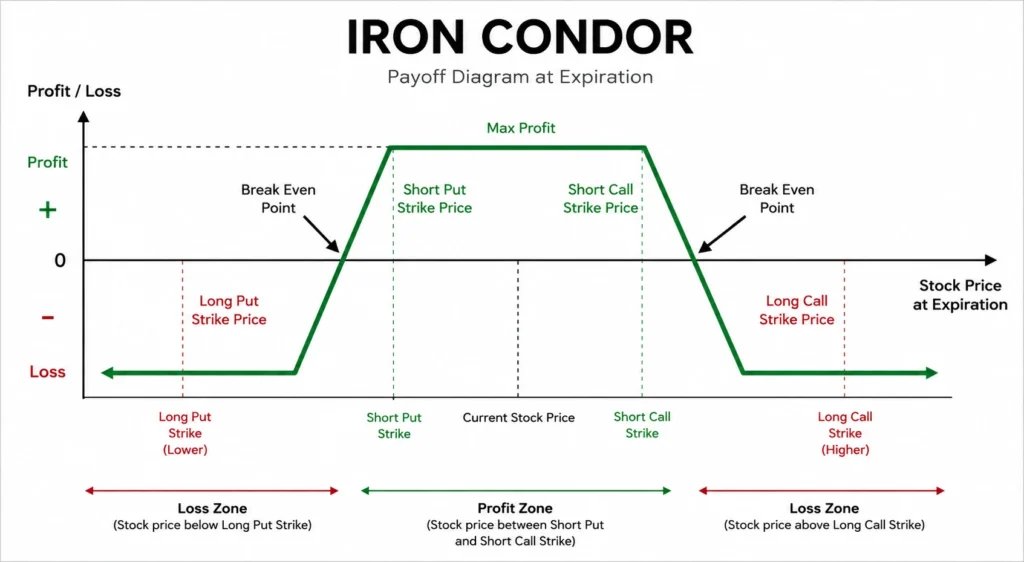
An iron condor is an options strategy built using four different option positions. It combines two separate spreads on opposite sides of the market to create a defined profit range.
The idea is simple. You want Nifty to stay within a certain zone till expiry. If it does, the options you sold lose value over time, and you keep the premium collected.
The strategy has two parts.
The Call Side: Bear Call Spread
First, you sell a call option at a strike price above the current Nifty level. This becomes your short call and is one of the positions from which you collect premium.
At the same time, you buy another call option at an even higher strike price. This is your long call. It acts like protection. If Nifty suddenly rallies sharply, this bought call limits how much loss you can face.
The Put Side: Bull Put Spread
Next, you sell a put option at a strike price below the current Nifty level. This is your short put and gives you additional premium income.
Simultaneously, you buy another put option at a lower strike price. This protects you if Nifty falls aggressively below your expected range.
Together, these four positions create a defined zone where the strategy works best.
If Nifty expires between the two short strikes, all the sold options lose value, and the trader gets to keep most or all of the premium collected.
The maximum profit is limited to the net premium received after paying for the two protective options. The maximum loss is also capped because the bought options protect both sides of the trade.
In Plain Numbers
Think of the iron condor like building two walls around the market.
One wall sits above the current Nifty level. The other sits below it.
As long as Nifty stays between those walls, you keep earning from the premium collected. If the market breaks strongly above or below the range, the protective options step in and stop the losses from becoming unlimited.
What Is the Iron Condor Strategy and How Does It Work?
The iron condor is an options trading strategy used when traders expect Nifty to remain within a certain range instead of making a sharp move up or down.
It is called a non-directional strategy because the trader is not trying to predict whether the market will rise or fall aggressively. The goal is simple: Nifty should stay relatively stable till expiry.
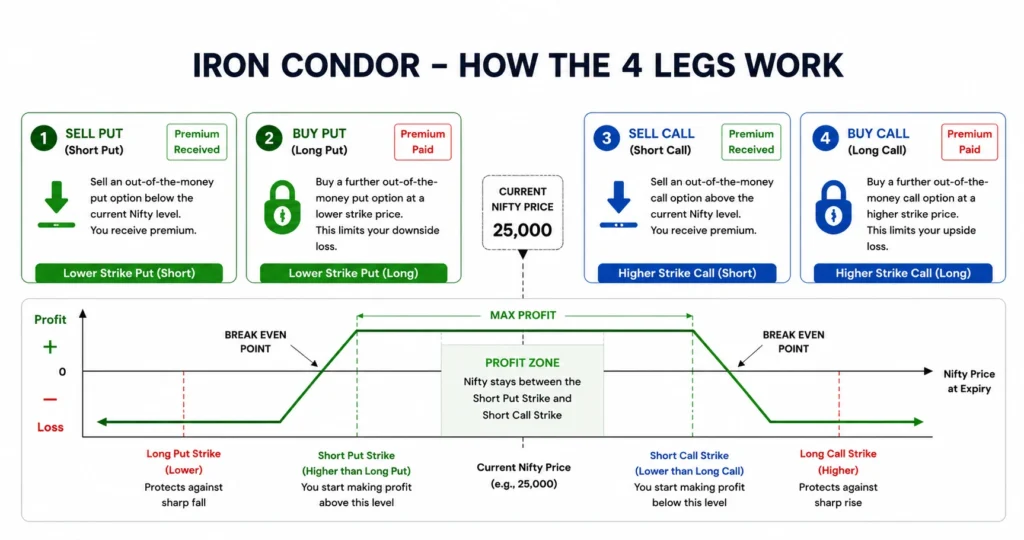
The strategy is created using four option positions, also called four “legs.”
The First Leg: Selling an Out-of-the-Money Call Option
The first step is selling a call option above the current Nifty price.
Suppose Nifty is trading at 25,000. A trader may sell the 25,300 Call Option (CE).
By selling this option, the trader is betting that Nifty is unlikely to rise above 25,300 before expiry.
In return for taking this risk, the trader receives option premium. This premium becomes part of the income generated from the strategy.
The Second Leg: Buying a Higher Strike Call Option
After selling the call option, the trader buys another call option at a higher strike price.
For example:
- Sell 25,300 CE
- Buy 25,500 CE
This bought call acts as protection.
If Nifty suddenly rallies sharply beyond 25,300, losses on the sold call can start increasing rapidly. The bought 25,500 CE limits these losses and keeps the risk capped.
Without this hedge, the upside risk could theoretically become unlimited.
The Third Leg: Selling an Out-of-the-Money Put Option
Next, the trader sells a put option below the current Nifty level.
For example:
- Nifty is at 25,000
- Sell 24,700 Put Option (PE)
This means the trader expects Nifty to stay above 24,700 till expiry.
Again, the trader receives premium for selling this option. This premium adds to the total profit potential of the iron condor.
The Fourth Leg: Buying a Lower Strike Put Option
Finally, the trader buys another put option at an even lower strike price.
Example:
- Sell 24,700 PE
- Buy 24,500 PE
This bought put acts as downside protection.
If Nifty falls sharply below 24,700, the bought 24,500 PE limits the maximum possible loss on the downside.
This is what makes the iron condor a defined-risk strategy.
How All Four Legs Work Together
When all four positions are combined, they create a price range where the strategy performs best.
Example setup:
- Sell 25,300 CE
- Buy 25,500 CE
- Sell 24,700 PE
- Buy 24,500 PE
This creates a profit zone between 24,700 and 25,300.
As long as Nifty stays within this range till expiry:
- The sold options gradually lose value
- Time decay works in the trader’s favour
- The trader keeps most or all of the premium collected
If the market moves sharply beyond either side:
- The protective bought options step in
- Losses remain limited instead of becoming unlimited
In simple words, the iron condor is like creating two boundaries around the market. The trader earns as long as Nifty stays comfortably between those boundaries.
Suggested Read: Nifty Options Trading Strategy: The 4-Step Framework Used by Consistent Traders
The 3 Things You Must Check Before Entering an Iron Condor
Most traders do not lose money in an iron condor because they picked the wrong strikes.
They lose because they entered at the wrong time.
The iron condor works best only in a specific type of market. Before entering the trade, these three conditions should ideally be true.
Condition 1: India VIX Should Be in the Right Range
India VIX shows how much movement the market expects in the coming days.
You can think of it as a “fear meter.”
- When traders expect calm markets, VIX stays low
- When traders expect big moves or panic, VIX rises
For an iron condor, the best VIX zone is usually between 13 and 18.
| India VIX | What It Means | Action |
| 13 to 18 | Market is stable with decent option premiums | Good for iron condor |
| Below 13 | Market is too calm, premiums become very small | Better to avoid |
| Above 20 | Market expects sharp movement | Avoid the trade |
Why This Matters
| If VIX is too low | If VIX is too high |
| You collect very little premium | The market may suddenly move aggressively |
| The reward may not justify the risk | Your strike range can break quickly |
The ideal situation is when VIX is stable or slowly cooling down after a rise.
Condition 2: Nifty Should Be Moving Sideways
The iron condor works best when Nifty is not trending strongly.
You want a market that is moving inside a range.
What a Good Setup Looks Like
Check the last 5 to 7 trading sessions on the Nifty chart.
A good iron condor market usually looks like this:
- Nifty keeps bouncing between support and resistance
- No strong breakout is happening
- No aggressive uptrend or downtrend is visible
Simple Practical Check
Look at the difference between the recent high and low.
A range of around 300 to 400 points is usually healthy because it shows the market already has visible boundaries.
Avoid Trending Markets
Do not use an iron condor when:
- Nifty keeps making higher highs
- Nifty keeps making lower lows
- Momentum is very strong in one direction
Strong trends are dangerous for this strategy because the market can easily break your strike range.
Condition 3: No Major Events Should Be Nearby
Big news events can destroy an iron condor very quickly.
Even one sudden move can push Nifty far outside your expected range.
Before entering the trade, always check if any major event is coming within the next 7 days.
Events You Should Watch
- RBI policy meetings
- Union Budget
- US Federal Reserve meetings
- Major earnings from large Nifty companies
- Geopolitical tensions
- Crude oil shocks or global panic events
The Golden Rule
If a major event is coming before your expiry:
- Avoid entering the trade
- Wait for the event to finish
- Then check the market again
One sharp event-day move can wipe out weeks of premium income from multiple successful trades.
How Iron Condor Strikes Are Commonly Structured
The examples below are only meant to help readers understand how iron condor setups are generally structured in options trading. Different traders may use different strike combinations depending on market conditions, volatility, expiry duration, and individual risk appetite.
Step 1: Start With the Current Nifty Level
Traders usually begin by checking the current Nifty spot price because it acts as the reference point for the structure.
Example: Nifty spot price = 24,500
The strike selection is then studied around this level.
Step 2: Study the Short Call and Short Put
An iron condor generally includes:
- One short call option above the current market level
- One short put option below the current market level
Example:
- Short Call = 24,750 CE
- Short Put = 24,250 PE
These are commonly referred to as the premium-generating legs of the structure.
While studying these strikes, traders may also review:
- Liquidity
- Open interest
- Trading activity
- Bid-ask spreads
Step 3: Study the Protective Long Options
The structure also includes:
- One long call option above the short call
- One long put option below the short put
Example:
- Long Call = 24,850 CE
- Long Put = 24,150 PE
These positions are commonly used to define the outer limits of the strategy and cap the theoretical maximum loss. The distance between the short and long strikes is known as the spread width.
Step 4: Understand Delta and Strike Distance
Some traders also analyse option Greeks while studying iron condor setups. Delta is commonly used to estimate how sensitive an option may be to market movement.
In general:
- Lower delta strikes are farther from the current market level
- Higher delta strikes are closer to the market level
Different traders may prefer different strike distances depending on volatility conditions and their own market approach.
Step 5: Understand Net Credit
In an iron condor, the premium received from the short options is partially offset by the premium paid for the long options. The remaining amount is commonly referred to as the net credit.
The final payoff structure of the strategy can vary depending on:
- Strike selection
- Volatility
- Expiry duration
- Margin requirements
- Transaction costs
- Market movement after entry
Because derivatives involve significant risk, traders typically evaluate the overall structure carefully before entering any options position.
A Practical Example of an Iron Condor: Nifty at 24,500
Imagine Nifty is currently trading at 24,500.
After studying the market, you feel Nifty may continue moving within a broad range till expiry instead of making a sharp move in either direction.
Based on this view, you create the following iron condor structure:
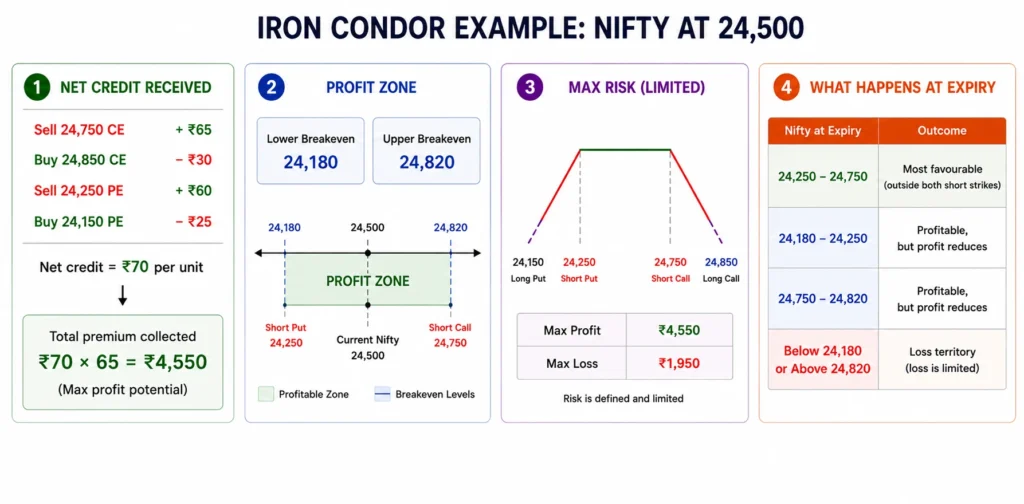
| Leg | Position |
| Sell 24,750 CE | Receive ₹65 |
| Buy 24,850 CE | Pay ₹30 |
| Sell 24,250 PE | Receive ₹60 |
| Buy 24,150 PE | Pay ₹25 |
Step 1: Calculate the Total Premium Collected
Premium received:
- ₹65 from the short call
- ₹60 from the short put
Total premium received: ₹125
Premium paid:
- ₹30 for the long call
- ₹25 for the long put
Total premium paid: ₹55
Net credit: ₹125 − ₹55 = ₹70 per unit
Assuming the Nifty lot size is 65 units: Total premium collected: ₹70 × 65 = ₹4,550
This becomes the maximum profit potential of the structure.
Step 2: Understand the Profit Zone
Your short strikes are:
- 24,750 on the upside
- 24,250 on the downside
After adjusting for the premium collected, the approximate breakeven levels become:
| Metric | Level |
| Upper breakeven | 24,820 |
| Lower breakeven | 24,180 |
This means the structure remains profitable if Nifty expires between 24,180 and 24,820.
Step 3: Understand the Maximum Risk
The bought options act as protection on both sides:
- The long call protects against a sharp upside move
- The long put protects against a sharp downside move
Because of these protection legs, the theoretical maximum loss remains limited even if the market moves aggressively.
| Metric | Amount |
| Maximum profit potential | ₹4,550 |
| Maximum theoretical loss | ₹1,950 |
Step 4: Understand What Happens at Expiry
| Nifty Expiry Level | What Happens |
| Between 24,250 and 24,750 | Most favourable outcome for the structure |
| Between 24,180 and 24,250 | Structure may still remain profitable, but profit reduces |
| Between 24,750 and 24,820 | Structure may still remain profitable, but profit reduces |
| Below 24,180 or above 24,820 | Structure moves into loss territory |
The farther Nifty moves outside the breakeven range, the more pressure the structure faces.
However, because the strategy includes protective long options, the theoretical loss remains capped instead of becoming unlimited.
What Actually Happened in This Example?
- You collected premium from both sides of the market by selling a call option and a put option.
- You created a broader expected trading range between 24,250 and 24,750.
- You added protection on both sides using bought options to keep the theoretical risk limited.
- You benefited if Nifty stayed relatively stable instead of making a sharp directional move.
- You already knew the approximate maximum profit potential and theoretical maximum loss before entering the structure.
Exit Rules: Knowing When to Get Out
Entering an iron condor is only half the job.
The bigger challenge is knowing when to close the trade.
Many traders lose money not because the setup was bad, but because they stayed in the trade for too long, ignored losses, or kept hoping the market would reverse.
That is why exit rules matter.
Rule 1: Book Profit Before Expiry
Suppose your maximum possible profit is ₹4,550.
You do not always need to wait till expiry to collect the full amount.
If the position already shows a healthy profit earlier, many traders prefer closing the trade and locking in gains instead of waiting for the last bit of premium.
Example:
- Maximum profit potential = ₹4,550
- Position profit reaches around ₹2,275
At this stage, some traders may choose to close all four legs and exit the trade.
Why Not Wait for Full Profit?
As expiry gets closer, option prices start moving much faster. Even a small move in Nifty can suddenly change the profit or loss of the position.
So sometimes, protecting existing profit becomes more important than chasing the last few hundred rupees.
Rule 2: Exit If the Loss Becomes Too Large
Now imagine the market moves strongly against your expected range.
Your position starts showing losses.
Instead of waiting endlessly for the market to reverse, many traders define a maximum acceptable loss before entering the trade.
Example:
- Premium collected = ₹4,550
- Position loss grows significantly beyond the original credit collected
At that point, some traders may choose to close the structure and limit further damage.
The main idea is simple:
- A small controlled loss is easier to recover from
- A very large loss can damage trading capital quickly
Rule 3: Pay Attention if Nifty Reaches Your Short Strikes
The short strikes are the key levels of the structure.
If Nifty starts closing near or beyond these levels, it usually means the market is moving outside the expected range.
At that stage:
- The structure becomes more sensitive
- Risk increases faster
- The probability of pressure on the position rises
Because of this, many traders closely monitor the short strikes throughout the trade.
Rule 4: Be Careful Near Expiry
Iron condors can behave very differently during the final hours before expiry.
As expiry approaches:
- Option prices move faster
- P&L swings become larger
- Risk can increase suddenly
Because of this, some traders prefer reducing or closing positions before the final trading session instead of holding till the very end.
The closer the position is to expiry, the more important risk management becomes.
The Simple Idea Behind All Exit Rules
Every exit rule is trying to do one thing: protect capital.
The goal is not to win every trade.
The goal is to:
- Avoid very large losses,
- Protect profits when available,
- And survive long enough to trade consistently over time.
5 Common Mistakes That Hurt Iron Condor Traders
- Trading During Major Event Weeks: One of the biggest mistakes traders make is entering iron condors during major event weeks. Events such as RBI policy announcements, the Union Budget, US Fed meetings, election results, or unexpected global news can cause sharp market movement in a very short time. Since iron condors work best in relatively stable markets, sudden volatility can quickly push the structure outside its expected range.
- Keeping Short Strikes Too Close to the Market: Some traders place short strikes very close to the current Nifty level just to collect more premium. While the premium may look attractive initially, closer strikes also increase the chances of the market reaching those levels. In many cases, the extra premium collected may not justify the additional risk taken.
- Ignoring Liquidity and Bid-Ask Spreads: Many beginners ignore liquidity while selecting strikes. Some option strikes may have low trading activity, making entry and exit difficult. Wide bid-ask spreads can quietly reduce a noticeable portion of the premium collected even before the trade properly begins.
- Entering Without a Risk Plan: Another common issue is entering the trade without deciding how much loss is acceptable or under what conditions the position should be closed. Without a predefined risk plan, emotional decision-making often takes over once the trade starts moving against the trader.
- Using Outdated Contract Information: Exchange rules, lot sizes, and expiry formats can change over time. Because of this, traders generally verify the latest contract specifications and expiry structures before using any options strategy. Relying on outdated information can create confusion and lead to incorrect assumptions about the setup.
Suggested Read: Why Telegram Trading Channels Are Risky for F&O Traders in 2026
Bottom Line
The iron condor is not a strategy for predicting huge market moves. It is a strategy built around patience, discipline, and understanding how options behave when markets stay relatively stable.
That is what makes it interesting.
Instead of constantly trying to guess whether Nifty will shoot up or crash down, the iron condor focuses on probabilities, risk control, and structured positioning. You already know the approximate profit zone, the theoretical maximum loss, and the points where the trade starts getting uncomfortable. Few trading strategies offer that kind of clarity upfront.
But at the same time, this is not a “set and forget” strategy. Volatility changes, sudden events, expiry pressure, and emotional decision-making can quickly turn a calm-looking trade into a stressful one. That is why position sizing, strike selection, and exit discipline matter just as much as the setup itself.
For beginners, the biggest takeaway should not be “how much money an iron condor can make.” It should be understanding how professional options traders think about risk before thinking about reward.
Because in options trading, survival comes first. Consistency comes later. Profit is usually the result of managing both properly.
Disclaimer: Investments in securities market are subject to market risks, read all the related documents carefully before investing.
Options trading strategies such as iron condor involve significant risk and may not be suitable for all investors. The examples and scenarios discussed are purely for educational and informational purposes and should not be considered investment advice, trading recommendations, or guaranteed return strategies. Past performance is not indicative of future results.
FAQs
What does an iron condor do?
An iron condor is an options strategy used when traders expect the market to stay within a certain range instead of making a sharp move up or down. It combines four option positions to create a defined profit zone. The strategy generally benefits when market volatility stays controlled and option premiums gradually lose value as expiry approaches.
How risky is the iron condor?
The iron condor is considered a defined-risk strategy because the protective bought options help limit the theoretical maximum loss on both sides. However, it still carries significant risk. Sudden market movement, rising volatility, poor strike selection, or weak risk management can lead to losses. Like all derivatives strategies, outcomes depend heavily on market conditions and trader discipline.
Which is better, strangle or iron condor?
A strangle and an iron condor are designed differently and suit different trading approaches. A strangle may offer higher premium potential but can also carry higher risk because it does not include protective hedge positions. An iron condor includes protection on both sides, which helps cap the theoretical loss. The choice depends on market conditions, risk tolerance, and trading style.
What is the four-legged iron condor strategy?
The four-legged iron condor strategy combines four separate option positions: one short call option, one long call option, one short put option, and one long put option. Together, these positions create a defined trading range where the strategy performs best. The short options generate premium income, while the long options act as protection and help limit the theoretical maximum loss.