
Options buying usually feels easiest right before it becomes the most dangerous.
You have probably seen this happen on an RBI policy day, Budget announcement, or during a sudden Bank Nifty breakout. One giant green candle appears. India VIX shoots higher. Telegram groups start screaming “upper circuit move coming” and finance creators on X begin posting profit screenshots. Within minutes, traders rush into calls or puts because the move suddenly feels “obvious.”
And then comes the painful part.
The market actually moves in the expected direction, but the option premium still falls. Your trade turns red. Sometimes, even a correct directional view ends in a loss because volatility collapses faster than the market moves.
This is one of the biggest traps in retail trading today.
Many traders confuse market excitement with opportunity. During sharp events, option premiums become extremely expensive because implied volatility spikes aggressively. Retail traders end up paying peak prices for fear and uncertainty just before that fear starts cooling down.
India is now the world’s largest options market by contracts traded. Yet according to SEBI, 93% of individual equity F&O traders lost money between FY22 and FY24, with cumulative losses crossing Rs. 1.8 lakh crore.
So why does this cycle repeat so often? The answer lies in psychology, volatility, and market structure.
This blog breaks just that!
Suggested Read: Nifty Options Trading Strategy: The 4-Step Framework Used by Consistent Traders
What Most Traders Don’t Realize: Options Are Not Just About Direction
Most people think options trading is simple.
If the market goes up, Call options should make money.
If the market falls, Put options should make money.
But this is where many retail traders get trapped.
In reality, options are not priced only based on market direction. They are also priced based on fear, uncertainty, and expectations.
That is why traders sometimes predict the market correctly and still lose money.
An Option Premium Has 2 Parts
Every option premium mainly has two components:
| Component | Meaning |
| Intrinsic Value | The actual value the option already has based on the current market price |
| Extrinsic Value (Time Value) | The extra premium traders pay for possible future movement |
The second part, extrinsic value, depends heavily on Implied Volatility (IV).
Suggested Read: Options Trading Made Simple (2026): Learn the Basics and Trade with Confidence
What Is Implied Volatility (IV)?
Implied volatility simply means: “How much movement the market expects in the future“.
If traders expect huge market swings, option premiums become expensive.
If markets are calm, option premiums become cheaper.
This is why options suddenly become costly during:
- RBI policy announcements
- Union Budget
- Election results
- Global market panic
- War or geopolitical tensions
At such times, traders rush to buy options because they expect big moves. As demand increases, option sellers increase premiums.
India VIX: The Market’s Fear Meter
In India, traders use India VIX to measure fear and uncertainty in the market.
- Low India VIX usually means calm markets
- High India VIX usually means panic or uncertainty
When India VIX rises sharply:
- Option premiums become expensive
- Buyers end up paying higher prices
- Even far OTM options suddenly inflate
This is usually when emotional options buying starts increasing.
The Biggest Trap: IV Crush
Now comes the part most beginners do not understand.
Once the event is over:
- Fear reduces
- Uncertainty disappears
- India VIX starts falling
- Implied volatility drops sharply
This sudden fall is called IV Crush.
And when IV crush happens, option premiums can collapse very quickly.
This means: Even if the market moves in your direction, your option trade can still lose money because the premium itself becomes cheaper.
Real Indian Market Examples
| Event | What Happens Before the Event | What Happens After the Event |
| Union Budget | Traders expect major announcements, so option premiums and IV rise sharply | Once the speech ends, uncertainty reduces and premiums cool down rapidly |
| RBI Policy Announcement | Traders aggressively buy options expecting volatility around interest rate decisions | IV contracts after the announcement, causing option premiums to fall |
| 2024 Election Results | India VIX surged as traders expected extreme market swings | After result clarity emerged, VIX normalized and many late option buyers got trapped |
| Geopolitical Events | Fear and panic push option premiums higher very quickly | As markets stabilize, volatility falls and expensive premiums deflate |
Why Low IV Environments Are Usually Better for Options Buying
When traders buy options during low IV:
- Premiums are relatively cheaper
- Less fear is priced in
- Rising volatility can help the trade
But during panic or hype:
- Premiums are already inflated
- Big moves are already expected
- The market must move even more to make the trade profitable
That is why many traders lose money during “obvious” market moves.
They are not just buying direction.
They are buying expensive fear at the worst possible time.
Suggested Read: Ultimate Guide to Brokerage, Taxes & Hidden Charges in Indian Trading: What Beginners Actually Pay
The Psychology Behind Why Traders Buy at the Worst Possible Moment
Your brain was built to protect you from danger, not to trade options calmly during volatile markets.
That is why many traders make emotional decisions exactly when they should slow down and think clearly.
Fear of Missing Out (FOMO)
One of the biggest reasons traders enter late is FOMO.
You open Telegram, WhatsApp, or X and suddenly everyone seems to be making money:
- Profit screenshots everywhere
- “Massive breakout coming”
- “Bank Nifty exploding”
- “Easy 5x trade”
At that moment, staying out feels harder than entering.
Psychologists say this happens because the brain releases dopamine when it sees the possibility of reward. Interestingly, uncertain rewards create even stronger excitement. This is the same psychological effect seen in gambling and slot machines.
In Indian markets, weekly expiry trading makes this even stronger.
Fast-moving premiums, zero-day expiries, and sudden spikes make traders feel that one big trade can recover all past losses. Over time, many traders become addicted to the excitement of options buying itself.
Loss Aversion: Why Missing a Trade Feels Painful
Behavioral psychologists Daniel Kahneman and Amos Tversky found that humans feel losses much more strongly than gains.
In trading, this creates a dangerous mindset: “What if the market makes a huge move and I miss it?“
During volatility spikes, many traders stop thinking logically. Instead of asking: “Is this option too expensive?“; they start thinking, “What if this becomes the next big move?“
This causes traders to ignore risk and chase inflated premiums.
Psychologists also describe two thinking systems:
- Fast thinking: emotional and impulsive
- Slow thinking: logical and analytical
During panic or excitement, emotional thinking usually takes control.
The Adrenaline Trap of Volatile Markets
Volatile markets feel exciting.
Big candles. Fast premium movement. Sudden profits and losses within minutes. This creates an adrenaline rush that keeps many traders glued to the screen.
The problem is that excitement and profitability are not the same thing.
Many traders slowly stop chasing good setups and start chasing action itself. The thrill of rapid movement becomes addictive, even when the strategy consistently loses money over time.
That is why some traders lose money repeatedly during high-volatility events but still keep returning to them.
The market is no longer just a place to trade.
It starts feeling like entertainment.
Suggested Read: F&O Trading in Volatile Markets: How to Use Greeks (Delta, Theta, Vega) Effectively
How to Know Whether It’s the Right or Wrong Time to Get Into, Continue, or Stop Options Trading
Options trading is not only about knowing where the market will go. It is also about knowing when not to trade. If volatility is extremely high, premiums are overpriced, or you are entering because of panic or FOMO, it may be the wrong time to trade.
Good traders do not chase every move. They wait for better pricing, calmer decisions, and setups with manageable risk.
| Situation | What It Means | What You Should Do |
| IV is very high | Options are expensive | Avoid emotional buying and be extra careful |
| India VIX is suddenly rising | Fear and uncertainty are increasing | Trade carefully around events like Budget or RBI policy |
| You are trading because of FOMO | Emotion is controlling the decision | Avoid entering impulsively |
| You do not have a stop loss or target | Risk is unclear | Do not enter the trade yet |
| You are increasing lot size after losses | Revenge trading may be happening | Reduce risk and slow down |
| You are breaking your own trading rules | Discipline is weakening | Take a short break from trading |
| You feel stressed or desperate while trading | Emotions are too high | Avoid taking fresh trades |
| Option premiums are relatively cheap | Better pricing environment | Safer for structured options buying |
| You clearly understand the risk-reward | Trade is planned properly | Better-quality setup |
| You feel calm before entering | Decision is more logical than emotional | Usually a healthier trading mindset |
A simple rule: If a trade feels extremely urgent or emotional, it is usually a sign to slow down and think again.
Good options trading is not about trading every move. It is about trading the right setups at the right price and staying out when conditions are unfavorable.
How Market Structure Quietly Punishes Emotional Option Buyers
The market already knows retail will chase volatility.
Market makers widen premiums when uncertainty rises due to heightened demand. They often sell this expensive volatility or hedge efficiently. Smart money benefits from theta decay (daily time erosion) and IV normalization after events.
Indian specifics amplify this:
- Weekly expiries create frequent event-like environments.
- Bank Nifty options see dramatic premium explosions.
- 0DTE-style behavior concentrates risk.
SEBI data highlights the imbalance: retail losses fund institutional and proprietary profitability in derivatives.
The Difference in Psychology Between Options Traders and Futures Traders
If you observe retail traders closely, you’ll notice something interesting.
Most futures traders usually enter the market thinking: “Where is the market likely to go?“
But many option buyers enter thinking: “What if this becomes a huge move?“
That one psychological difference changes the entire trading experience.
Why Options Buying Feels So Emotionally Intense
Options buying creates the feeling that life-changing profits can happen very quickly.
A Rs. 15 premium suddenly becomes Rs. 60. Someone on Telegram posts a screenshot of turning Rs. 10,000 into Rs. 1 lakh in a single expiry session. A massive Bank Nifty candle appears and suddenly the brain starts imagining: “What if this is that one big trade?“
This is where emotions slowly take control.
The fast movement in option premiums creates constant excitement. Every candle feels important. Every breakout feels urgent. Every missed move feels painful.
And because option buying requires smaller capital compared to futures, many traders feel psychologically comfortable taking repeated trades. The risk starts feeling “small” because the premium itself looks small.
But that is exactly where the trap begins.
Over time, many traders stop focusing on probability and start chasing emotional stimulation:
- The thrill of quick profits,
- The excitement of volatility,
- And the hope of recovering losses instantly.
This is why options buying can sometimes feel less like investing and more like emotional gambling if discipline disappears.
Why Futures Traders Usually Think Differently
Futures trading feels psychologically heavier.
Since futures positions can create large losses quickly, futures traders are often forced to think more seriously about:
- Stop losses,
- Margin pressure,
- Risk management,
- And capital protection.
The emotional focus becomes: “How much can I lose if this goes wrong?“
But in options buying, the brain often focuses on: “How much can I make if this suddenly explodes?“
That difference matters a lot.
Options psychology is usually driven more by excitement and possibility. Futures psychology is usually driven more by risk awareness and survival.
How to Stay Mentally Calm While Options Trading
- Accept that not every market move needs to be traded
- Avoid entering trades because of FOMO or social media hype
- Trade with smaller position sizes to reduce emotional pressure
- Define stop loss and target before entering the trade
- Avoid revenge trading after losses
- Take short breaks after highly emotional trading sessions
- Do not keep checking P&L every few seconds during volatility
- Focus on process and discipline instead of quick profits
- Understand and accept the risk before entering the trade
- Remember that preserving capital is more important than chasing every opportunity
Why You Can Be Right on Direction and Still Lose Money
The market moved correctly. Your timing and pricing did not.
This is one of the biggest misconceptions in options buying. Many traders believe that correctly predicting market direction is enough to make money. But options trading is not just about direction. It is also about when you enter and how much premium you pay.
The three biggest enemies for option buyers are:
- IV Crush: After a major event, implied volatility often falls sharply. This reduces option premiums quickly, even if the market moves in your favor.
- Theta Decay: Options lose value with time, especially near expiry. If the move takes too long, the premium keeps decaying.
- Overpaying for Premium: During panic or excitement, traders often buy options at inflated prices. The market already expects a large move by then.
Example: Suppose you expect Nifty to move 500 points ahead of an important event. Because everyone expects volatility, option premiums become very expensive.
Now imagine Nifty actually moves 300 points in your direction.
Normally, that sounds like a successful trade. But if implied volatility collapses sharply after the event, the option premium may still fall overall. The market moved correctly, but not enough to justify the expensive premium you paid.
Consider this comparison:
| Scenario | Spot Move | IV Change | Typical Result for Naked Buyer | Assessment |
| Low IV Entry | Moderate to strong | Stable or expanding IV | Often profitable | Better risk-reward because premiums are relatively cheaper and volatility can support the trade |
| High IV Entry | Moderate | Sharp IV collapse | Loss despite correct direction | High-risk setup because inflated premiums leave very little margin for error |
Movement alone is not enough in options buying.
You need the market to move more than what is already priced in. That is why buying options when volatility is cheap is usually far safer than buying during emotional spikes.
The Retail Trading Illusion: “Movement = Opportunity”
Many traders enter trades simply because the market feels exciting and urgent.
A sudden breakout, huge candles, breaking news, expiry-day volatility, or social media hype creates the feeling that “something big is happening.” At that moment, emotions often become stronger than logic.
This is where several psychological biases start affecting decisions:
- Availability Bias: Traders easily remember recent big moves and start expecting the same thing to happen again.
- Recency Bias: The latest market event heavily influences current expectations. If the last expiry saw a massive rally, traders expect another one immediately.
- Herd Mentality: Seeing everyone else take trades makes following the crowd feel safer.
Another big problem is that traders remember rare jackpot profits very clearly but forget the many small losses that happened before them.
A single lucky trade can stay in memory for months. But consistent losses slowly get ignored.
Ironically, calmer markets with cheaper option premiums often provide better risk-reward opportunities. But since they feel “boring,” many traders avoid them.
The emotional excitement of fast-moving markets attracts far more attention than disciplined trading setups.
What the Actual Fix Is
The biggest mistake beginners make in options buying is focusing only on direction.
They ask:
- “Will Nifty go up?“
- “Will Bank Nifty fall?“
- “Should I buy Calls or Puts?“
But experienced traders ask one more important question: “Am I paying too much for this option?“
Because in options trading, buying at the wrong price can turn even a correct prediction into a losing trade.
| Step | What You Should Do | Why It Matters |
| Step 1: Check If Options Are Cheap or Expensive | Look at current Implied Volatility (IV) before buying options | High IV usually means premiums are expensive. Low IV usually means premiums are relatively cheaper |
| Step 2: Use IV Rank or IV Percentile | Compare current IV with its historical levels using IV Rank or IV Percentile | Helps you understand whether options are overpriced or reasonably priced |
| Step 3: Understand the IV Reading | If IV Rank/Percentile is above 70–80%, avoid aggressive options buying. Lower IV levels usually offer better buying opportunities | High IV means fear and expectations are already heavily priced in |
| Step 4: Monitor India VIX | Check whether India VIX is suddenly rising before major events like Budget, RBI policy, or elections | A sharp rise in VIX usually signals panic and inflated option premiums |
| Step 5: Ask if the Move Is Already Priced In | Before entering, ask: “Has the market already expected this move?” | Even correct directional trades can lose money if premiums are already too expensive |
| Step 6: Avoid Emotional Entries | Do not chase sudden candles, social media hype, or expiry-day panic | Emotional entries often happen near peak IV levels |
| Step 7: Focus on Pricing, Not Just Direction | Think beyond “market up or down” and focus on whether you are paying a fair premium | Successful options buying depends on both direction and entry pricing |
The Real Goal in Options Buying
The goal is not just predicting direction correctly.
The goal is:
- Buying options when premiums are reasonably priced
- Avoiding emotional entries during panic
- Understanding when volatility is cheap versus expensive
Sometimes the best options trade is not the fastest trade. It is the trade where you paid the right price for uncertainty.
Stop Buying Panic. Start Planning Trades
Use a Checklist
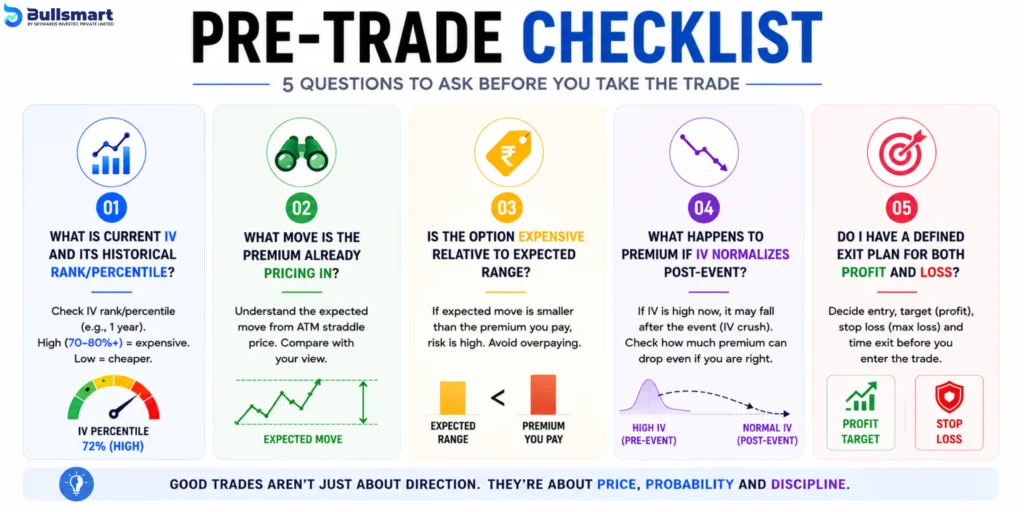
Use Structures Instead of Naked Buying
Consider basic hedged approaches when IV is elevated:
- Debit spreads: Limit cost and define maximum loss.
- Calendar spreads: Benefit from differential decay.
- Other defined-risk setups.
These reduce the impact of IV crush and theta while keeping directional exposure. Keep it simple initially.
Learn to Do Nothing
One of the strongest professional edges is skipping unfavorable environments. Patience feels unproductive to retail traders wired for stimulation, yet avoiding overpriced chaos preserves capital for better setups.
Professionals often sit out event-driven spikes or when IV is extremely elevated.
The Bigger Truth About Modern Options Trading
Most retail traders are not trading volatility. Volatility is trading them.
Mobile apps, instant notifications, gamification, and social media accelerate impulsive behavior. The surge in retail derivatives participation, especially among younger traders, has regulators concerned. Weekly expiries and short-term speculation dominate.
Bottom Line
The harsh truth about options buying is that the market does not reward excitement. It rewards timing, pricing, and discipline.
Most retail traders enter trades when emotions are already running high. The candles look powerful, social media turns loud, and every breakout feels like the start of a massive move. In that moment, buying options feels easy. It feels obvious. But that is often exactly when premiums become the most dangerous.
The market has a way of making traders feel late. And once that fear of missing out kicks in, logic slowly disappears. Traders stop asking whether the option is overpriced. They stop checking IV. They stop thinking about how much movement is already priced in. They only focus on one thing: “What if this keeps running without me?“
That mindset is where most damage happens.
Because in options trading, being correct on direction alone is not enough. You also need to enter at a reasonable price, understand volatility, and avoid emotional decisions during peak panic.
The traders who survive long term are usually not the ones chasing every fast move. They are the ones patient enough to wait for better pricing, better setups, and calmer decisions.
Sometimes the smartest options trade is the one you chose not to take.
Disclaimer: Investments in securities market are subject to market risks, read all the related documents carefully before investing.
This blog is intended only for educational and informational purposes and should not be treated as financial, investment, or trading advice. Options trading involves high risk, including potential loss of capital. Readers should evaluate their financial objectives, risk appetite, and consult a registered financial advisor before making trading or investment decisions.
FAQs
Why do 90% option traders lose money?
Most option traders lose money because they focus only on direction and ignore factors like implied volatility, theta decay, risk management, and position sizing. Many also trade emotionally during volatile events and overtrade weekly expiries. According to SEBI data, retail traders often chase fast profits without understanding pricing, probabilities, or how quickly option premiums can lose value.
What is Warren Buffett’s favorite option strategy?
Warren Buffett has historically preferred conservative, probability-based derivative strategies rather than aggressive short-term options buying. Berkshire Hathaway has previously used long-dated option contracts and cash-backed positions where time decay and risk management worked in its favor. Buffett has consistently emphasized discipline, valuation, and avoiding speculative trading behavior in derivatives markets.
Can I become rich by options trading?
Options trading can generate significant profits, but it also carries high risk and requires strong understanding of volatility, pricing, risk management, and market behavior. While some traders achieve long-term success, regulatory studies such as SEBI’s derivatives reports show that a large percentage of retail traders incur losses over time. Consistency, discipline, and controlled risk are generally more important than chasing quick profits.
How to make profit in options trading?
Profitable options trading typically involves understanding multiple factors beyond market direction, including implied volatility, option pricing, risk management, and timing. Traders often improve consistency by following structured strategies, managing position sizes carefully, and maintaining defined entry and exit plans. Market conditions, volatility levels, and discipline can play an important role in influencing outcomes over the long term.