

You predicted the market direction correctly. Nifty moved exactly as expected. Yet your option trade still ended in a loss. If that sounds familiar, you are not alone.
Many options traders focus heavily on price movement but overlook another powerful force working against them: theta decay.
Often called the silent premium killer, theta represents the loss in an option’s time value as each day passes. Even when the market moves in your favour, the premium may not rise enough to offset the value lost to time.
What makes theta even more interesting is that it does not affect options equally throughout the week. The pace of time decay changes as expiry approaches, and certain days can be far more punishing for option buyers than others. This becomes especially important in India’s highly active weekly Nifty options market, where time is always ticking faster than most traders realise.
In this blog, we will break down how theta behaves across the trading week, when options typically lose value the fastest, and how traders can adapt their strategies to avoid becoming victims of time decay.
Let’s get started!
What Is Theta Decay in Options?
Theta measures the daily rate of decline in an option’s price due to the passage of time, assuming the underlying price, volatility, and other factors stay constant. It is usually negative for long options (buyers lose) and positive for short options (sellers benefit).
Options have two components:
- Intrinsic value: Realized if exercised now (e.g., a call when spot > strike).
- Time (extrinsic) value: Premium for the possibility of favorable moves before expiry.
Option buyers pay for time value but fight theta as it erodes. Sellers collect premium and hope time works in their favor. Theta peaks for at-the-money (ATM) options, which have the highest uncertainty and extrinsic value. Out-of-the-money (OTM) options can lose value rapidly near expiry if the expected move fails.
Simple Example: A Nifty call trades at ₹100 with a theta of -₹8. If Nifty stays flat and volatility is stable, it could theoretically drop to ~₹92 the next day.
Suggested Read: Options Trading Made Simple: Learn the Basics and Trade with Confidence
Why Theta Decay Is Not Linear
Many traders assume that options lose value at the same rate every day. In reality, theta decay speeds up as expiry gets closer.
Think of it like an ice cube. It melts slowly at first, but much faster near the end. Options behave in a similar way. An option with several weeks left until expiry loses time value gradually, while an option with just a day or two remaining can lose value very quickly.
This is why a weekly option behaves differently from a monthly option. Similarly, a one-day-to-expiry option will usually lose value much faster than a five-day-to-expiry option.
Here are some important points to remember:
- Theta decay becomes much faster in the final days before expiry.
- At-the-money (ATM) options are usually the most affected by time decay.
- Deep in-the-money (ITM) options have less time value, so theta has a smaller impact.
- Deep out-of-the-money (OTM) options can lose most of their value very quickly if the expected move does not happen.
- A sudden rise in implied volatility (IV) can temporarily offset or hide the effects of theta decay.
This is why traders should not only focus on market direction. They also need to consider how much time is left before expiry.
The Weekly Expiry Context in India
Nifty weekly options are among the most actively traded contracts in India, making theta decay highly visible. Because weekly expiries occur frequently, option premiums can lose value quickly as expiry approaches. Regulatory and exchange-level changes have also altered expiry dynamics over time.
As of 2026, Nifty weekly options expire on Tuesdays, while monthly contracts expire on the last Tuesday of the month. Traders should always verify the latest expiry calendar, as older Thursday-based strategies may not work the same way due to changes in liquidity and time-decay patterns.
Suggested Read: How to Read the NSE Option Chain Beyond Strikes and Premiums: 6 Powerful Components Explained
Day-by-Day Theta Decay Behaviour
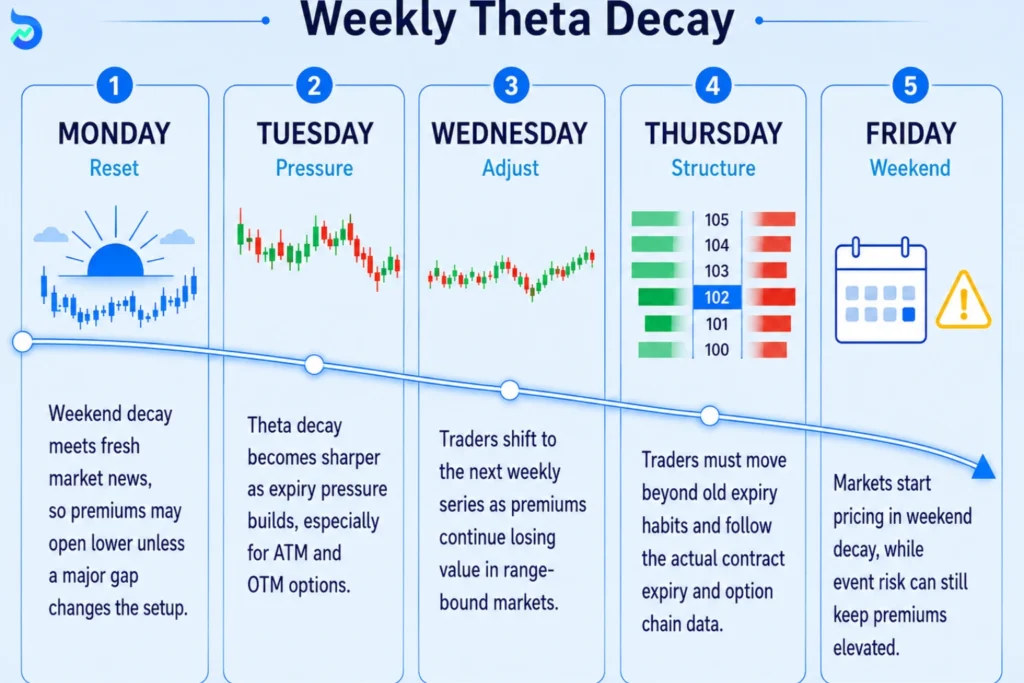
Monday: The Reset Day
Monday often reflects the impact of weekend time decay along with any news or events that occurred while markets were closed. In a relatively flat market, option premiums may open lower, although large gaps can sometimes overshadow the effects of theta decay.
What traders often watch: Implied volatility (IV), market direction, and whether weekend events have significantly changed market expectations.
Tuesday: The Pressure Builds
With Nifty weekly options expiring on Tuesday, time decay tends to become much more noticeable. Option premiums can react sharply when expected price movements fail to materialise, particularly for ATM and OTM contracts.
What traders often watch: The pace of premium erosion, changes in IV, and how option prices respond to intraday market moves.
Wednesday: The Adjustment Phase
Following expiry, attention typically shifts to the next weekly series. In range-bound markets, option premiums can gradually lose value as time passes, especially when volatility remains subdued.
What traders often watch: Whether market momentum is strong enough to offset the impact of time decay.
Thursday: Moving Beyond the Old Expiry Mindset
Many traders still associate Thursday with expiry-related behaviour. However, option pricing and liquidity are influenced by the current expiry structure rather than historical market habits.
What traders often watch: Option chain data, open interest (OI), implied volatility, and the actual expiry schedule of the contract being traded.
Friday: Weekend Decay Starts Getting Priced In
As the weekend approaches, market participants begin factoring in the passage of non-trading days. At the same time, uncertainty around potential weekend events can influence option premiums.
What traders often watch: The balance between time decay, implied volatility, and any anticipated news or events that could affect markets when trading resumes.
When Do Options Lose Value Fastest?
While theta decay affects options throughout their life, the pace of premium erosion is usually highest under certain conditions:
- During the final days leading up to expiry
- In at-the-money (ATM) and slightly out-of-the-money (OTM) options
- When the underlying market remains range-bound or sideways
- After major events when implied volatility (IV) falls sharply
- When short-dated weekly options are held without a meaningful price move
- When the expected market move fails to materialise within the available time
This is why many traders find that an option’s premium can lose value even when the market has not moved significantly against them. As time passes, the opportunity for the option to become profitable gradually reduces, and the premium reflects that reality.
However, it is important to remember that theta is only one component of option pricing. Factors such as price movement (delta), acceleration in price movement (gamma), changes in implied volatility (IV), and overall market conditions can sometimes outweigh the effects of time decay in the short term.
In other words, theta may be a powerful force, but it rarely operates in isolation.
The Weekend Theta Myth
- Theta is based on calendar days, including weekends, even though markets remain closed on Saturday and Sunday.
- A portion of the expected weekend decay is often priced into option premiums before Friday’s close.
- Monday opening gaps can either hide or amplify the impact of time decay.
- Long weekends, major events, or important announcements can keep option premiums elevated despite the passage of time.
- Implied volatility (IV) and event risk can sometimes have a bigger impact on option prices than weekend theta decay.
Key takeaway: Weekend premium behaviour is influenced by multiple factors, not just the passage of time.
Theta Decay vs IV Crush
Many traders use the terms theta decay and IV crush interchangeably, but they are actually two different concepts. Both can reduce an option’s premium, yet they occur for different reasons.
Theta decay happens because time is passing. IV crush happens because market expectations of future volatility suddenly fall, often after major events such as RBI policy announcements, election results, or corporate earnings.
This is why an option’s premium can lose value even when the market moves in the expected direction. Sometimes time decay is responsible. In other cases, a sharp drop in implied volatility is the main reason.
| Theta Decay | IV Crush |
| Caused by the passage of time | Caused by a fall in implied volatility (IV) |
| Affects options every day | Usually occurs after major events |
| Becomes stronger as expiry approaches | Can happen suddenly within minutes or hours |
| Most noticeable in short-dated options | Most noticeable when IV was elevated before an event |
| Predictable and gradual | Often sharp and unexpected |
The key takeaway is that option premiums are influenced by both time and volatility. Looking at theta alone may not provide the complete picture.
Suggested Read: How to Use PCR (Put-Call Ratio) as a Trading Signal in Nifty Options, and 4 Traps to Avoid
Theta Decay and Moneyness
Theta decay does not affect all options in the same way. The impact often depends on whether the option is at-the-money (ATM), in-the-money (ITM), or out-of-the-money (OTM).
| Option Type | How Theta Typically Affects It |
| ATM (At-the-Money) | Usually has the highest time value and is often most affected by theta decay. |
| Slightly OTM (Out-of-the-Money) | Can lose value quickly as expiry approaches if the expected move does not happen. |
| Deep OTM | Often looks inexpensive, but may lose most of its value before expiry. |
| Deep ITM (In-the-Money) | Contains less time value, so theta generally has a smaller impact. |
A common mistake is assuming that a low-priced option is less risky. In reality, a cheaper premium often reflects a lower probability of the option finishing profitably before expiry.
Understanding moneyness can help traders better understand why some options lose value much faster than others as time passes.
Understanding Theta Risk as an Option Buyer
Theta decay affects long option positions because the time value of an option reduces as expiry approaches. As a result, time becomes an important factor alongside market direction.
An option’s premium may lose value even if the underlying moves in the expected direction, particularly when the move is smaller than anticipated or takes longer to occur. The impact of theta is generally more noticeable in short-dated options and tends to increase as expiry gets closer.
Several factors influence how significantly time decay affects an option, including:
- Time remaining until expiry
- The option’s moneyness (ATM, ITM, or OTM)
- Implied volatility (IV)
- Market conditions and price movement
When evaluating an options position, it can be useful to consider:
- How much time remains until expiry?
- Is the expected price move significant relative to the option premium?
- What is the current level of implied volatility?
- Is the market trending or range-bound?
- What factors could affect the original market outlook?
Since option premiums are influenced by multiple variables, theta should be viewed alongside other factors rather than in isolation.
How to Trade Around Theta and Avoid the Silent Premium Melt
Theta decay is a reality of options trading, especially as expiry approaches. Since time value reduces every day, it is important to understand how theta can affect an option’s premium alongside factors such as price movement and implied volatility.
When evaluating an options position, some useful considerations include:
- How much time remains until expiry?
- Is the option ATM, ITM, or OTM?
- What is the current level of implied volatility (IV)?
- Is the expected market move significant relative to the option premium?
- Are there any major events before expiry that could affect volatility?
It is also important to remember that theta does not act alone. Market direction, volatility changes, liquidity, and event risk can all influence option prices and sometimes have a larger impact than time decay itself.
Key takeaway: Understanding theta is not about predicting profits or losses. It is about recognising how the passage of time can influence option premiums and incorporating that understanding into the overall evaluation of risk.
The Gamma Risk Problem Near Expiry
As expiry approaches, option premiums can become more sensitive to small movements in the underlying asset. This happens because gamma tends to increase near expiry, especially for ATM options.
As a result:
- Small market moves can lead to large changes in option premiums.
- ATM options are usually the most affected.
- Price swings can become more frequent and unpredictable.
- Rapid moves may make risk management more challenging.
Key takeaway: While theta speeds up near expiry, price sensitivity can also increase significantly. This is why option premiums may move much more sharply in the final days before expiry.
The Best and Worst Market Conditions for Theta-Based Strategies
| Market Condition | Impact on Theta | Why? |
| Range-bound or sideways markets | Generally favourable for theta decay | Limited price movement means time decay may have a greater influence on option premiums. |
| Falling implied volatility (IV) | Can support premium erosion | Both time decay and lower volatility can reduce option premiums. |
| No major scheduled events | More stable environment | Lower uncertainty often results in fewer sudden premium spikes. |
| Strong liquidity | More predictable pricing | Tighter bid-ask spreads can reduce pricing distortions. |
| Well-defined trading ranges | Time decay may become more noticeable | Option premiums may gradually lose value if large moves do not occur. |
| Strong breakout or trending markets | Less favourable for theta-driven outcomes | Significant price moves can outweigh the impact of time decay. |
| Event-driven trading sessions | Less favourable for theta-driven outcomes | Events can trigger sharp changes in volatility and option premiums. |
| High gap-risk environments | Less favourable for theta-driven outcomes | Large overnight moves can have a bigger impact than theta decay. |
| Rising implied volatility (IV) | Can offset theta decay | Higher volatility often increases option premiums. |
| Expiry-day momentum | Less favourable for theta-driven outcomes | Rapid price movements can dominate option pricing near expiry. |
Key takeaway: Theta tends to have a greater impact in stable, range-bound markets. When volatility rises or large price moves occur, other factors can become more important than time decay.
A Day-by-Day Theta Awareness Framework
You may consider to set-up a framework to closely monitor how market is reacting in order to devise the best strategy for your trades.
For starters, you may consider trying a framework-based approach similar to the following:
| Day | What to Be Aware Of |
| Monday | Weekend news, market gaps, and changes in implied volatility can influence option premiums. |
| Tuesday | For Nifty weekly options, expiry-related time decay can become more noticeable as the contract approaches settlement. |
| Wednesday | Attention typically shifts to the next weekly series, while time decay continues to affect short-dated options. |
| Thursday | Option pricing and liquidity should be viewed in the context of the current expiry structure rather than historical expiry habits. |
| Friday | Weekend time, event risk, and potential market gaps can all influence option premiums ahead of the market close. |
Key takeaway: Theta does not affect option premiums in the same way every day. Factors such as expiry proximity, volatility, market events, and liquidity can influence how time decay is reflected in option prices throughout the week.
Common Mistakes Traders Make with Theta
- Buying Too Close to Expiry: As expiry approaches, time decay accelerates. This can make option premiums lose value quickly.
- Holding OTM Options for Too Long: Out-of-the-money (OTM) options may look inexpensive, but they can lose most of their value if the expected move does not occur.
- Ignoring Implied Volatility (IV): Option premiums are influenced by both theta and IV. Looking at only one factor may provide an incomplete picture.
- Underestimating Expiry-Day Risks: Near expiry, option premiums can become highly sensitive to market movements and volatility.
- Assuming Weekend Decay Is Guaranteed: Weekend option pricing is affected by multiple factors, including implied volatility, market expectations, and event risk.
- Forgetting About Holidays: Long weekends and market holidays can affect how time decay is reflected in option premiums.
- Treating Theta as a Standalone Signal: Theta is only one component of option pricing. Other Greeks and market conditions also matter.
- Ignoring the Expiry Calendar: Changes in expiry schedules can affect liquidity, positioning, and option pricing behaviour.
Suggested Read: The #1 Hidden Trap Behind Options Buying During Big Market Moves
Practical Checklist Before Any Theta-Based Trade
- Expiry date confirmed?
- Trading sessions left?
- Moneyness (ATM/ITM/OTM)?
- IV trend?
- Events before expiry?
- Market trend vs. range?
- Liquidity strong?
- Max loss defined?
- Hedged?
- Exit rule clear?
Suggested Read: How to Trade Index Options Around Earnings Season Without Getting Trapped?
Bottom Line
Theta decay is one of the most misunderstood forces in options trading. Most traders spend hours analysing charts, indicators, support levels, and market direction, yet many overlook a simple reality: time is constantly working in the background.
The challenge is that theta does not affect every option equally. Its impact changes based on the day of the week, the time remaining until expiry, the option’s strike, market volatility, and even upcoming events. This is why two seemingly similar options can behave very differently despite tracking the same underlying asset.
The good news is that theta is not a hidden market secret. Once you understand how time decay works, you can start viewing option premiums through a different lens. Instead of asking only, “Where will the market go?”, you also begin asking, “How much time does this move have to happen?”
That small shift in thinking can make a big difference.
At the end of the day, successful options analysis is not just about direction. It is about direction, timing, volatility, and risk working together. And among all those factors, theta is the quiet reminder that in options trading, time is never standing still.
Disclaimer: Investments in the securities market are subject to market risks, read all related documents carefully before investing.
FAQs
How does theta decay work over the weekend?
Theta is based on calendar days, which means weekends are included in option pricing models. However, the impact of weekend time decay is not always visible in a straightforward way, as factors such as market expectations, implied volatility (IV), and Monday opening gaps can also influence option premiums.
Does theta decay happen in intraday trading?
Yes. Time passes continuously, so theta decay is present throughout the trading day. However, its impact is often more noticeable as expiry approaches, particularly in short-dated options. Intraday option prices can also be influenced by market movement, volatility, and liquidity conditions.
What is the time decay in options on expiry day?
Time decay is generally at its highest on expiry day because very little time remains until the option expires. As the trading session progresses, the remaining time value of an option may reduce rapidly, especially for contracts that are close to the strike price.
How to avoid time decay in options?
Time decay is a natural part of option pricing and cannot be completely avoided. However, understanding factors such as expiry, moneyness, implied volatility, and time remaining can help traders better evaluate how theta may affect an option’s premium.