

Bull call spread vs naked call buying is not just a strategy comparison anymore. For many Nifty traders, it is the difference between surviving the options market and slowly bleeding capital despite getting the direction right.
Every day, thousands of traders buy Nifty call options expecting a rally. The market moves up, the view turns out correct…yet the profits still disappoint. Sometimes trade even ends in a loss. That is the frustrating reality of options trading. Direction alone is not enough.
Time decay keeps eating option premiums. Volatility crashes after events. Expensive calls need massive moves just to break even. And by the time many traders realise this, the premium has already melted.
This is exactly why strategies like bull call spread have started gaining attention among experienced traders. Instead of chasing unlimited upside with expensive premiums, spreads focus on something far more important: capital efficiency, controlled risk, and realistic market expectations.
And the numbers show why this conversation matters. According to SEBI’s FY25 derivatives study, over 91% of individual traders incurred net losses, with aggregate retail losses rising to around Rs. 1.06 lakh crore. The lesson is simple: in options trading, how you structure the trade can matter just as much as predicting where Nifty will go next.
This blog will be your helping guide!
Quick Explanation: What Is Naked Call Buying?
Naked call buying, also known as a long call strategy, is one of the most common bullish trades used by Nifty option traders. In this strategy, a trader buys a call option by paying the entire premium upfront, expecting the market to rise sharply before expiry.
The biggest attraction of naked call buying is its simplicity. If Nifty moves aggressively upward, the value of the call option can rise rapidly, offering strong percentage returns with relatively lower capital compared to futures trading.
Here’s how the strategy works:
- Profit potential is theoretically unlimited if Nifty continues rising strongly.
- Maximum loss is limited to the premium paid for the option.
- The breakeven point is calculated as: Breakeven = Strike Price + Premium Paid
- Time decay, also known as theta, works against the buyer every single day.
- Elevated implied volatility can make call options expensive, reducing the overall risk-reward ratio.
The challenge is that naked call buying usually needs both direction and speed to work well. A slow or moderate move in Nifty may still fail to generate meaningful profits because option premiums keep losing value as expiry approaches.
Suggested Read: Options Trading Made Simple (2026): Learn the Basics and Trade with Confidence
What Is a Bull Call Spread?
A bull call spread is a bullish options strategy designed for traders who expect Nifty to rise moderately rather than make an explosive breakout. Unlike naked call buying, this strategy focuses on reducing premium cost and defining risk more efficiently.
In a bull call spread, the trader buys a lower strike call option and simultaneously sells a higher strike call option of the same expiry. The premium received from the sold call helps offset part of the premium paid for the bought call, reducing the overall capital outflow.
This creates a trade structure with limited risk and limited reward.
The basic calculations are:
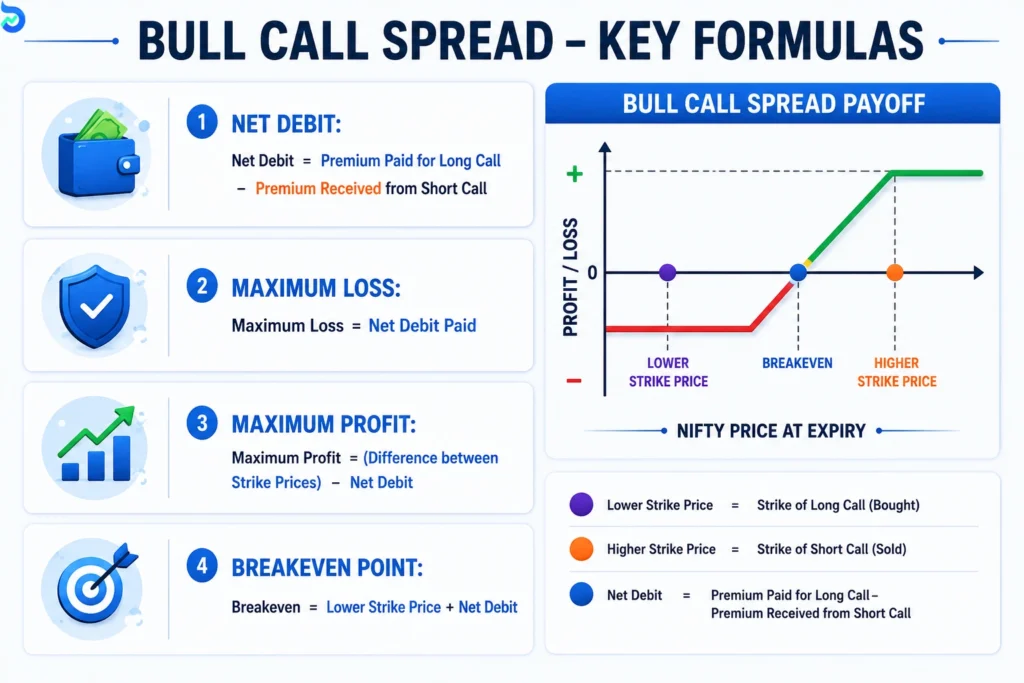
The strategy works best when Nifty moves upward gradually within an expected range. By reducing the upfront premium cost, a bull call spread can improve capital efficiency and lower the breakeven point compared to naked call buying.
The trade-off, however, is that profits become capped beyond the higher strike price sold by the trader.
Suggested Read: How to Trade Index Options Around Earnings Season Without Getting Trapped in 2026?
Why This Matters More on Nifty Options
Nifty options move very fast. That’s the biggest reason why strategy selection matters here.
Nifty has weekly expiries every Tuesday along with monthly expiries. As expiry gets closer, option premiums start losing value very quickly because of time decay. So even if Nifty moves slightly in your favour, your option may still not make much money.
This is where many traders get confused. They buy a call option, Nifty goes up, but the premium barely moves because:
- The move was too small
- The move came too late
- Volatility dropped after an event
- The option was already too expensive
For example, before events like RBI policy, Budget, or US Fed meetings, option premiums usually become expensive because volatility rises. But once the event is over, premiums can suddenly crash. This is called volatility crush.
Liquidity in popular Nifty strikes is usually good, but some far OTM options can still have bad bid – ask spreads, making entries and exits difficult.
That is why many experienced traders focus less on “Will Nifty go up?” and more on “How much premium am I risking for this view?” In Nifty options, controlling premium outflow is often more important than simply being directionally correct.
Suggested Read: The #1 Hidden Trap Behind Options Buying During Big Market Moves
Bull Call Spread vs Naked Call: Core Comparison
Check this table for a quick overview:
| Aspect | Naked Call Buying | Bull Call Spread |
| Market View | Strongly bullish | Moderately bullish |
| Capital Required | Higher (full premium) | Lower (net debit after offset) |
| Maximum Loss | Premium paid | Net debit paid |
| Maximum Profit | Theoretically unlimited | Capped (strike difference minus debit) |
| Breakeven | Higher (strike + full premium) | Lower (strike + net debit) |
| Impact of Theta | Strongly negative | Reduced (short call helps) |
| Impact of Volatility Fall | Strongly negative (IV crush) | Less severe |
| Best Market Condition | Sharp, strong breakout | Moderate, steady upward move |
| Biggest Drawback | High cost and full premium risk | Capped upside potential |
Example Simulation on Nifty
Let’s understand this with a simple example.
Assume Nifty is trading at 23,000.
Scenario 1: Naked Call Buying
A trader buys the 23,000 CE for Rs. 180.
- Total premium paid = Rs. 180
- Breakeven becomes: 23000+180=2318023000 + 180 = 2318023000+180=23180
This means Nifty must move above 23,180 by expiry just to start making profits.
Scenario 2: Bull Call Spread
The trader:
- Buys the 23,000 CE at Rs. 180
- Sells the 23,300 CE at Rs. 80
So the net premium paid becomes: 180 – 80=100180 – 80 = 100180 – 80=100
New breakeven: 23000+100=2310023000 + 100 = 2310023000+100=23100
Now look at what happens at expiry:
| Nifty Expiry | Naked Call P&L | Bull Call Spread P&L |
| 23,000 | – Rs. 180 | – Rs. 100 |
| 23,100 | – Rs. 80 | Rs. 0 |
| 23,200 | +Rs. 20 | +Rs. 100 |
| 23,300 | +Rs. 120 | +Rs. 200 (max profit) |
| 23,500 | +Rs. 320 | +Rs. 200 |
Here’s the interesting part: the bull call spread needs a smaller move to break even because the upfront premium cost is lower. That makes the strategy more efficient when Nifty rises moderately instead of exploding upward.
But if Nifty makes a very sharp rally beyond 23,300, the naked call starts outperforming because its upside remains unlimited while the spread profit gets capped.
When Does a Bull Call Spread Work Better Than Naked Call Buying?
In order to understand when a bull call spread works better than naked call buying, you need to understand how both will act given distinct circumstances.
| Situation | Bull Call Spread May Work Better | Naked Call Buying May Work Better |
| Expected Market Move | When the trader expects a moderate rise in Nifty | When the trader expects a sharp breakout or strong momentum rally |
| Option Premiums | When premiums are expensive due to high implied volatility | When premiums are relatively cheaper and volatility is reasonable |
| Time to Expiry | When expiry is near and theta decay is a concern | When there is enough time left before expiry |
| Capital Requirement | When the trader wants lower premium outflow and better capital efficiency | When the trader is comfortable paying a higher premium for unlimited upside |
| Risk Preference | When the trader prefers defined risk and controlled exposure | When the trader is willing to take higher premium risk for bigger gains |
| Breakeven Requirement | When a lower breakeven point is preferred | When the trader expects a very large move that can comfortably cross higher breakeven levels |
| Market Structure | When resistance levels may limit upside | When there are no major resistance zones nearby |
| Profit Potential | When the goal is to capture a realistic portion of the move efficiently | When the goal is to maximise gains from a massive directional move |
| Impact of Time Decay | Lower impact because the short call offsets part of the theta decay | Higher impact because the bought call keeps losing premium value daily |
| Best Trader Profile | Traders focused on consistency, controlled risk, and efficient structures | Aggressive traders seeking high upside from strong momentum trades |
Bull Call Spread Margin Requirement vs Naked Call Buying: What Traders Should Know
When you buy a call option, you mainly pay the premium upfront. For example, if a Nifty call option costs Rs. 180, that amount becomes your maximum possible loss.
In a bull call spread, things work slightly differently because you are also selling a higher strike call option. The premium received from that sold call reduces your overall cost, which is why spreads usually require lower net premium outflow compared to naked call buying.
But there’s one important thing traders often miss.
Since a bull call spread includes a short call position, the exchange also blocks some margin amount as a safety measure. This margin is charged by NSE Clearing and can change depending on:
- Market volatility
- Expiry proximity
- Strike selection
- Overall portfolio positions
The good part is that spreads usually require a much lower margin compared to naked option selling because the risk is already capped by the bought call option.
Still, traders should always check live margin requirements on their broker platform before entering any spread trade, especially during volatile market conditions.
Risk Management Rules for Bull Call Spread and Naked Call Buying
No options strategy works without proper risk management. Even a good market view can turn into a bad trade if position sizing, exits, and premium risk are ignored. Whether someone is trading a bull call spread or naked call buying on Nifty, these basic rules can make a big difference over time.
- Do not hold positions blindly till expiry hoping the market will reverse.
- Decide the maximum acceptable loss before entering the trade.
- Prefer liquid Nifty strikes with strong trading volume for smoother entries and exits.
- Watch bid-ask spreads carefully, especially in far OTM options.
- Avoid taking oversized positions just because the spread looks cheaper.
- Do not assume bull call spreads are “safe” trades. Losses are still possible.
- Exit the trade if the original market setup or directional view changes.
- Avoid emotional averaging in losing option positions.
- Track theta decay closely during the final days before expiry.
In options trading, survival matters more than one big winning trade. Many experienced traders focus less on “How much can this make?” and more on “How much can this lose if the setup fails?”
Common Mistakes Traders Make in Bull Call Spreads
A bull call spread may look simple, but small mistakes in strike selection or timing can badly affect the trade outcome. Many traders focus only on reducing premium cost and ignore the overall setup quality.
Here are some common mistakes traders make while using bull call spreads on Nifty:
- Selling the higher strike too close to the bought strike, which limits profits too early if Nifty moves strongly.
- Buying far-out-of-the-money calls just because they look cheaper. These options usually have lower delta and may not react much even if the market rises.
- Ignoring important resistance zones where Nifty could struggle to move higher.
- Entering spreads when implied volatility is already very high and likely to cool off after an event.
- Forgetting that the short call leg may still require margin blocking.
- Holding positions carelessly on expiry day without understanding settlement behaviour and rapid premium swings.
- Focusing only on lower cost instead of overall probability of success.
- Not planning exits before entering the trade.
A good bull call spread is not just about buying one call and selling another. The strike selection, timing, volatility environment, and risk management all matter together.
Bull Call Spread vs Naked Call Buying: Which Strategy Should Nifty Traders Choose?
There is no single “best” options strategy for every market condition. The right choice usually depends on how strongly a trader feels about the move, how much premium they are willing to risk, and what kind of market environment Nifty is currently trading in.
Here’s a simple way to think about it:
| Market View or Situation | Strategy That May Fit Better |
| Expecting a strong bullish breakout with sharp momentum | Naked call buying |
| Expecting a moderate or controlled rise in Nifty | Bull call spread |
| Premiums are expensive because volatility is high | Bull call spread |
| Premiums are relatively cheaper | Naked call buying |
| Want lower breakeven and smaller capital outflow | Bull call spread |
| Want unlimited upside potential | Naked call buying |
| Market direction is unclear or range – bound | Avoid trading or wait for clarity |
| Comfortable with aggressive risk – taking | Naked call buying |
| Prefer defined risk and more controlled exposure | Bull call spread |
In simple terms, naked call buying usually works better when traders expect a fast and powerful move in Nifty. But if the expectation is for a more realistic or moderate rise, a bull call spread can often become more capital – efficient because of the lower premium cost and reduced breakeven level.
The key is understanding that strategy selection should match the market condition, not emotions or excitement.
Bottom Line
Bull call spread vs naked call buying is ultimately a question of balance between risk, reward, and market expectations. Many traders enter Nifty options thinking only about direction, but options trading is far more complex than simply predicting whether the market will go up or down. Premium decay, volatility changes, expiry pressure, and capital management all play a major role in the final outcome.
Naked call buying can deliver massive returns when Nifty makes a fast and powerful breakout. But those trades usually need strong momentum and proper timing to work well. On the other hand, a bull call spread focuses more on efficiency. By reducing the upfront premium cost and lowering the breakeven point, spreads can become more practical during moderate bullish conditions where explosive moves are less likely.
Neither strategy is “better” in every situation. The smarter approach is understanding which setup matches the market environment and your own risk appetite. In the end, successful options trading is not about chasing excitement. It is about structuring trades in a way that keeps risk controlled while giving the market enough room to reward the view.
Disclaimer: Investments in the securities market are subject to market risks, read all related documents carefully before investing. Options trading involves substantial risk and may not be suitable for all investors.
The strategies, examples, and scenarios discussed in this blog are for educational purposes only and should not be treated as investment advice, trading recommendations, or return guarantees. Past performance is not indicative of future results. Bullsmart does not guarantee profits or protection from losses. Please trade responsibly.
FAQs
Is buying a call better than a bull call spread?
Buying a naked call may work better when traders expect a strong and fast bullish move in Nifty. A bull call spread is often more efficient during moderate bullish conditions because it reduces premium cost and lowers breakeven. The better strategy depends on market momentum, volatility, expiry timing, and the trader’s risk appetite.
What is the best strategy for a bull put spread?
A bull put spread generally works best in mildly bullish or range – bound markets where the trader expects the index to stay above a support level. The strategy involves selling a higher strike put and buying a lower strike put to limit risk. It is commonly used to generate limited income with defined downside exposure.
When to exit bull call spread?
A bull call spread is usually exited when the target profit is achieved, the market view changes, or time decay starts accelerating near expiry. Many traders also exit if Nifty approaches strong resistance or if implied volatility drops sharply. Waiting blindly till expiry can increase risk and reduce remaining premium value significantly.
What is the Nifty call strategy?
A Nifty call strategy refers to any options setup used to benefit from a bullish view on the Nifty 50 index. Common strategies include naked call buying, bull call spreads, and call ratio spreads. The right strategy depends on expected market movement, volatility conditions, capital availability, and the trader’s overall risk tolerance.