
As Nifty expiry gets closer, two numbers start attracting more attention on the option chain: Put-call Ratio, or PCR, and Max Pain.
PCR tells you how put positioning compares with call positioning. Max Pain estimates the strike where the combined theoretical payout of outstanding options would be the lowest if expiry happened there.
Both are built from options-market data. Neither is a guaranteed Nifty target.
This distinction matters because Nifty options activity can change quickly near expiry as positions are closed, rolled or re-hedged. NSE currently provides four weekly Nifty 50 option expiries excluding the monthly contract, along with three monthly expiries. Weekly and monthly Nifty 50 contracts expire on Tuesday, or on the previous trading day when Tuesday is a market holiday.
So why do PCR and Max Pain receive so much attention near expiry, and what can they actually tell you?
Let’s dive in!
What Is PCR in Nifty Options?
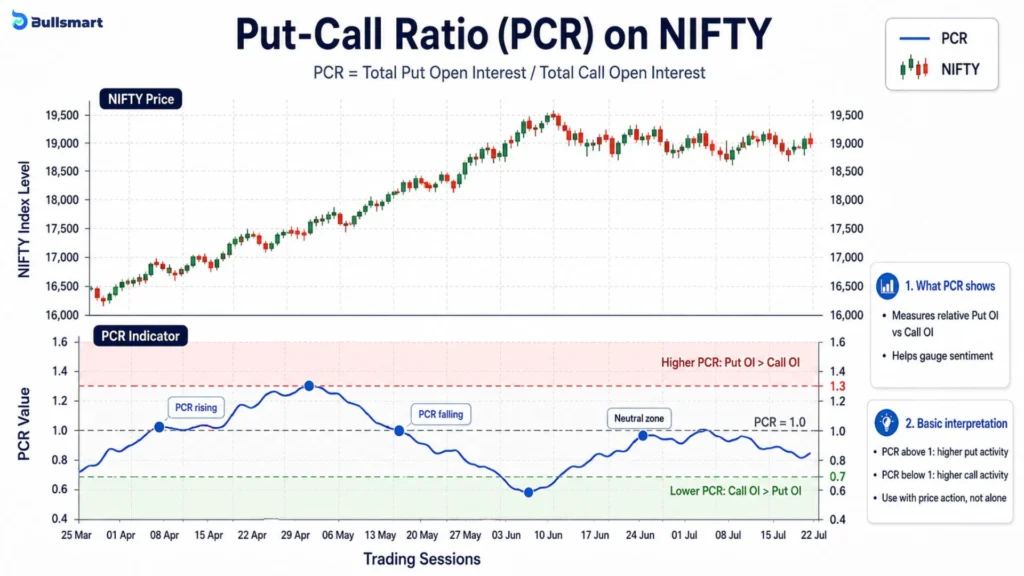
PCR, or Put-Call Ratio, is an options market indicator that compares the trading activity in Nifty put options with Nifty call options. It is commonly calculated using either open interest or trading volume.
The basic formula for calculating PCR is: PCR = Put Open Interest ÷ Call Open Interest
Types of PCR in Nifty Options
There are two main types of Put-Call Ratio used in Nifty options:
1. OI-Based PCR
OI-based PCR compares the total open interest in put options with the total open interest in call options.
It shows how existing option positions are distributed between puts and calls.
Formula: OI-Based PCR = Put Open Interest ÷ Call Open Interest
This is the more commonly tracked form of PCR because it reflects outstanding positions that are still open in the market.
2. Volume-Based PCR
Volume-based PCR compares the trading volume in put options with the trading volume in call options over a particular period.
It reflects current trading activity rather than outstanding positions.
Formula: Volume-Based PCR = Put Volume ÷ Call Volume
In simple terms, OI-based PCR shows existing market positioning, while volume-based PCR shows current trading activity.
Suggested Read: Elder’s Triple Screen System: The 3 Timeframe Check Before Every Trade
Examples of How to Calculate PCR in Nifty Options
PCR in Nifty options can be calculated using either Open Interest (OI) or trading volume.
How to Calculate OI-Based PCR
OI-based PCR compares the total open interest in Nifty put options with the total open interest in Nifty call options.
Formula: OI-Based PCR = Put Open Interest ÷ Call Open Interest
Suppose:
- Put Open Interest = 15 lakh contracts
- Call Open Interest = 12 lakh contracts
Step 1: Insert the values into the formula
PCR = 15 ÷ 12
Step 2: Calculate the ratio
PCR = 1.25
So, the OI-based PCR is 1.25, meaning put open interest is 25% higher than call open interest.
How to Calculate Volume-Based PCR
Volume-based PCR compares the trading volume in Nifty put options with the trading volume in Nifty call options during a selected period.
Formula: Volume-Based PCR = Put Volume ÷ Call Volume
Suppose:
- Put Volume = 18 lakh contracts
- Call Volume = 20 lakh contracts
Step 1: Insert the values into the formula
PCR = 18 ÷ 20
Step 2: Calculate the ratio
PCR = 0.90
So, the volume-based PCR is 0.90, meaning put trading volume is lower than call trading volume during that period.
Why OI PCR and Volume PCR Are Different
| Aspect | OI PCR | Volume PCR |
| What it measures | Outstanding put positions relative to outstanding call positions | Put contracts traded relative to call contracts traded during a given period |
| What it reflects | Positions that remain open in the market | Current trading activity |
| What it can indicate | How existing put-call positioning is distributed | How actively puts are being traded compared with calls |
| Can they be used interchangeably? | No | No |
| Does it directly predict Nifty direction? | No | No |
A higher or lower PCR should not automatically be treated as bullish or bearish because put and call positions can represent directional trades, hedging, option writing or multi-leg strategies. Open interest shows how many contracts remain open, but not the complete intention behind those positions.
Suggested Read: 2 Powerful Fibonacci Levels Explained: Fibonacci Retracement vs Fibonacci Extension
What Is Max Pain in Nifty Options?
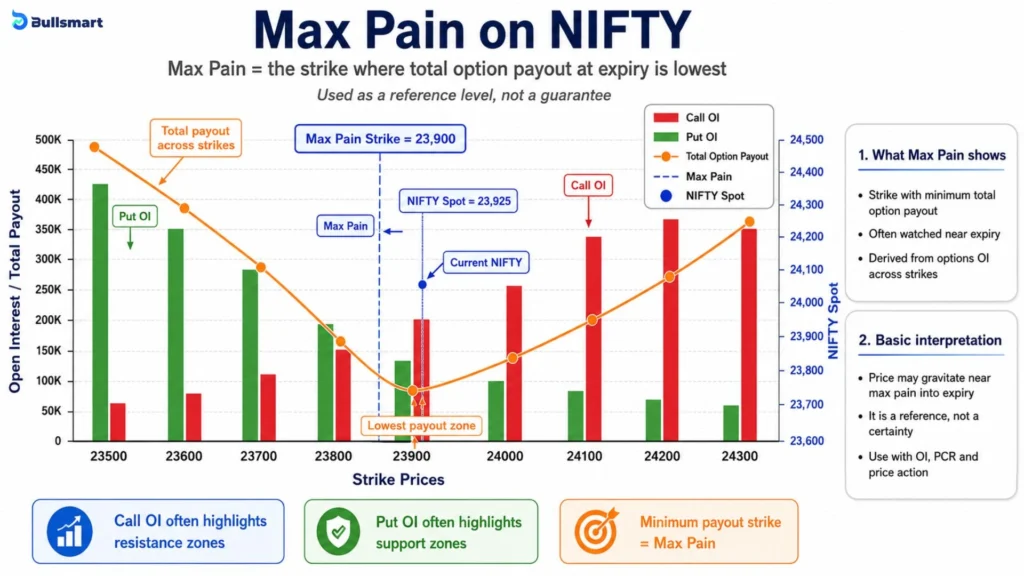
Max Pain is the strike price where, at expiry, option buyers (call and put holders) would together lose the most money, based on how positions are currently built in the market.
Unlike PCR, which simply compares the number of puts and calls, Max Pain looks at which strike has the most option positions built around it.
It is important to understand that Max Pain does not just mean “the strike where most options become worthless.” Instead, it is found by calculating and comparing the total possible payout for all strikes in the option chain.
How Is Max Pain Calculated?
The process is straightforward:
- Take the call and put open interest at each strike for the selected Nifty expiry.
- Treat each strike as a possible expiry level.
- Calculate the theoretical intrinsic payout of outstanding calls at that level.
- Calculate the theoretical intrinsic payout of outstanding puts.
- Add both payouts together.
- Repeat the calculation across all relevant strikes.
- The strike with the lowest combined payout becomes the Max Pain level.
Numerical Example of Max Pain in Nifty
Assume three strikes with the following simplified open interest:
- 24,000 CE OI = 10,000 contracts, PE OI = 2,000 contracts
- 24,100 CE OI = 8,000 contracts, PE OI = 3,000 contracts
- 24,200 CE OI = 6,000 contracts, PE OI = 5,000 contracts
Now assume Nifty expires at 24,100:
- Calls at 24,000 and 24,100 are in-the-money, so payout is calculated based on intrinsic value
- Puts at 24,200 are in-the-money, so payout applies there
After summing all payouts across strikes, suppose total losses are:
- At 24,000, ₹120 crore
- At 24,100, ₹85 crore
- At 24,200, ₹110 crore
Here, 24,100 has the lowest total payout, so it becomes the Max Pain level for that expiry.
Why Max Pain Can Change
Max Pain is not fixed.
It can shift during the session as traders:
- Build fresh positions
- Unwind existing positions
- Roll contracts to another expiry
- Shift open interest between strikes
As the OI structure changes, the Max Pain level can change as well.
For this reason, Max Pain is better viewed as a dynamic snapshot of option positioning, not as a guaranteed Nifty expiry level.
Suggested Read: 4 Powerful XABCD Harmonic Patterns Explained: Master Gartley, Butterfly, Bat & Crab
Difference Between PCR and Max Pain
| Aspect | PCR | Max Pain |
| Full form / meaning | Put Call Ratio | Strike with the lowest combined theoretical option payout at expiry |
| What it measures | Relative put activity compared with call activity | Where option positioning is concentrated across strikes |
| Main input | Open interest or trading volume | Strike-wise call and put open interest |
| Common versions | OI PCR and Volume PCR | No formally recognised types |
| What it helps indicate | How put-call positioning is changing | Which strike currently produces the lowest estimated total payout |
| Does it show direction? | Not directly | No |
| Can it change during the day? | Yes, as OI or volume changes | Yes, as OI shifts across strikes |
| Best use near expiry | To track changes in overall put-call positioning | To track how expiry-related positioning is distributed across strikes |
| Key limitation | Does not reveal whether positions are buying, writing, hedging or part of multi-leg strategies | Does not mean Nifty must expire at the Max Pain strike |
PCR + Max Pain: How to Read Them Together
PCR and Max Pain are more useful when you read them together with Nifty price and the option chain, instead of treating either one as a standalone signal.
Step 1: Check Where Nifty Is Trading
Start with the current Nifty spot price.
Then compare it with the important option strikes and the Max Pain level.
For example, a Max Pain level that is very close to Nifty is more relevant to watch than one that is several hundred points away.
Step 2: Look at Open Interest Across Strikes
Next, check where Call OI and Put OI are concentrated.
This helps you understand which strikes currently have the most open positions.
Also look at Change in OI, because it tells you whether positions are being added or removed.
Step 3: Check the Right PCR
Now look at the Put Call Ratio.
If you are studying one particular expiry, use PCR data for that expiry rather than mixing data from different contracts.
Also check which PCR you are looking at:
- OI PCR: compares open put positions with open call positions
- Volume PCR: compares put trading volume with call trading volume
Step 4: Check the Max Pain Level
See where the Max Pain strike is compared with the current Nifty price.
Use it as a reference point for option positioning, not as a prediction that Nifty must expire there.
Step 5: Watch How OI Changes
A strike with high OI now may not remain important until expiry.
If positions are closed or moved to another strike, the option-chain structure can change quickly.
That is why Change in OI can be more useful than looking only at total OI.
Step 6: See If Max Pain Is Moving
If Max Pain keeps shifting from one strike to another, it means open interest is also changing across the option chain.
Tracking this movement can give more context than looking at one Max Pain number in isolation.
Step 7: Let Nifty Price Have the Final Say
PCR and Max Pain should support your reading of the market, not replace it.
Always compare them with:
- Nifty price movement
- Open Interest
- Change in OI
- Volatility
- Actual price behaviour near important strikes
Simply put: PCR tells you how puts compare with calls, while Max Pain tells you where option positioning is concentrated. Nifty price tells you whether that positioning is actually influencing the market.
Suggested Read: The Wyckoff Spring: How Institutions Trap Retail Traders Before Major Rallies & 2 Ways It Happens
Does Nifty Really Get Pulled Towards Max Pain?
It is common to hear that Nifty gets “pulled” towards the Max Pain strike near expiry. But Max Pain should not be treated as a magnet or guaranteed expiry target.
To understand why, it helps to separate Max Pain from another concept called option pinning.
What Is Option Pinning?
Option pinning refers to a tendency for the price of an underlying asset to stay close to, or cluster around, certain option strike prices as expiry approaches.
Research has found evidence of this effect in different markets.
- Marco Avellaneda and Michael Lipkin showed that large open interest at particular strikes, combined with delta-hedging activity, could contribute to prices staying near those strikes close to expiry.
- A study published in the Journal of Financial Economics found stronger price clustering around option strikes on expiry dates. In its historical sample, expiry-day returns were affected by at least 16.5 basis points on average, with market-maker hedge adjustments identified as one contributing factor.
- Research on S&P 500 futures has also found evidence of expiry-day pinning linked to hedging activity.
But Max Pain and Option Pinning Are Not the Same
This distinction is important.
Max Pain is calculated using open interest across the entire option chain to find the strike with the lowest theoretical combined payout.
Option pinning, on the other hand, refers to price behaviour around particular strikes and can be influenced by hedging activity.
Therefore, evidence that option pinning exists does not prove that Nifty must move towards its Max Pain level.
Why Nifty May Stay Away From Max Pain
Other market forces can easily outweigh option positioning, including:
- Strong directional buying or selling
- Changes in volatility
- Large-scale position unwinding
- Fresh positions at different strikes
- Major economic or market news
- Changes in hedging activity
Indian studies have also found changes in trading volume and, in some cases, volatility around derivatives expiry. This supports the idea that expiry can affect market behaviour, but it still does not make Max Pain a guaranteed Nifty expiry level.
In simple terms: Max Pain can be a useful reference for understanding option positioning, but Nifty is under no obligation to move or settle there.
Why PCR and Max Pain Matter More Near Expiry
PCR and Max Pain become more important to track as expiry approaches because option positions start changing faster and less time remains before contracts expire.
NSE Clearing states that in-the-money index options are automatically exercised at expiry and settled in cash. After expiry, the open positions in those contracts cease to exist.
Before that happens, traders may:
- Close existing positions
- Roll positions into the next expiry
- Build fresh positions at new strikes
- Shift Call and Put open interest across strikes
- Change the overall Put Call Ratio
- Cause the Max Pain level to move
Why This Matters
A PCR or Max Pain reading from earlier in the expiry cycle may not remain relevant close to expiry.
For example, if large positions are unwound or shifted to different strikes, both PCR and Max Pain can change even without a major move in Nifty.
That is why these numbers should be treated as dynamic indicators, not fixed expiry signals.
Simply put: as expiry gets closer, watch how PCR, open interest and Max Pain are changing rather than relying on one static reading.
When PCR and Max Pain Disagree
PCR and Max Pain do not always move together because they measure different parts of the option chain.
Condition 1: PCR Changes, Max Pain Stays Stable
This may happen when the overall balance between Put and Call positions changes, but the strike-wise distribution of open interest does not change enough to shift Max Pain.
What it can indicate: Put-call positioning is changing, while the main concentration of OI remains broadly in the same area.
Condition 2: Max Pain Moves, PCR Barely Changes
This can happen when Put and Call positions shift from one strike to another, while their overall ratio remains almost unchanged.
What it can indicate: The location of option positioning is changing, even though the overall Put Call Ratio looks stable.
Condition 3: Both PCR and Max Pain Change Quickly
This may occur when there is significant repositioning near expiry through fresh positions, unwinding or rollovers.
What it can indicate: Both the balance of Put-Call positioning and its distribution across strikes are changing.
Condition 4: Neither Changes Much
If both PCR and Max Pain remain relatively stable, it may suggest that the overall option-chain structure has not changed significantly.
However, this does not mean Nifty itself will remain stable. Price can still move because of factors outside the option chain.
The key difference: PCR shows how Put positioning compares with Call positioning, while Max Pain shows where that positioning is concentrated across strikes.
6 Common Mistakes With PCR and Max Pain
| Mistake | Why It Can Mislead |
| Treating PCR above 1 as automatically bullish | The strategy behind the OI is unknown |
| Mixing OI PCR and Volume PCR | They measure different types of activity |
| Assuming Nifty must expire at Max Pain | Max Pain is a calculation, not an expiry rule |
| Ignoring Change in OI | Existing positioning can shift rapidly |
| Reading Max Pain without Nifty spot | Distance from the current index matters |
| Using either metric as a standalone signal | Price, volatility and risk still matter |
What PCR and Max Pain Cannot Tell You
Neither PCR nor Max Pain independently tells you:
- The exact direction of Nifty
- The exact expiry price
- The probability of profit
- Future volatility
- The correct entry point
- Where a stop-loss should be placed
- Whether every OI position represents buying, writing or hedging
They are context indicators, not expiry-day guarantees.
That distinction becomes particularly important in derivatives, where leverage and rapid changes in option value can magnify losses.
SEBI’s updated study covering FY22 to FY24 found that 93% of individual traders in equity F&O incurred losses, with aggregate losses exceeding ₹1.8 lakh crore over the three-year period.
Understanding PCR or Max Pain does not remove those risks.
Bottom Line
PCR and Max Pain can make Nifty expiry look more complicated than it really is. The key is to understand what each number is actually telling you.
PCR shows how put positioning compares with call positioning, while Max Pain highlights the strike where the combined theoretical option payout is currently the lowest. Both can offer useful context, but neither can predict the exact direction or expiry level of Nifty on its own.
What matters more is how these numbers change alongside Nifty spot, Open Interest, Change in OI, volatility and price behaviour. A rising PCR, shifting Max Pain or heavy OI at a particular strike becomes meaningful only when the broader option-chain picture supports it.
That is also why Max Pain should not be treated like a magnet and PCR should not be reduced to simple bullish or bearish rules.
Near expiry, focus less on finding one magical number and more on understanding how positioning is evolving.
Use PCR and Max Pain as context, not conclusions. The market still gets the final say.
Disclaimer: This article is for educational and informational purposes only and should not be considered investment advice, research, a recommendation, or a solicitation to buy or sell any security or derivative. PCR, Max Pain, open interest, price levels, and other market indicators may change rapidly and do not guarantee future price movement or trading outcomes. Trading in futures and options involves significant risk and may result in substantial losses. Investors should conduct their own research, consider their financial situation and risk tolerance, and consult a SEBI-registered investment adviser where necessary before making investment decisions. Past performance is not indicative of future results.
FAQs
What is PCR in trading?
PCR, or Put Call Ratio, compares put-option activity with call-option activity. It can be calculated using open interest or trading volume. PCR helps traders understand how put and call positioning is changing, but it should be read with price, OI and other market data rather than as a standalone directional signal.
Is high PCR bullish or bearish?
A high PCR means put activity or open interest is greater relative to calls. It is sometimes interpreted as bearish sentiment or, at extreme levels, as a contrarian bullish signal. However, there is no universal PCR level that is automatically bullish or bearish, because positions may involve buying, writing or hedging.
What is the maximum pain in Nifty?
Nifty Max Pain is the strike where the combined theoretical payout of outstanding call and put options would be the lowest at expiry, based on current open interest. It is useful for understanding where option positioning is concentrated, but it does not mean Nifty is guaranteed to expire at that strike.
What is the current Nifty Max Pain?
Nifty Max Pain is dynamic and changes with the selected expiry and changing open interest, so there is no permanent current value. NSE provides the underlying strike-wise OI data but does not publish Max Pain as an official Nifty target. For an evergreen blog, readers should check a live Max Pain calculator for the relevant expiry.