
Every F&O trader should know one thing before entering a trade: the right risk number matters more than the dream profit.
F&O trading looks exciting for a reason. Fast moves, weekly expiries, leverage, and the chance to catch a sharp market move can make it feel like the most thrilling part of trading.
But here is the reality check: F&O is not just fast profit. It is fast risk too.
Many traders enter a trade thinking, “How much can I make?” But the smarter question is, “How much can I lose if this goes wrong?”
That one question can save a lot of capital.
In F&O, getting the direction right is only one part of the game. You also need to know how much money is at risk, how large your position actually is, and where the trade starts making sense.
Before placing any F&O trade, these three numbers should be clear:
- Maximum loss per trade
- Position size and total exposure
- Breakeven level
Think of them as your pre-trade reality check. If these numbers do not make sense, the trade probably does not either.
Because before the market tests your confidence, these numbers test your trade.
Let’s learn the math!
What Is Risk Calculation in F&O Trading?
Risk calculation means knowing how much money can be lost before placing a trade. For an F&O trader, it is not enough to look at possible profit. The trader should first know the downside.
In simple words, risk calculation answers one basic question: “If this trade goes wrong, how much can I lose?”
Why Is Risk Calculation Important?
F&O trading involves leverage, lot sizes, margin, premium movement, and fast price changes. This means even a small market move can create a big impact on the account.
Risk calculation helps traders avoid oversized positions, emotional decisions, and trades that look exciting but are not worth the risk. It also helps protect trading capital.
How Is Risk Calculation Done?
Risk calculation is done by checking three key numbers before entry:
- Maximum loss per trade
- Position size and total exposure
- Breakeven level
Basic Formulas
How Is Risk Calculation Done?
Risk calculation is done by checking three key numbers before entry:
- Maximum loss per trade
- Position size and total exposure
- Breakeven level
| Risk Number | Formula | What It Tells You |
| Risk per trade | (Entry price – Stop-loss price) × Lot size × Number of lots | How much you can lose if the stop-loss is hit |
| Maximum premium risk | Premium paid × Lot size × Number of lots | Maximum loss for an option buyer if the option expires worthless |
| Total exposure | Underlying price × Lot size × Number of lots | The actual market value controlled by the position |
| Call option breakeven | Strike price + Premium paid | The level above which a call option starts becoming profitable before costs |
| Put option breakeven | Strike price – Premium paid | The level below which a put option starts becoming profitable before costs |
Once these numbers are clear, the trader can decide whether the trade is actually worth taking.
Why Risk Calculation Matters More in F&O
1. F&O Uses Margin and Premium
In normal stock investing, you usually pay the full value of the shares. In F&O, futures traders pay margin, while option buyers pay premium. This makes the trade look cheaper than it actually is.
2. Small Money Can Control Big Exposure
In F&O, the amount paid upfront is not the full trade value. A trader may pay a smaller margin or premium but still control a much larger position.
For example, if Nifty is around Rs. 24,000 and one lot has 65 units, one lot controls exposure of over Rs. 15 lakh.
3. Small Moves Can Create Big P&L Swings
Because the exposure is large, even a small move in Nifty or Bank Nifty can create a big change in profit or loss. This is why F&O can move the account quickly, both ways.
4. Lot Size Increases the Impact
In stocks, you can buy one share. In F&O, you trade in fixed lots. That means every price movement affects the entire lot, not just one unit.
5. Risk Calculation Prevents Emotional Trading
Without clear risk numbers, traders may take oversized positions, hold losing trades too long, or enter revenge trades after a loss.
6. Risk Clarity Makes Trading More Structured
Before entering, a trader should know: how much can be lost, how big the position really is, and where the trade starts making sense.
Once these numbers are clear, F&O trading becomes more planned and less emotional.
Suggested Read: Revenge Trading in Stock Market: Meaning, Psychology, Examples, and 3 Rules to Avoid It
The 3 Risk Numbers Every F&O Trader Should Check Before Entry
Before placing an F&O trade, do not only check the chart or profit potential. First, check the risk. These three numbers help you understand whether the trade is worth taking.
Risk No. 1: Maximum Loss Per Trade
What it means
Maximum loss is the most money you are ready to lose if the trade goes wrong. This number should be decided before entering, not after the trade starts moving against you.
How to calculate it
| Trade Type | How to Calculate Risk | Example |
| Option buyer | Premium paid × Lot size | Rs. 150 × 65 = Rs. 9,750 |
| Futures trader | Entry price – Stop-loss × Lot size | 300 points × 65 = Rs. 19,500 |
| Option seller | Risk depends on strategy and stop-loss | Naked selling can carry very high risk |
Why it matters
This number tells you whether the trade is affordable for your account. A simple rule is to risk only a small part of your capital per trade. For beginners, 1% to 2% risk per trade can help protect capital from one bad decision.
Risk No. 2: Position Size and Total Exposure
What it means
Position size means how many lots you trade. Total exposure means the actual market value your trade controls.
In F&O, the premium or margin paid can look small, but the exposure can be much larger.
How to calculate it
| Formula | Example |
| Total Exposure = Underlying Price × Lot Size × Number of Lots | 24,000 × 65 × 1 = Rs. 15.6 lakh |
Why it matters
If Nifty is at 24,000 and one lot has 65 units, one lot controls Rs. 15.6 lakh of market exposure. So even a small move can create a large profit or loss.
This is why traders should not increase lots only because the premium looks cheap or margin looks manageable.
Risk No. 3: Breakeven Level
What it means
Breakeven is the level where the trade starts making money after covering the premium paid.
In options, being right about direction is not enough. The market also needs to move enough before expiry.
How to calculate it
| Option Type | Formula | Example |
| Call option | Strike price + Premium paid | 24,000 + 120 = 24,120 |
| Put option | Strike price – Premium paid | 24,000 – 130 = 23,870 |
| Futures | Entry price plus costs | If entry is 24,000, breakeven is around 24,000 plus costs |
Why it matters
Breakeven helps you check whether the trade is realistic. If your analysis expects only a small move, but the option needs a much bigger move to break even, the trade may not be worth taking.
How These 3 Numbers Work Together
| Risk Number | Main Question |
| Maximum loss | How much can I lose if this goes wrong? |
| Position size and exposure | How big is this trade really? |
| Breakeven level | How far must the market move for this trade to work? |
If these three answers are not clear, the trade is not ready.
Suggested Read: The 7-Day Theta Decay Cycle: When Options Lose Value Fastest & How to Trade Around It
Simple Pre-Trade Risk Checklist for F&O Traders
Use this quick checklist before every trade:
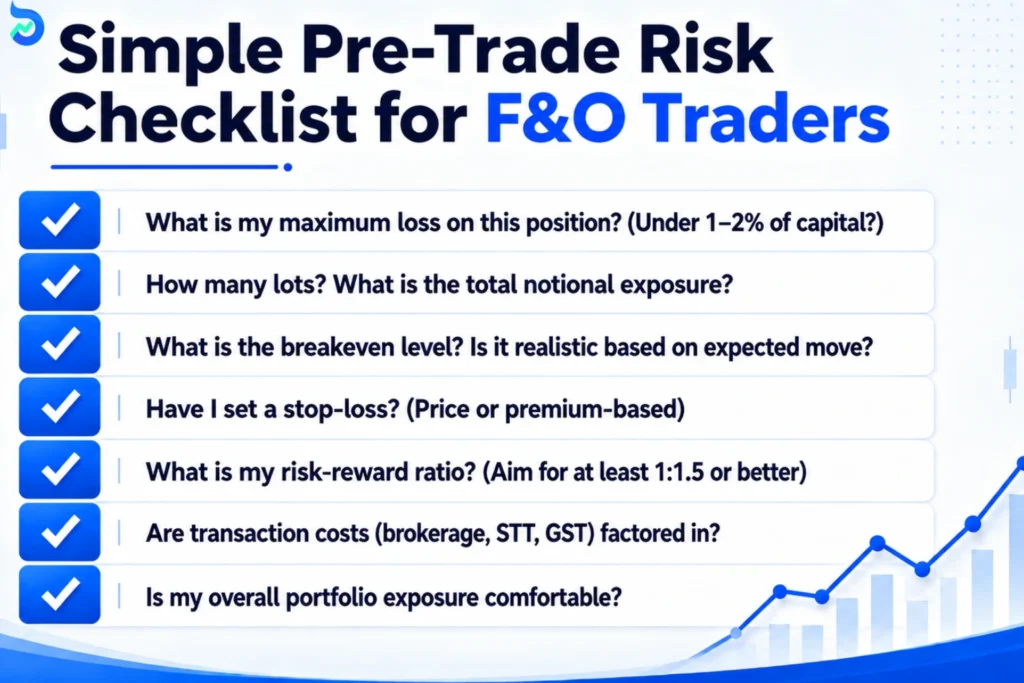
Print or save this list. Make it a habit.
Suggested Read: How to Read the NSE Option Chain Beyond Strikes and Premiums: 6 Powerful Components Explained
Common Mistakes Indian F&O Traders Make
Many retail traders repeat these errors:
- Looking only at premium: Buying cheap OTM options that need huge moves to profit.
- Trading too many lots: Because margin is “only” Rs. 20,000–50,000.
- Treating margin as maximum loss: Forgetting futures MTM can demand more funds quickly.
- Ignoring breakeven: Hoping for direction without calculating required movement.
- Increasing quantity after losses (revenge trading).
- Forgetting costs: Brokerage and taxes can turn small wins into losses.
- No stop-loss: Hoping the market will reverse.
These mistakes explain why 91% lose money despite easy access to apps and charts.
Practical Risk Rules for Beginners and Active Traders
For Beginners
- Risk maximum 1% of capital per trade.
- Start with 1 lot only.
- Prefer defined-risk strategies (like debit/credit spreads) over naked options.
- Avoid expiry-day trading initially.
- Paper trade until you consistently calculate the three numbers correctly.
For Active Traders
- Scale down size during high IV or news events.
- Use position sizing formula: Lots = (Capital × Risk %) / (Risk per lot).
- Review weekly exposure and drawdowns.
- Maintain a trading journal noting the three risk numbers for every trade.
- Reduce risk during losing streaks (e.g., halve position size).
Always remember: Preservation of capital comes before profit generation.
Bottom Line
F&O trading can look exciting from the outside, but the traders who survive longer are usually not the ones chasing the biggest profit. They are the ones who understand risk before they enter the trade.
Maximum loss, position size, total exposure, and breakeven may sound like basic numbers, but they can completely change the way a trader thinks. They help you pause before clicking buy or sell. They show whether the trade is affordable, whether the lot size is too aggressive, and whether the market actually needs to move too much for the trade to work.
That is why every F&O trader should treat these three risk numbers as a pre-trade habit, not a once-in-a-while calculation. Charts, indicators, and market views can help with direction, but risk numbers help protect capital.
In the end, good trading is not only about being right. It is about staying in the game long enough to improve. And that starts with knowing your risk before the market reminds you.
Disclaimer: Investments in the securities market are subject to market risks, read all related documents carefully before investing.
This blog is for educational and informational purposes only and should not be considered investment advice, trading advice, or a recommendation to trade in futures and options. F&O trading involves high risk due to leverage, volatility, margin requirements, and fast price movements. Traders should assess their risk appetite, understand the product, and consult a qualified financial advisor before making any trading decision. Past performance is not indicative of future returns.
FAQ
What is the risk in F&O trading?
F&O trading involves high risk because it uses leverage, fixed lot sizes, margins, and fast price movements. Losses can be higher than expected, especially in futures and option selling. Traders should understand the product, calculate risk before entry, and trade only according to their risk appetite.
Which is more risky, F&O or intraday?
F&O is generally considered riskier than regular intraday equity trading because leverage and lot sizes can amplify losses. However, intraday trading also carries risk if stop-loss, position size, and capital exposure are not managed properly. Risk depends on the instrument, strategy, and trader discipline.
What is my risk number?
Your risk number is the maximum amount you are comfortable losing on a single trade. It should be based on your capital, stop-loss, lot size, and personal risk appetite. For example, if your capital is Rs. 1 lakh and you risk 1%, your risk number is Rs. 1,000 per trade.
Is 2% risk per trade good?
A 2% risk per trade may suit some experienced traders, but it may be high for beginners or highly volatile F&O trades. Many traders prefer keeping risk lower to protect capital. The right risk level depends on capital size, experience, strategy, and ability to handle losses.