

For the past two years, the biggest story in Indian markets hasn’t been the companies listed on them. It has been the foreign money leaving them. FII data clearly shows that in FY26 till April, FIIs pulled out over ₹1.8 lakh crore from Indian equities. In calendar year 2025, they sold ₹1 lakh crore. This blog explains exactly why, what history tells us, and what signals you should watch in FII data and DII data to understand when the tide turns.
Note on terminology: FII (Foreign Institutional Investor) and FPI (Foreign Portfolio Investor) are often used interchangeably. SEBI officially merged these into “FPI” in 2014. For clarity, we use FII throughout this article, and it refers to the FII data for FPI. FPI is a broader category that includes FIIs. Every FII is an FPI, but not every FPI is a traditional FII.
This blog will help you understand the whats and whys of using FII data and DII data.
Let’s dive in!
What are FIIs and DIIs?
Before diving into the data, it helps to understand who these players are and why they matter so much to the Indian market.
FII (Foreign Institutional Investor)
These are global entities such as pension funds, hedge funds, sovereign wealth funds, and insurance companies based outside India. They bring foreign capital into Indian equities.
Their decisions are influenced by global interest rates, currency movements, emerging market valuations, and geopolitical risks. They tend to move fast, deploy large capital, and follow global macro trends.
DII (Domestic Institutional Investor)
These are India-based institutions such as mutual funds, insurance companies, banks, and pension funds. They invest the savings of Indian households, which flow in steadily through SIPs and premiums.
Their decisions are more aligned with domestic fundamentals. They often act as a stabilising force in the market, especially when FIIs are selling.
Together, FIIs and DIIs are the two biggest institutional forces in the Indian market. The interaction between them, when one sells and the other buys, is a key dynamic every serious investor or trader should understand.
The Big Picture: a Decade of FII vs DII Data
Let’s look at the annual net flows first. A positive number means net buying; negative means net selling. The numbers below are in ₹ crore.
FII data & DII data net flow (₹ Cr):
| Year | FII net flow | DII net flow | Nifty 50 change | FII stance |
| 2016 | -23081 | 35,362 | 3.01% | Seller |
| 2017 | 200048 | 90,738 | 28.65% | Buyer |
| 2018 | -80919 | 109,661 | 3.15% | Seller |
| 2019 | 135995 | 42,257 | 12.02% | Buyer |
| 2020 | 103156 | -35,663 | 14.90% | Buyer |
| 2021 | 50089 | 94,574 | 24.12% | Buyer |
| 2022 | -132815 | 276,698 | 4.32% | Seller |
| 2023 | 237062 | 184,650 | 19.42% | Buyer |
| 2024 | 165769 | 526,545 | 8.75% | Buyer |
| 2025 | -104050 | 788,184 | 10.51% | Heavy seller |
| FY26 (YTD) | -180674 | 288,450 | -15.06% (YTD) | Record seller |
Source: NSDL
Key insight: Notice 2022 and 2025, FIIs sold heavily, but DIIs bought even harder. Markets fell, but didn’t collapse. The DII cushion is now structural, not incidental.
The Shift that Changed Everything: DIIs Now Own More than FIIs
In March 2025, something historic happened for the first time in the history of Indian markets.
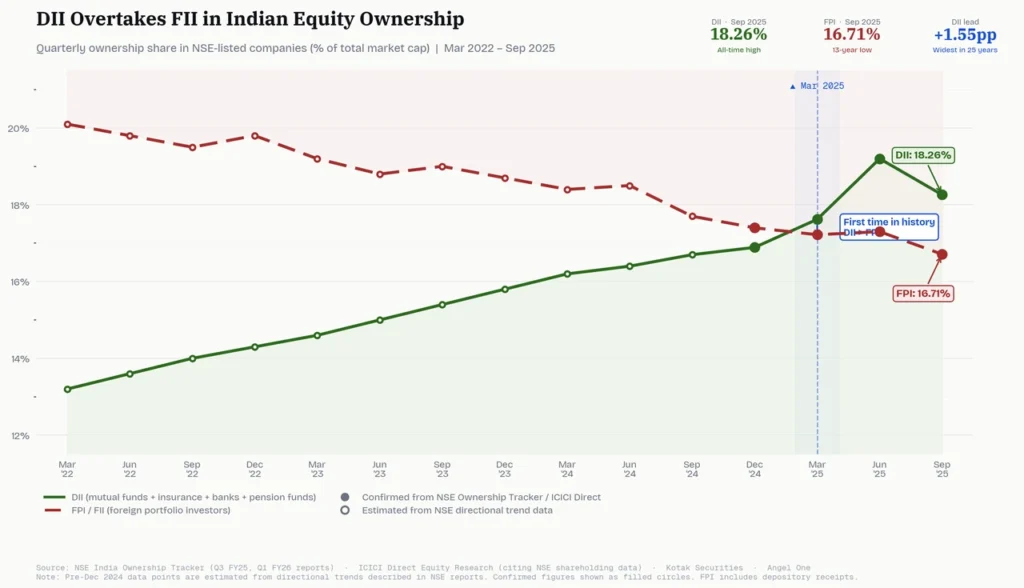
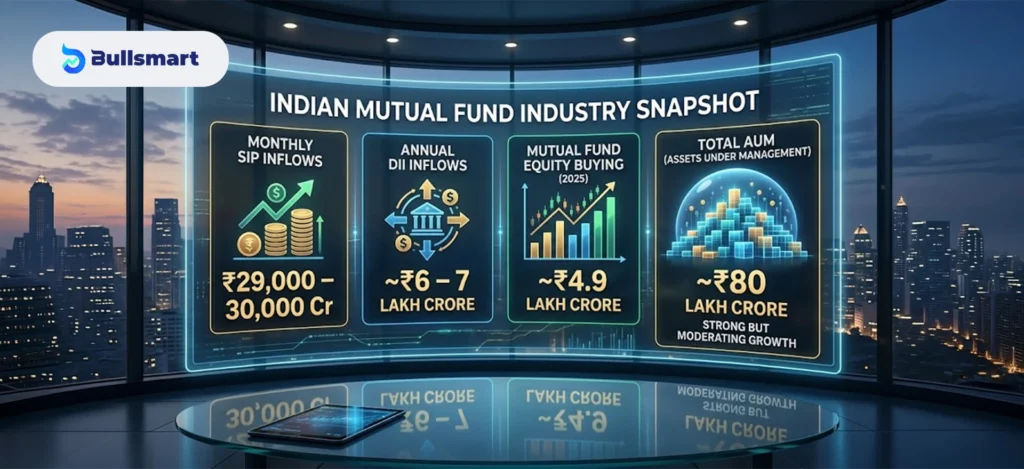
For the first time in India’s market history, domestic institutions own more of Indian equities than foreign ones. This is a structural shift built on 25+ months of continuous DII buying worth ₹11.40 lakh crore. Monthly SIP contributions alone crossed ₹29,000 crore every month throughout this period, a floor of domestic capital that didn’t exist in 2008 or 2013.
Why are FIIs selling in 2025-26? The full picture
FII data shows selling isn’t driven by one thing, it’s a convergence of five pressures, each compounding the others.
Reason 1: Rupee depreciation, the silent return killer
The rupee depreciated over 11% against the US dollar in FY26. This is the steepest fall since FY2012. For a foreign investor, every rupee of returns in Indian equities gets converted back to dollars when they exit. A 10% rally in the Nifty that’s paired with a 10% rupee fall means the foreign investor made near zero in dollar terms. The rupee hit ₹95.22 intraday on March 23, 2026, an all-time low.
The math that hurts FIIs: If Nifty returned +8% in rupee terms in FY26, but the rupee fell 11%, the USD return is approximately -3%. That’s why they sold even when Nifty wasn’t crashing in rupee terms.
Reason 2: The global AI trade
This is the one most people miss. The US tech sector, driven by AI, delivered extraordinary returns in 2023 and 2024. Global fund managers who needed to show performance poured money into Nvidia, Microsoft, Meta, and other AI beneficiaries. India has no equivalent large-cap AI play. From a portfolio perspective, global FIIs were not “selling India”; they were “buying AI,” and India happened to fund that trade.
Reason 3: India was expensive relative to peers
Even after corrections, the Nifty 50 was trading at around 20x trailing PE, higher than Japan, South Korea, and Hong Kong, all of which were trading below 20x and offering better dollar-adjusted returns at the time of selling.
Reason 4: Oil prices and the West Asia crisis
Oil crossed $110/barrel after the West Asia conflict escalated in late February 2026. India imports ~85% of its oil. Every $10 rise in oil prices pushes India’s retail inflation up by approximately 0.60 percentage points, widens the current account deficit, and pressures the rupee further. For a foreign investor already losing on currency, a deteriorating macro backdrop accelerated exits.
Reason 5: US tariff uncertainty and a strong dollar
Early 2026 saw significant US-India trade tension, with tariff uncertainty creating a risk-off environment for emerging markets broadly. A stronger US dollar simultaneously made dollar-denominated assets like US Treasuries more attractive, pulling capital away from all EM markets, not just India.
How DIIs absorbed the shock and why it matters
The real story of this period is not just FII selling, it’s that Indian domestic investors systematically absorbed every rupee of that selling without the markets collapsing.
How to Read FII Data and DII Data as a Trader or Investor
This data is published every day after market close on NSE and BSE. Here’s how to actually use it in your decision-making.
The four possible combinations
1. Strongly bullish
FII buying + DII buying
Both domestic and foreign money is flowing in. This is the strongest confirmation of an uptrend. Markets tend to rally with breadth and momentum. Example: 2021 and H1 2023.
2. Bearish pressure
FII selling + DII selling
Both forces exiting. Rare, but when it happens, as in early 2020 during COVID, markets crash fast. Watch for this as a risk signal in your portfolio.
3. Resilient but cautious
FII selling + DII buying
The current state of Indian markets since late 2024. Markets fall, but DII buying provides a floor. Good time for long-term accumulation, but expect volatility. Don’t expect sharp rallies without FII participation.
4. Weak signal
FII selling + DII selling
Foreign money exits; domestic institutions book profits. Often seen at market peaks. A possible topping signal, be cautious about fresh large positions in this environment.
Suggested Read: Foreign Investors (FII) Finally Making a Strong Return to India in 2026?
What to Actually Track, a Practical Checklist
- Look at the trend, not a single day’s inflow or outflow. One day’s FII selling means nothing. 10-15 consecutive days of selling signal a trend. Track weekly and monthly cumulative data.
- Track the DII-FII divergence ratio. When DII net buying significantly exceeds FII net selling, markets are in a cushioned decline, good for systematic accumulation.
- Watch F&O data alongside cash data. FII positions in index futures tell you their near-term directional bet. Heavy short positions in Nifty futures = they’re hedging or betting on a fall.
- Combine with the USD/INR rate. FII flows and the rupee move together. A stabilising rupee is often an early signal that FII selling pressure is easing.
- Monitor crude oil prices. For India, oil is a macro proxy. Below $85/barrel = conducive FII environment. Above $100/barrel = outflow risk increases sharply.
- Don’t use FII data alone. It tells you sentiment, not fundamentals. Always check with technical levels, sector earnings, and global cues.
- Don’t react to intraday FII data. Provisional intraday figures are unreliable. Use the final EOD figures published by NSE/BSE after 6pm.
Suggested Read: INR at Record Low: A Huge Threat to Indian Investors in 2026
Where to Find FII data and DII data Daily
| Source | Data available | Update timing |
| NSE India (nseindia.com) | Daily FII/DII cash + F&O data | After market close |
| NSDL (fpi.nsdl.co.in) | Monthly + yearly FPI data | Updated monthly |
| News Agencies | Daily/monthly/yearly dashboard | Same day |
| Trendlyne / Tickertape | Historical charts, sector-wise | Real-time + historical |
When will FIIs come back? The checklist to watch
HSBC Mutual Fund’s outlook puts it directly: they expect a return of FII investors into India, catalysed by better earnings growth visibility in FY27 and a potential US trade deal. Here are the specific triggers to monitor.
- Rupee stabilisation below ₹88/$: the currency is the single biggest variable for FII dollar-adjusted returns. RBI is already defending it with dollar sales.
- Oil below $85/barrel: a sustained drop from current levels significantly improves India’s CAD, reduces inflation pressure, and removes a key FII deterrent.
- US-India trade deal: a resolution removes tariff uncertainty and signals India’s openness, a positive for global fund allocation models.
- Nifty PE back below 18x: valuations need to look attractive relative to global peers. Post-correction, India is closer but not yet clearly cheap on a relative basis.
- FY27 earnings recovery: after multiple quarters of below-expectation growth, a strong Q1/Q2 FY27 earnings season would be the most powerful catalyst for sustained FII re-entry.
- Global AI trade unwinding: when global momentum in US tech stocks reverses, capital will rotate back to EM markets like India. Watch for signs of Nasdaq fatigue.
- West Asia conflict escalation: this remains the biggest wildcard. If it deepens, oil rises, the rupee falls, and FIIs stay away longer regardless of domestic fundamentals.
“FIIs don’t create trends – they chase them. They consistently bought Indian stocks when PE ratios were high and sold when PE ratios were low. So when you see massive FII selling, the data says opportunity, not danger.”
Historical perspective: What Happened after Previous Big FII Exits: FII Data Study
| Exodus period | Trigger | FII net selling | Nifty at bottom | Recovery within 12 months |
| Sep-08 | Global financial crisis | -₹52,000 Cr | -60% | 73% |
| 2013 | US Fed taper tantrum | -₹44,000 Cr | -10% | 18% |
| 2018 | US rate hike cycle | -₹33,000 Cr | -15% | 14% |
| 2020 | COVID-19 crash | -₹61,000 Cr (Mar only) | -38% | 9% |
| 2022 | US rate hikes, Russia-Ukraine | -₹1,21,000 Cr | -17% | 20% |
| 2025-26 | AI trade, rupee, oil, tariffs | -₹2,80,000 Cr+ | -12% (so far) | ? |
Every single previous FII exodus has been followed by a recovery. The depth and duration vary, but the pattern is consistent: FIIs exit on macro fear, Indian markets bounce back on earnings and DII support, and FIIs re-enter chasing recovery.
What should you do as a trader or investor?
If you’re a long-term investor
Continued DII data shows strength, and SIP flows create a floor. Periods of heavy FII selling have historically been among the best accumulation windows over a 2-3 year horizon. Focus on quality businesses with domestic earnings visibility, low rupee sensitivity, and strong cash flows.
If you’re an active trader
Use FII F&O data to gauge short-term directional bias. Heavy FII short positions in Nifty futures = near-term downside pressure. Watch for FII position unwinding as a potential trigger for short covering rallies. Don’t fight a sustained FII selling trend with long positions.
Sectors to watch when FIIs return
FIIs historically return first to financial services, IT, and energy; large, liquid stocks they can move in and out of quickly. Banking stocks and Nifty 50 heavyweights tend to lead any FII-driven recovery.
Watch the early signals
The first sign of returning FIIs is typically 3-5 consecutive days of net buying after a long selling streak. Pair with rupee appreciation above ₹88/$ and a pullback in crude oil. These three together are historically the most reliable combo.
Bottom Line
The FII exodus of 2025-26 is severe by historical standards, but not unprecedented in its triggers or eventual outcome. India’s macro fundamentals, 7.6% GDP growth, rising DII ownership, and credit rating upgrades, remain intact. The question is not if FIIs return, but when the combination of a stable rupee, cooling oil, and credible earnings growth tilts the calculus back in India’s favour. Track the five triggers. Watch the data daily. History is on your side.
Disclaimer: This article is for educational purposes only and does not constitute investment advice. Markets are subject to risk. Please read all scheme-related documents before investing. Data sourced from NSE, NSDL, SEBI, and public market research reports.
FAQs
Will the Indian stock market bounce back in 2026?
A bounce back is possible, but it depends on key triggers like global rate cuts, stable crude prices, and strong corporate earnings. India’s fundamentals remain strong, supported by domestic inflows. If external pressures ease, markets can stabilise and recover, though the pace may be gradual rather than sharp.
Will fii selling continue?
FII selling can continue in the short term if global uncertainties persist, especially around US interest rates, inflation, and currency movements. However, it is usually cyclical. Once global conditions improve and valuations become attractive again, FIIs tend to return with equally strong inflows.
How long will it take for the stock market to recover?
Recovery timelines are not fixed. Historically, markets take a few months to a couple of years depending on the severity of outflows and global conditions. If macro factors stabilise sooner, recovery can be quicker. Long-term investors typically benefit by staying invested through such cycles rather than timing the bottom.
Why are DIIs buying when FIIs are selling?
DIIs invest domestic savings, largely through SIPs and insurance flows, which remain steady regardless of global conditions. Their decisions are driven more by India’s long-term growth story than short-term global risks. This makes them natural buyers during FII selling phases, helping stabilise the market.