
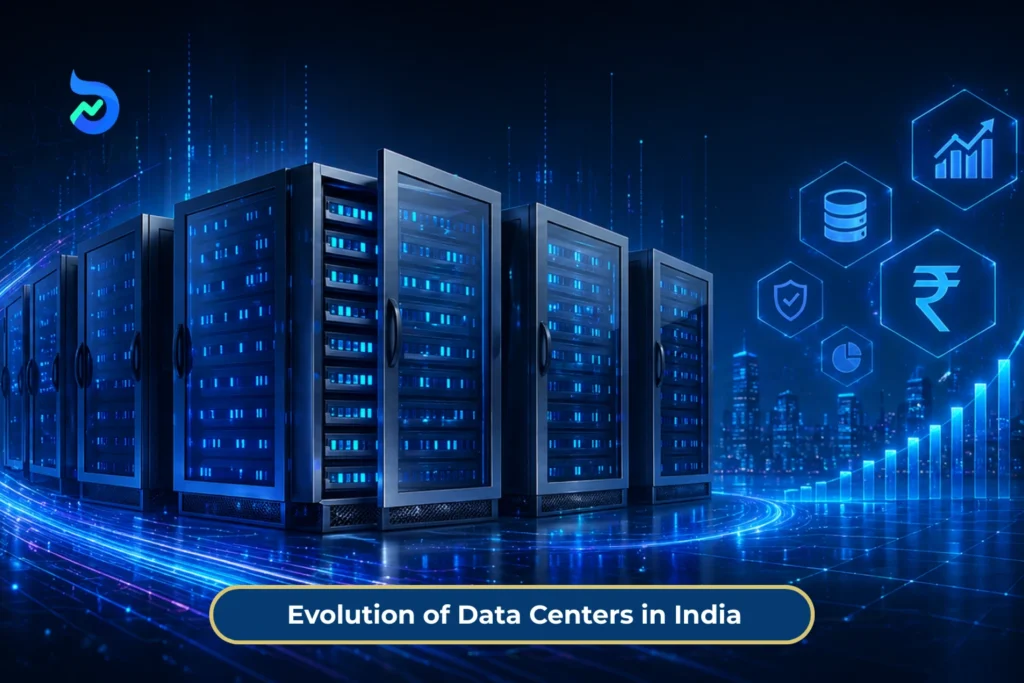
India’s AI story is no longer small talk. In 2026, the industry is already worth around Rs. 1.25 lakh crore ($15 billion), growing at 25-35% annually, and expected to add up to Rs. 41-42 lakh crore ($500 billion) to GDP by 2030.
But here’s the catch: AI doesn’t run on ideas alone. It runs on infrastructure.
Every AI query, UPI payment, stock trade, OTT stream, or digital loan depends on one invisible backbone – data centers. They store, process, and move the data that powers India’s entire digital economy.
That’s why the recent move by N. Chandrababu Naidu matters. On April 28, 2026, he laid the foundation for a Rs. 1.25 lakh crore ($15 billion) Google AI data center hub in Visakhapatnam. This isn’t just another tech park. It’s a 1 GW hyperscale AI infrastructure project spread across 600+ acres, involving players like Google Cloud, AdaniConneX, and Airtel Nxtra.
The bigger picture is clear. India is no longer just consuming digital services. It is positioning itself as a global hub for AI, cloud, and compute power.
Let’s dive in!
What Is a Data Center?
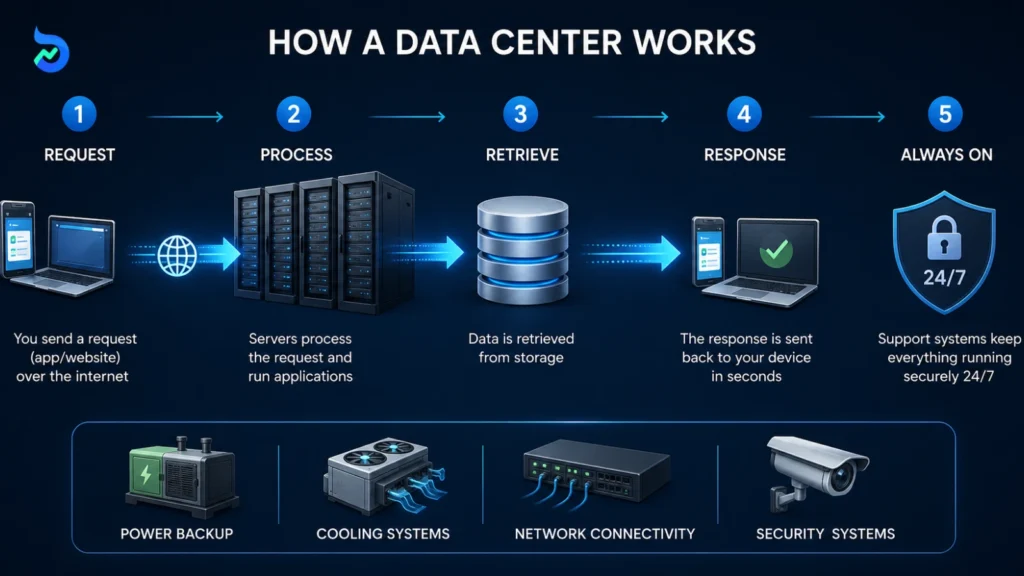
A data center is a place where digital information is stored, processed, and managed so that apps and online services keep running smoothly.
What Does a Data Center Contain?
A data center is not just computers. It includes:
- Servers that process data
- Storage systems that save information
- Networking equipment that connects everything to the internet
- Power backup to avoid downtime
- Cooling systems to prevent overheating
- Security systems to protect data
How has it evolved?
- Earlier: Used mainly by companies to store records and run internal systems
- Now: Powers cloud services, mobile apps, UPI payments, OTT platforms, stock trading apps, cybersecurity systems, and AI tools
Types of data centers
- Small data center: Supports one company or limited users
- Hyperscale data center: Supports millions of users, large businesses, and advanced AI workloads
What makes a good data center?
Modern data centers are judged based on:
- Reliability (runs without interruption)
- Speed (fast data processing)
- Security (protects sensitive data)
- Efficiency (manages power and cooling well)
- Scalability (can grow as demand increases)
Evolution of Data Centers in India
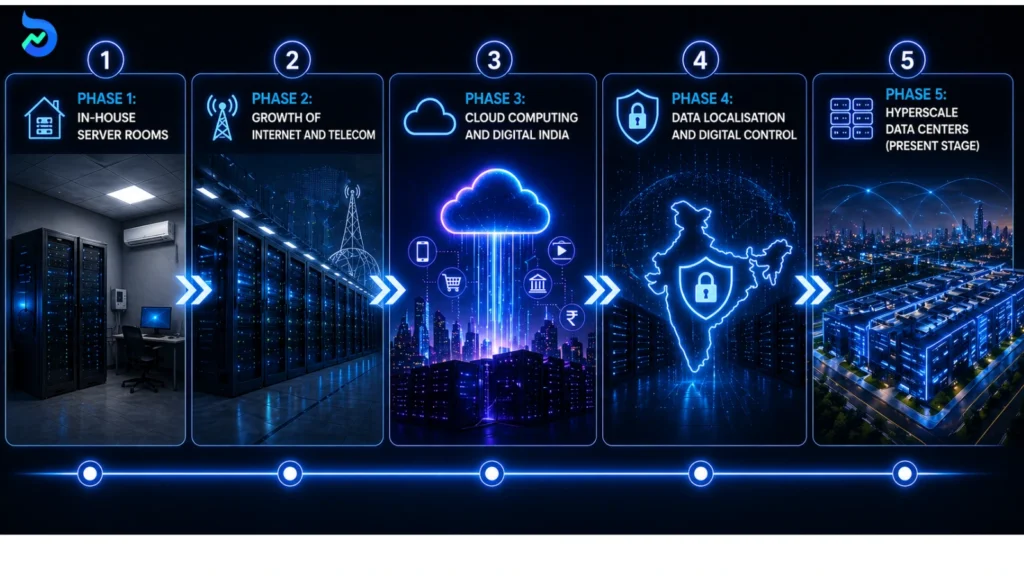
Phase 1: In-House Server Rooms
In the early days, companies in India kept their own data inside office buildings. Banks, telecom companies, IT firms, and government offices had small server rooms.
These setups worked at that time but had limitations:
- Limited storage and capacity
- Basic cooling and backup systems
- High risk of downtime during power or system failure
As internet usage and digital services grew, this model became difficult to scale.
Phase 2: Growth of Internet and Telecom
As the internet and telecom sectors expanded, companies needed better systems to handle growing data.
Key industries like banking, telecom, IT services, and government digitization increased demand.
This led to:
- Professionally managed data centers
- Focus on uptime and reliability
- Use of third-party facilities (colocation)
Phase 3: Cloud Computing and Digital India
With cloud computing, companies no longer needed to own all hardware.
They could rent storage and computing power, making things more flexible and cost-effective.
At the same time, India saw rapid digital growth through:
- Fintech and digital payments
- E-commerce and OTT platforms
- Government initiatives like Digital India
This increased demand for fast and always-available infrastructure.
Phase 4: Data Localisation and Digital Control
Government policies started focusing on keeping data within India.
The Data Centre Policy 2020 highlighted the importance of building infrastructure locally.
Data centers were now seen as:
- Critical for national security
- Important for financial systems and governance
- Key to reducing dependence on foreign infrastructure
Phase 5: Hyperscale Data Centers (Present Stage)
Today, India is in the hyperscale phase.
These are massive data centers that support millions of users, cloud platforms, and AI workloads.
Key trends:
- Capacity grew from ~375 MW (2020) to ~1,500 MW (2025)
- Expected to reach ~4 GW by 2030
- Driven by cloud, AI, and digital services
The takeaway is simple: India’s data centers have moved from small office rooms to large-scale digital infrastructure that powers the entire economy.
India’s Main Data Center Hubs
India’s data centers are built in specific cities for a reason. Each location offers something unique, whether it is connectivity, business demand, or access to power and infrastructure.
Major Data Center Cities
- Mumbai and Navi Mumbai
- Chennai
- Delhi-NCR and Noida
- Hyderabad
- Bengaluru
- Pune
- Visakhapatnam (emerging)
Mumbai: Financial and Connectivity Hub
Mumbai is India’s largest data center market. It is strategically important because:
- It connects India to global internet cables (international data flow)
- It is the financial capital, so banks and trading platforms rely on it
- It has strong demand from large enterprises and cloud companies
According to CBRE Group, Mumbai has around 670 MW capacity, making it the backbone of India’s digital infrastructure.
Chennai: Gateway to Global Data
Chennai plays a key role because of its coastal location.
- Houses major undersea cable landing stations
- Acts as a gateway for international data traffic
- Ideal for companies needing global connectivity
Delhi-NCR and Noida: Government and Enterprise Hub
This region is important for:
- Government data and public digital services
- Large enterprises and corporate offices
- Strong policy and regulatory ecosystem
It is strategically positioned close to decision-making centers.
Hyderabad: Emerging Tech Infrastructure Hub
Hyderabad is growing fast because:
- It offers cheaper land and power compared to Mumbai
- Strong support from the state government
- Attracting large cloud and tech investments
It is becoming a cost-efficient alternative for expansion.
Bengaluru: Technology and Startup Hub
Bengaluru’s strength comes from:
- India’s largest tech and startup ecosystem
- High demand for cloud, AI, and SaaS infrastructure
- Presence of global tech companies
It is where innovation drives data demand.
Pune: Overflow and Backup Hub
Pune benefits from being close to Mumbai.
- Used as a backup and disaster recovery location
- Lower costs compared to Mumbai
- Growing enterprise demand
It supports Mumbai rather than replacing it.
Visakhapatnam: The Next Big Bet
Visakhapatnam is emerging as a new hub.
- Located on the eastern coast, balancing India’s west-heavy infrastructure
- Strong potential for new cable connections
- Large-scale land availability for future expansion
Its strategic role is to create a new digital corridor on the east coast, reducing pressure on cities like Mumbai and Chennai.
Big Picture
Around 90% of India’s data center capacity is still concentrated in Mumbai, Chennai, Delhi-NCR, and Bengaluru.
Simple takeaway: Each city plays a different role. Some connect India to the world, some serve businesses and government, and others support growth and backup. Together, they form the backbone of India’s digital economy.
State Policies and Incentives
India’s data center growth is now a state-level race. Different states are offering unique benefits to attract large investments.
Which states are leading?
- Maharashtra
- Tamil Nadu
- Telangana
- Uttar Pradesh
- Karnataka
- Andhra Pradesh
What do data centers actually need?
It’s not just land. They need:
- Reliable 24/7 electricity
- Strong internet connectivity
- Water for cooling
- Renewable energy access
- Fast approvals and clear policies
States that solve these problems better attract more investment.
What each state is doing differently
Maharashtra: Strong ecosystem advantage
- India’s most mature data center market
- Policies support large-scale infrastructure projects
- Close to financial institutions and global connectivity
Strategic edge: Ready demand + strong infrastructure
Tamil Nadu: Renewable energy focus
- Dedicated data center policy
- Easy land access and faster approvals
- Strong push for renewable energy usage
Strategic edge: Green energy + coastal connectivity
Telangana: Speed and ease of doing business
- Single-window clearance system
- Quick approvals for large projects
- Focus on attracting global cloud players
Strategic edge: Faster setup and execution
Uttar Pradesh: Land and incentives
- Data center parks in Noida and Greater Noida
- Subsidies on land and infrastructure
- Strong focus on attracting large campuses
Strategic edge: Large land availability near Delhi
Karnataka: Tech-driven demand
- Policy support for digital infrastructure
- Close to Bengaluru’s tech ecosystem
- Demand from startups, SaaS, and AI companies
Strategic edge: High demand from innovation ecosystem
Andhra Pradesh: Power flexibility model
Andhra Pradesh has introduced the “Deemed Distribution Company” policy.
This allows large data centers (300 MW+) to:
- Build and manage their own power systems
- Source electricity from multiple sources, including renewables
- Control power usage within their campus
It also requires 51% renewable energy usage.
Strategic edge: Flexible and reliable power access
Why this matters
Power is the biggest challenge for modern data centers, especially AI-focused ones.
States that can provide:
- Reliable electricity
- Renewable energy options
- Faster approvals
All this will attract the biggest investments.
Simple takeaway
Each state is competing in its own way. Some offer better infrastructure, some faster approvals, and some smarter energy policies. The winners will be the ones who can combine all three.
The AI Era: Data Centers Become Strategic Infrastructure
AI has completely changed what data centers are meant to do.
Earlier, data centers were mostly used for storing data, running apps, and supporting cloud services. Important, but still behind-the-scenes. Now with AI, they’ve moved to the center of the story.
Why? Because AI needs a very different kind of infrastructure.
Instead of basic servers, AI data centers require:
- Powerful GPUs for heavy computation
- High-density racks to handle more machines in less space
- Advanced cooling systems to manage heat
- Strong and stable power supply
- Ultra-fast, low-latency connectivity
- Ability to process massive amounts of data continuously
Simply put, AI workloads consume far more power and resources than traditional cloud systems.
India is also stepping in to build its own AI capacity. According to the Press Information Bureau, around 38,231 GPUs have already been onboarded through 14 approved service providers and data centers.
What’s interesting is how this capacity is being used. These GPUs are being offered to startups, researchers, and academic institutions at a subsidized rate of about Rs. 65 per hour, which is roughly one-third of global costs.
This matters more than it seems.
AI leadership is not just about having talent or good ideas. It depends heavily on access to affordable computing power. Without that, startups cannot train models, researchers cannot experiment, and innovation slows down.
In simple terms, if data is the fuel, then compute is the engine. And today, data centers are where that engine lives.
Suggested Read: Top AI Mutual Funds in India 2026: Best Investment Options
Google’s $15 Billion (Rs. 1.25 lakh crore) AI Data Center Hub in Visakhapatnam
Let’s break this down together, because this is not just another announcement.
On April 28, 2026, N. Chandrababu Naidu laid the foundation for what could become one of India’s most important digital infrastructure projects. We’re talking about a $15 billion (Rs. 1.25 lakh crore) investment, spread over five years, across ~601 acres in Visakhapatnam.
Now pause for a second. A 1 GW data center is not a normal facility. That’s hyperscale. Add to that three campuses, and partnerships with Google Cloud, AdaniConneX, and Airtel Nxtra, and you start seeing the scale of what’s being built here.
So what are we really looking at?
- First, this is India moving from being a user of global tech infrastructure to becoming a creator of it. A gigawatt-scale AI hub means serious compute power sitting within the country.
- Second, notice the location choice. Visakhapatnam isn’t a traditional hub like Mumbai or Chennai. This signals a shift. We’re not just expanding capacity, we’re expanding geography and creating a new east coast corridor.
- Third, look at how everything is being bundled together. Cloud, AI, subsea connectivity, and compute infrastructure are being built as one ecosystem. That’s very different from earlier models where these pieces evolved separately.
And finally, think about who benefits. This kind of infrastructure doesn’t just serve big tech. It enables startups, researchers, enterprises, and digital platforms that need high-performance computing.
There’s also a direct economic angle. Reports suggest around 3,000 technical jobs could be created once operational, expected by September 2028.
If you step back, this isn’t just a large investment. It’s a signal of where India’s digital future is heading.
Suggested Read: FII Data vs DII Data Trends: Why FIIs Are Tragically Exiting Indian Markets in 2026
Why Visakhapatnam Matters
Let’s look at this logically.
Why would a city like Visakhapatnam suddenly come into focus for something as complex as AI data centers?
Start with geography. Visakhapatnam is a coastal city, which means it can support subsea cable connectivity. That’s critical because global internet traffic flows through these cables. Add to that its port infrastructure, and you get easier movement of equipment and faster project execution.
Now layer in the practical advantages.
- Large land availability for building hyperscale campuses
- Renewable energy potential to support high power demand
- Strong state government support for long-term projects
Individually, these are useful. Together, they make the city strategically strong.
Then comes the bigger piece. The project linked to Google Cloud includes plans for a new international subsea gateway. That’s not a small upgrade. It improves global connectivity and positions Visakhapatnam as a serious node in international data traffic.
Now think about the ambition. Andhra Pradesh is targeting around Rs. 6.32 lakh crore ($75+ billion) in investments and aims to build 6 GW of data center capacity. That’s massive.
And it’s not just one company showing interest. Names like Reliance Industries, Bharti Airtel, Tata Communications, Sify Technologies, and CtrlS Datacenters are all part of the conversation.
So what does this really mean?
If everything comes together as planned, Visakhapatnam won’t just be a place where data is stored. It could evolve into a full digital infrastructure cluster; where data centers, power systems, global connectivity, equipment ecosystems, skilled jobs, and AI services all exist in one place.
That’s when a city stops being a location and starts becoming a hub.
Suggested Read: Top AI Startups Driving India’s Explosive AI Development in 2026
Economic Impact of Data Centers
- Capital Investment Boost: Data centers require heavy upfront investment in land, construction, power systems, cooling, networking, and security, bringing large-scale capital into the economy.
- Job Creation Across Sectors: They generate employment in areas like engineering, operations, facility management, cybersecurity, electrical systems, and cloud infrastructure.
- Ecosystem Development: Data centers create demand for multiple supporting industries such as manufacturing, logistics, real estate, and power services.
- Supply Chain Expansion: Building and running data centers requires equipment like servers, cables, transformers, cooling systems, chips, and fiber networks, strengthening the overall supply chain.
- Enterprise and Cloud Attraction: Availability of local infrastructure attracts global cloud providers and enterprises, helping businesses operate more efficiently with faster data access.
- Digital Economy Growth: Data centers support key sectors like fintech, banking, healthcare, education, and AI by providing the infrastructure needed for digital services.
- Foreign Investment Inflow: Large-scale data center projects attract international investors looking to participate in India’s growing digital market.
- Technology Capability Growth: They help India build stronger capabilities in advanced technologies like AI, cloud computing, and large-scale digital systems.
Challenges in India’s Data Center Growth
- Power Demand and Reliability: Data centers need constant, uninterrupted electricity. AI data centers need even more power because GPUs consume high energy. This makes grid reliability, power transmission, renewable sourcing, and backup systems critical.
- Cooling and Heat Management: Servers generate heat, and AI workloads generate even more. Cooling systems are essential but consume large amounts of electricity and water, making efficiency a major concern.
- Rising Energy and Water Consumption: According to Council on Energy, Environment and Water, data centers used about 0.5% of India’s electricity and 15,000 crore litres (150 billion litres) of water annually in 2025. Both are expected to more than double by 2030, with electricity demand rising from ~13 TWh to ~57 TWh.
- Land and Approvals: Setting up large data centers requires significant land and multiple approvals. Delays in land acquisition and regulatory clearances can slow down projects.
- Cybersecurity and Data Protection: Data centers must be secure both physically and digitally. They handle sensitive financial, personal, and enterprise data, making cybersecurity a top priority.
- Skilled Manpower Gap: Operating advanced data centers requires skilled professionals in areas like cloud, AI infrastructure, and cybersecurity, which is still a developing talent pool.
- Regulatory and Compliance Requirements: Data centers must follow strict Indian regulations around data protection, cybersecurity, and sector-specific rules, adding complexity to operations.
Simple takeaway: While the opportunity is huge, solving power, cooling, infrastructure, and regulatory challenges will decide how fast India can scale its data center ecosystem.
Sustainability: The Next Big Test
When we talk about data centers, it’s easy to focus only on size and investment. But that’s just one side of the story. The real question is, how sustainable is this growth?
Data centers consume a lot of power and water. So their long-term impact depends on a few key things: where they are built, how they source electricity, what kind of cooling they use, and how efficiently they operate.
Now this is where things get interesting.
To make data centers more sustainable, companies are starting to look at:
- Renewable energy agreements instead of traditional power
- Captive renewable sources like solar and wind
- Battery storage for better energy management
- Advanced cooling methods like liquid cooling
- Water-efficient cooling systems
- Smarter building design
- Reusing excess heat
- Using AI to optimize energy usage
And this is not just happening at a company level. Policy is stepping in too.
Take Andhra Pradesh’s “deemed discom” model. It requires large data centers to source at least 51% of their energy from renewable sources. That’s a clear attempt to link infrastructure growth with clean energy planning.
So if we step back, the future of this sector won’t be decided only by who builds the biggest data centers.
It will be decided by who can build infrastructure that is reliable, cost-efficient, fast, and sustainable at the same time.
India Compared With Global Markets: 2026 Status Update
Let’s step back and look at where India stands globally. This is where things get interesting.
India has caught up with the world in terms of internet users and smartphone adoption. But when it comes to data centers, it is still behind.
For example, India has only about 1–1.2 MW of data center capacity per million users, while the global average is 5 MW. Compare that with China (4 MW) and the United States (51 MW), and the gap becomes clear.
So the issue is not demand. The issue is supply.
India currently contributes only around 4% of global data center capacity, with about 1.2 GW in 2025, expected to reach 4 GW by 2030. That tells us one thing: India is still early in its growth cycle.
Now look at global leaders. Northern Virginia, the largest data center market, already has 3,046 MW capacity with almost no vacancy. That level of scale comes from strong power, connectivity, and enterprise demand.
Other markets offer lessons too. Singapore had to pause data center expansion due to power and water constraints. Ireland saw data centers consume 22% of its electricity in 2024.
So what does this mean for India?
The opportunity is huge. But execution will decide everything.
India’s advantage lies in its scale, talent, and rising digital demand. But to compete globally, it must solve four key challenges: power, connectivity, approvals, and sustainability.
Because in this space, growth is not just about building more. It’s about building right.
The Future of Data Centers in India: What Is Actually Being Built
India’s next phase of data center growth is no longer theoretical. It is already being shaped by large-scale investments, government policy, and concrete infrastructure projects across multiple states.
According to the Government of India, nearly Rs. 5.8 lakh crore (USD 70 billion) worth of data center investments are already underway, with an additional Rs. 7.5 lakh crore (USD 90 billion) in announced projects. This places India in one of its largest infrastructure expansion cycles in digital infrastructure.
Between March 2025 and April 2026 alone, operators announced around 30 large data center projects, adding approximately 3.5 GW of planned capacity. This indicates that future capacity is not just expected, it is already being committed.
Shift Toward AI-First Infrastructure
The biggest structural change is the transition from cloud-focused infrastructure to AI-focused infrastructure.
India’s AI market is expected to reach ~Rs. 1.90–2.09 lakh crore (USD 20–22 billion) by 2027, driven by enterprise adoption, public sector use cases, and startup innovation. This shift is increasing demand for:
- High-density compute clusters
- GPU-based infrastructure
- Advanced cooling systems
- Gigawatt-scale power availability
The most visible example is the 1.42 lakh crore (USD 15 billion) AI hub in Visakhapatnam, where a 1 GW hyperscale AI data center campus is being developed across multiple locations with global partnerships.
This is not an isolated case. Companies such as Google, Microsoft, and Amazon are each building or planning large multi-billion-dollar facilities in India, while firms like Meta are exploring partnerships for similar infrastructure.
Emergence of Multi-Gigawatt Data Center Clusters
India is moving from individual facilities to cluster-based development.
Visakhapatnam is being positioned as a large-scale data center corridor, with:
- Planned investments of around Rs. 6.32 lakh crore
- Target capacity of 6 GW, which exceeds India’s current total capacity
- Participation from companies such as Google, Reliance Industries, Bharti Airtel, Tata Data Center, Sify, and CtrlS
Similarly, private developers are building large campuses. For example:
- Lodha Developers is planning a 1 GW data center in Palava near Mumbai
- Reliance is working on a large data center project in Jamnagar
- AdaniConneX continues to expand across multiple cities
- Sify is developing AI-focused data center campuses such as its project in Lucknow
This reflects a shift from scattered infrastructure to integrated, high-capacity digital ecosystems.
Expansion Beyond Metro Cities
Future growth is not limited to Mumbai, Chennai, and Delhi-NCR.
New projects are being planned in:
- Visakhapatnam
- Lucknow
- Bhopal
- GIFT City in Gujarat
- Navi Mumbai expansion zones
For example, CtrlS is building an AI-ready facility in Bhopal, while Sify is developing an AI hub in Lucknow to support regional demand.
This expansion into Tier 2 and emerging cities is driven by:
- Lower land costs
- Availability of large contiguous land parcels
- State-level incentives
- Need to reduce latency across regions
This marks the beginning of distributed infrastructure rather than centralized clusters.
Integration of Energy Infrastructure with Data Centers
Power is becoming the defining constraint and design variable for future data centers.
The Union Budget 2026 linked data center growth with:
- Battery Energy Storage Systems (BESS)
- Renewable energy integration
- Industrial cluster development
- Tax incentives for infrastructure development
At the state level, Andhra Pradesh introduced a policy allowing large data centers to operate as “Deemed Distribution Companies,” enabling:
- Flexible power sourcing
- Captive and renewable energy usage
- Dedicated internal distribution networks
- Mandatory renewable energy usage of at least 51%
This shows that future data centers in India will be co-designed with energy infrastructure rather than treated as standalone IT assets.
Hyperscaler-Led Expansion
Global cloud providers are driving a large share of future investments.
Recent developments include:
- Amazon Web Services planning a Rs. 3,600 crore ($429 million) data center near Navi Mumbai on a 49-acre site
- Google’s multi-billion-dollar AI infrastructure build-out in Andhra Pradesh
- Ongoing expansion plans by Microsoft and other global cloud providers
This trend is important because hyperscalers bring long-term capital, advanced technology, and global demand pipelines.
Industrial Ecosystem Around Data Centers
Future data center growth in India is not limited to hosting infrastructure.
The ecosystem being built includes:
- Manufacturing of racks, transformers, cooling systems, and components
- Development of semiconductor and chip supply chains
- Growth of engineering, construction, and facility management services
- Expansion of fiber networks and subsea cable infrastructure
The Visakhapatnam cluster, for example, is expected to integrate manufacturing and digital infrastructure into a single ecosystem, supporting both data processing and supply chain development.
Scale of Future Growth
Industry estimates suggest that India’s data center capacity could grow multiple times by 2030.
Some projections include:
- Capacity expected to cross 2 GW by 2026 and potentially exceed 8 GW by 2030
- Sector projected to attract over Rs. 2.84 lakh crore (USD 30 billion) in capital expenditure over the next few years
- Long-term ambition of up to Rs. 18.96 lakh crore (USD 200 billion) in investments as India positions itself as a global AI infrastructure hub
These projections are supported by real announcements and policy direction, not just demand forecasts.
What This Means
India’s data center future is no longer defined by incremental growth.
It is being shaped by:
- Gigawatt-scale AI infrastructure
- Multi-billion-dollar investments
- Cluster-based development models
- Integration with renewable energy systems
- Expansion into new geographic regions
- Strong participation from global hyperscalers
The shift is structural. Data centers are moving from being support infrastructure to becoming a core layer of India’s digital economy.
The next phase will not be about whether India builds data centers. It will be about how quickly it can execute these large-scale plans and convert announced capacity into operational infrastructure.
Bottom Line
If you step back and look at the full picture, one thing becomes clear. India is not just expanding its data center capacity. It is redefining its digital backbone.
From small in-office server rooms to gigawatt-scale AI campuses, this journey reflects how fast the country has moved. What started as basic storage infrastructure has now become the foundation for AI, cloud, fintech, and the entire digital economy.
But this is still an early stage.
India has the demand, the talent, and the digital adoption to lead globally. What will decide the outcome is execution. Power availability, sustainable design, faster approvals, and strong connectivity will shape how quickly this vision becomes reality.
Projects like the Visakhapatnam AI hub show what is possible when infrastructure, policy, and investment come together.
The shift is no longer gradual. It is structural.
Data centers are no longer behind-the-scenes systems. They are becoming the core layer on which India’s next decade of growth will run.
The real opportunity is not just to build more, but to build smarter, faster, and sustainably.
Disclaimer: This article is for informational and educational purposes only and should not be considered investment, financial, legal, or technical advice. The information is based on publicly available sources believed to be reliable, but no guarantee is made regarding its accuracy or completeness. Any company or project mentioned is purely for illustration and not a recommendation. Readers should do their own research or consult professionals before making decisions.
FAQs
Is Google investing $15 BN to build AI data hub in India?
Yes. Google is investing about $15 billion (Rs. 1.25 lakh crore) to build a large AI data center hub near Visakhapatnam. The project includes a 1 GW hyperscale facility, multiple campuses, and global connectivity infrastructure. It is expected to strengthen India’s AI and cloud ecosystem and improve access to high-performance computing.
Is there any AI hub in India?
Yes, India is actively building AI hubs. The Visakhapatnam AI hub is one major example. In addition, cities like Bengaluru, Hyderabad, and Delhi-NCR host strong AI ecosystems with startups, research labs, and cloud infrastructure. Government initiatives like IndiaAI Mission are also supporting AI development across academia, startups, and enterprises.
Who are the big 4 of AI?
Globally, the “big 4” in AI typically include Google, Microsoft, Amazon, and Meta Platforms. These companies lead in AI research, cloud computing, and large-scale infrastructure, and are investing heavily in data centers, AI models, and enterprise AI solutions.
Which are the top 5 AI companies in India?
Some leading AI companies in India include Tata Consultancy Services, Infosys, Wipro, HCLTech, and Tech Mahindra. These firms are heavily investing in AI services, enterprise solutions, and global AI deployments.
Which is the highest paid job in AI?
One of the highest-paid roles in AI is an AI/ML Engineer or AI Research Scientist. These professionals design models, build AI systems, and work on advanced technologies. Salaries are high due to strong demand and limited skilled talent, especially in areas like deep learning, generative AI, and large-scale AI infrastructure.