
Most traders open the option chain and jump straight to one question: which strike should I pick?
But the traders who actually survive and grow don’t start there. They pause and ask something far more uncomfortable: does today even deserve a trade?
It sounds like a small shift. It’s not. It’s the difference between reacting to the market and reading it. Between trading out of habit and trading with intent.
Here’s the hard truth most people ignore. Not every market condition is worth your money. Some days are noisy, directionless, or simply stacked against you. And forcing a trade on those days? That’s where most losses quietly build up.
Consistent Nifty options traders understand this early. They spend less time hunting for the “perfect strike” and more time filtering out bad days altogether. Because sometimes, the best trade is no trade.
If you’ve been searching for a Nifty options trading strategy, wondering how to trade Nifty options more consistently, or looking for a solid pre-trade checklist, this is where it actually starts.
Not with entry. Not with indicators.
But with one simple decision: should you even be trading today?
Why a Pre-Trade Framework Matters More Than Any Setup
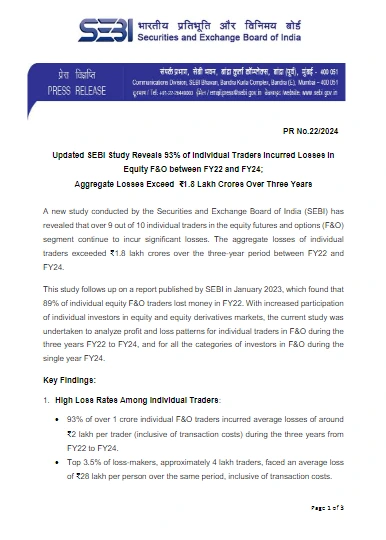
The uncomfortable reality is backed by data from the Securities and Exchange Board of India (SEBI):
- Over 90% of individual F&O traders make net losses
- Aggregate losses crossed ₹1.8 lakh crore in 3 years
- Losses are increasing year-on-year
But here’s the part most traders miss:
The minority that makes money is not using “secret strategies.”
They are:
- Trading fewer times
- Avoiding low-probability environments
- Following a structured decision process before entry
In other words, their edge comes from what they don’t trade.
This 4-step framework is that filter.
Suggested Read: Best Time to Trade Commodities in India: Market Timings, Active Hours, and Smart Trading Windows (2026)
Step 1: Check India VIX Percentile, Not Just the Number
India VIX is often called the “fear gauge” of the market. But for options traders, it’s more practical than that.
It tells you one simple thing:
Are options expensive right now, or cheap?
The Mistake Most Traders Make
They look at VIX = 15 or 18 and assume they understand volatility.
But a VIX of 15 could be:
- High (if the recent range is 10-14)
- Low (if the recent range is 14-22)
Suggested Read: India VIX Levels Fluctuating: Rising Volatility Signals Growing Global Market Fear in 2026
What You Should do Instead
Compare today’s VIX with its last 30-day range.
How to Interpret It
1. High VIX (Above ~70th percentile)
- Options premiums are inflated
- Option sellers get better credit for same risk
- Option buyers need a larger move to break even
- Risk of IV crush if volatility falls
2. Low VIX (Below ~30th percentile)
- Options are relatively cheap
- Buyers get better risk-reward
- Sellers collect smaller premiums
- Lower risk of volatility collapsing
Why this Matters Practically
Let’s say you’re buying a Nifty call:
- At high VIX, even if Nifty moves in your direction, you may not make money because premium drops (IV crush)
- At low VIX, even a moderate move can give good returns
2026 Context
With global tensions and crude volatility, VIX stayed elevated for long periods. Traders who ignored this ended up overpaying for options repeatedly.
This single check decides your strategy bias before you even open the option chain.
Step 2: Check FII Positioning in Index Futures
Markets are not just charts moving up and down. They are a reflection of where large money is positioning itself. And institutions drive that positioning.
Every day, data from the National Stock Exchange shows how FIIs are positioned, especially in index futures. This is one of the clearest windows into what big money is expecting next.
What to Look At
Whether FIIs are net long or net short in index futures.
A net long position signals a bullish bias. A net short position indicates a bearish stance. It is not about predicting the exact move. It is about understanding the direction institutions are leaning toward.
Why Index Futures Matter
Options data can often be noisy. Positions are hedged, layered, and sometimes misleading.
Futures, on the other hand, are more straightforward. They represent direct bets on market direction. When FIIs build positions here, they are putting real conviction behind their view.
That is why index futures positioning often gives a cleaner, more reliable sense of market bias compared to most other indicators.
Suggested Read: FII Data vs DII Data Trends: Why FIIs Are Tragically Exiting Indian Markets in 2026
How to Interpret It
Here’s a clean comparison table:
| Aspect | FII Net Short | FII Net Long |
| Positioning | Institutions positioned for downside | Institutions positioned for upside |
| Market Sentiment | Cautious to bearish | Positive to bullish |
| Impact on Price | Downward pressure or resistance on upside | Supports upward moves |
| Retail Perspective | Buying calls goes against institutional flow | Buying calls aligns with institutional flow |
Important Nuance
This is not a prediction tool.
It does not mean: “The market will fall because FIIs are short “.
It simply means this: large players are already positioned in a certain direction. If you’re planning to take the opposite side, you’re not just trading the market, you’re trading against that positioning.
And that’s fine, but it should be a conscious decision, not an accidental one.
Why this Matters More Than You Think
SEBI data highlights that a significant portion of institutional profits comes from systematic and algorithmic trading.
Retail traders often:
- Trade based on price movement alone
- Ignore positioning data
- Enter crowded trades late
This step helps you avoid being on the wrong side of momentum without knowing it.
Step 3: Select Strategy by Confluence, Not by Prediction
This is the step where everything comes together.
Most traders ask: “Where will Nifty go today?“
Consistent traders ask: “Does the environment support my strategy?“
What is Confluence?
Confluence simply means everything lining up before you take a trade.
- Volatility (VIX) tells you how expensive or risky the trade is
- Positioning (FII data) shows what large players are doing
- Your directional view is your own market read
When all three point in the same direction, the trade has context, not just conviction.
How it Works in Practice
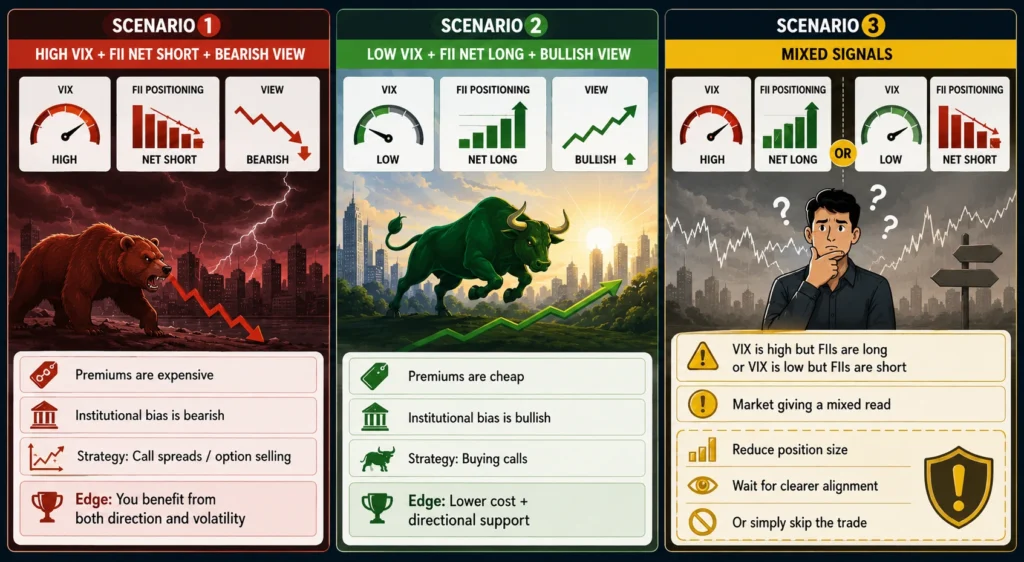
Scenario 1: High VIX + FII Net Short + Bearish View
- Premiums are expensive
- Institutional bias is bearish
- Strategy: Call spreads / option selling
- Edge: You benefit from both direction and volatility
Scenario 2: Low VIX + FII Net Long + Bullish View
- Premiums are cheap
- Institutional bias is bullish
- Strategy: Buying calls
- Edge: Lower cost + directional support
Scenario 3: Mixed Signals
- VIX is high but FIIs are long
- Or VIX is low but FIIs are short
This is where things get tricky. The market isn’t giving a clean read.
And this is exactly where most traders still go all in, trying to force a trade out of confusion.
Consistent traders don’t.
They treat mixed signals as a warning, not an opportunity.
- Reduce position size
- Wait for clearer alignment
- Or simply skip the trade
Because when the market itself is unsure, the smartest move is to stay patient, not aggressive.
Key Shift in Thinking
Stop trying to force trades.
Start aligning with the market.
When conditions are clear, you act.
When they’re not, you step back.
Consistency comes from patience, not constant action.
Strike Selection Comes Last
- ATM vs OTM
- Distance from spot
- Expiry
All of that is secondary.
If the environment is wrong, the strike doesn’t save you.
Suggested Read: Intraday Trading Guide 2026: Best Indicators, VWAP Strategies & Time Frames for NSE Stocks
Step 4: Define Exit Rules Before You Enter
This is the most ignored step – and the most important.
SEBI data shows:
- Retail traders hold losing trades longer than winners
- Decisions are emotional, not structured
| The Real Problem | The Solution |
| Decisions are made after the trade starts going wrong. | Define exit conditions before entering the trade |
Good Exit Rules Look Like This
- “Exit if VIX drops 15% against my position”
- “Exit if loss reaches 30% without IV support in 2 sessions”
- “Exit if price breaks key level + no follow-through”
Why this Works
- Removes emotional decision-making
- Converts uncertainty into rules
- Protects capital during wrong trades
A Practical Example
You sell a call in high VIX expecting premium decay.
But:
- VIX drops sharply
- Premium collapses faster than expected
If you don’t have a rule, you’ll hold hoping for reversal.
If you have a rule, you exit mechanically.
That difference protects your account over time.
The 10-Minute Pre-Market Routine
| Time | Action | What You’re Doing |
| 8:35 AM | Check VIX | Compare India VIX with its 30-day range to understand volatility |
| 8:40 AM | Check FII Data | Review index futures positioning to see where big money is leaning |
| 8:45 AM | Decide Strategy | Use confluence to decide whether to trade and in which direction |
| 8:50 AM | Set Exit Rule | Clearly write your stop loss or exit condition before entering |
| 9:15 AM | Execute Trade | Enter the trade only if all conditions are aligned |
That’s it. No indicators. No noise. No guesswork.
What This Framework Really Does
Here’s a clean table version:
| What It Doesn’t Do | What It Does |
| Predict the market | Reduce low-quality trades |
| Guarantee profits | Improve decision consistency |
| Eliminate losses | Align strategy with market conditions |
Suggested Read: How to Start F&O Trading in 2026? Unlock the Confidence to Trade Like a Pro
Final Takeaway for Nifty Options Traders
Let’s be honest. Most traders are obsessed with one thing:
“What’s the best Nifty options strategy right now?”
New strategy. New indicator. New setup. Same cycle.
But here’s the part nobody tells you. The problem usually isn’t your strategy. It’s when you’re using it.
Think about it. Even the best strategy fails on the wrong day. Sideways market, high volatility, conflicting signals… and you’re still trying to force trades like something has to work.
It doesn’t.
Consistent traders flip the question completely. Instead of chasing better entries, they ask:
“Does today even make sense to trade?”
That one question changes everything.
Because suddenly, you’re not reacting to the market. You’re filtering it. You’re choosing when not to participate. And that’s where most losses quietly disappear.
The real edge in options trading isn’t finding the perfect trade. It’s avoiding the unnecessary ones.
Better filters beat better entries. Every single time.
So the next time you open your chart, don’t rush to trade.
Pause. Look at the conditions.
And ask yourself: Is today even worth it?
Disclaimer: Investments in securities market are subject to market risks. Read all the related documents carefully before investing. The securities are quoted as an example and not as a recommendation.
This blog is intended for educational purposes only and does not constitute investment advice or a solicitation to trade. Options trading involves significant risk and may not be suitable for all investors. Always evaluate your risk appetite and consult a qualified financial advisor before making any trading decisions.
FAQs
What are the 4 major trading sessions?
In India, markets run in one session (9:15 AM-3:30 PM IST), but globally traders track four major sessions: Sydney, Tokyo, London, and New York. These matter because global cues, especially from US and European markets, often influence Nifty’s opening direction and intraday volatility.
What are the 4 basic options strategies?
The four basics are: Long Call (bullish), Long Put (bearish), Covered Call (income on holdings), and Protective Put (downside protection). These form the foundation for more advanced strategies like spreads and straddles commonly used by Indian Nifty traders.
Which strategy is best for Nifty options?
There is no single “best” strategy. What works depends on market conditions. Trending markets may suit directional trades like calls or puts, while sideways markets favour spreads. Consistent Indian traders focus more on timing, volatility, and risk management than chasing one fixed strategy.
What is the 3-5-7 rule in trading?
The 3-5-7 rule is a risk management guideline. Risk only 3% capital per trade, limit total exposure to 5% at a time, and aim for at least 7% returns on winners. While not official, it helps Indian traders control losses and maintain discipline.