

Investing in top solar energy stocks is becoming a smart choice as India grows as a leader in clean energy. The country’s energy sector is worth about $70 billion, and solar power is one of the fastest-growing parts. India has set a big goal to reach 500 gigawatts of renewable energy by 2030, with solar power playing a key role.
The government is supporting this growth with helpful policies, and the cost of solar technology is going down. This means more people and businesses are using solar energy every day. Because of this fast growth, solar energy companies have a lot of opportunities to expand.
For investors, solar stocks offer good opportunities to earn money while also supporting cleaner energy for the planet. Knowing which companies are strong and how the market is changing can help you make better investment choices.
In this blog, we will look at the top solar energy stocks to watch in 2026. We’ll share details about how these companies are doing and what their future looks like.
If you want to invest in a growing and important industry, solar energy stocks could be a great option.
The Solar Energy Landscape in 2026
In March 2026, the solar energy landscape in India has moved from a period of “steady growth” to a full-scale industrial explosion. India has officially overtaken Japan to become the world’s third-largest solar producer, and it is on track to surpass the United States as the second-largest solar market by the end of this year.
The technology has matured rapidly; solar is no longer just “as affordable” as coal—it is now consistently the cheapest source of new power in the country, with storage-linked projects becoming the new gold standard for grid stability.
The 2026 Solar Milestone
As of early 2026, India’s installed solar capacity has surged past 140 GW, a massive jump from the 107 GW targets of early 2025. This momentum is part of a larger achievement where non-fossil fuel sources now account for over 50% of India’s total power capacity.
The 2026 Policy & Project Drivers
The growth is being fueled by a mix of massive utility-scale parks and a revolutionary push for household energy independence:
- PM Surya Ghar (Muft Bijli Yojana): This has been the real “game-changer” for 2026. The scheme has already reached over 3 million households, providing up to 300 units of free electricity and transforming rooftops across Tier 2 and Tier 3 cities into mini-power plants.
- PM-KUSUM Extension: The scheme for farmers has been extended through March 2026, with a fresh focus on “feeder-level solarization.” This allows entire agricultural grids to run on sun power, significantly reducing the subsidy burden on state DISCOMs.
- Solar-Plus-Storage: 2026 is the year where “plain vanilla” solar projects are being phased out in favor of BESS (Battery Energy Storage Systems). Major hubs like Adani’s Khavda project are setting global benchmarks for round-the-clock renewable energy.
- Manufacturing Self-Reliance: Under the PLI scheme and the ALMM-II mandate, India’s domestic module manufacturing capacity has hit a staggering 200 GW, making the country a global hub for solar exports.
State Leadership in 2026
While Rajasthan and Gujarat continue to battle for the top spot in total capacity—thanks to their massive desert solar parks—Maharashtra and Uttar Pradesh have emerged as the new leaders in the residential rooftop and solar pump categories.
What’s driving this growth?
- Government help and subsidies
- Falling prices of solar technology
- Companies wanting to be more environmentally friendly
- More people are learning about solar benefits
As India’s energy needs grow and solar becomes cheaper than traditional power in many areas, solar energy is ready to grow even faster.
Criteria for Selecting Top Solar Stocks
When evaluating solar energy stocks, here are the main factors investors should consider:
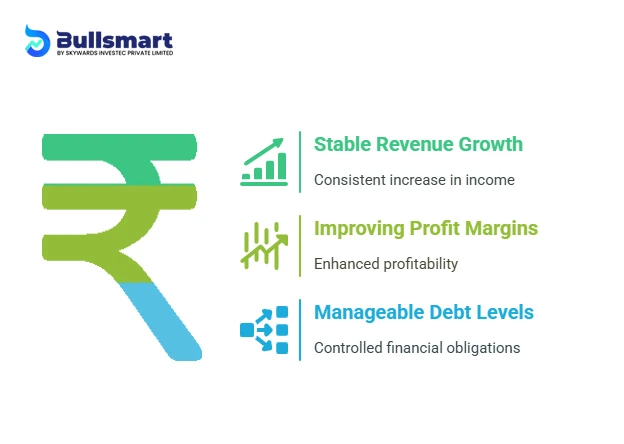
Financial Health
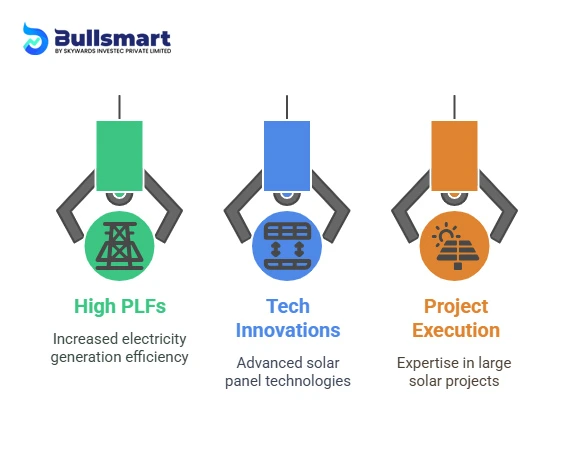
Operational Efficiency
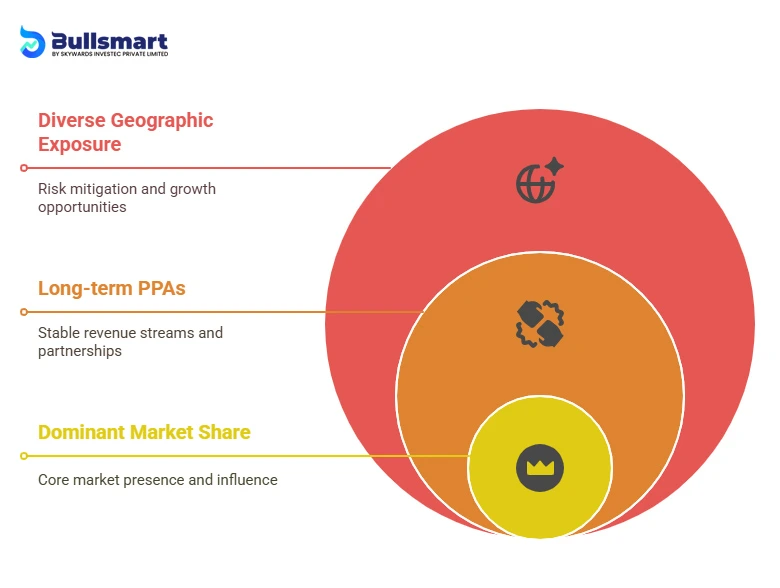
Market Position
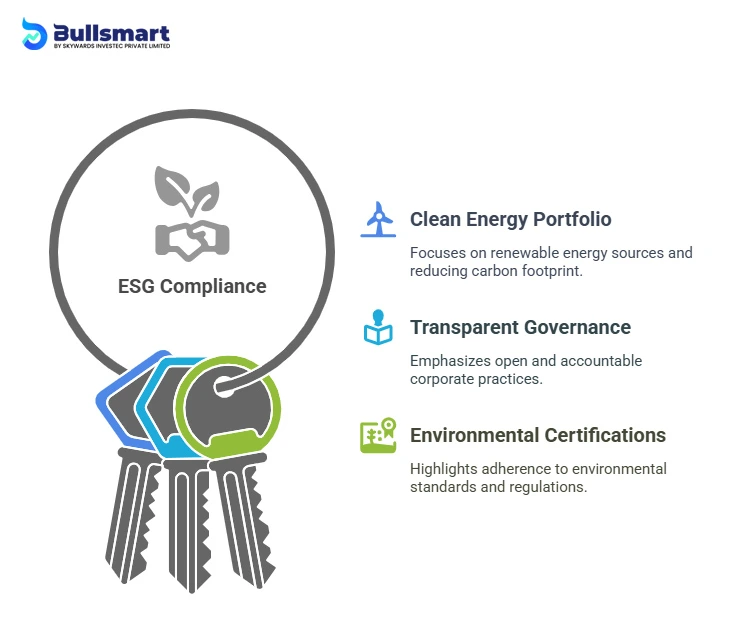
ESG Compliance
Top Solar Energy Stocks for 2026 in India
Below is a carefully curated list of the top 10 solar power stocks in India you can go for:
| Stock Name | Market Cap (in Cr.) | CMP | P/E Ratio | Dividend Yield |
| NTPC | 334680.37 | 345.15 | 15.28 | 2.25 |
| Power Grid Corpn | 277995.05 | 298.90 | 17.91 | 3.75 |
| Adani Power | 214195.13 | 555.35 | 16.81 | 0.00 |
| Adani Green | 156819.18 | 990.00 | 94.98 | 0.00 |
| Tata Power Co. | 129890.55 | 406.50 | 32.05 | 0.50 |
| Adani Energy Sol | 109605.02 | 912.40 | 49.07 | 0.00 |
| NHPC Ltd | 90425.47 | 90.02 | 33.33 | 2.14 |
| JSW Energy | 87370.92 | 499.90 | 44.76 | 0.41 |
| NTPC Green | 86706.93 | 102.90 | 251.56 | 0.00 |
| Torrent Power | 72564.55 | 1440.05 | 24.30 | 1.09 |
The data available is as of 16.05.25.
Emerging Trends and Opportunities in the Solar Sector
- Hybrid Energy Systems: Combining solar with wind and storage offers a consistent power supply and better capacity utilization.
- PM Surya Ghar Muft Bijli Yojana: Aims to install rooftop solar systems on 1 crore households. This will boost demand for modules and EPC services.
- Tech Innovations: Better battery storage, AI-powered grid management, and smart metering.
- Foreign Investments: Companies like BlackRock and Sembcorp are showing increased interest in Indian solar assets.
These trends are likely to redefine the solar landscape in 2026 and beyond.
Risks and Challenges in Solar Energy Investments
- Regulatory Hurdles: Sudden changes in tariff policies or import duties can affect profitability.
- Supply Chain Issues: Dependence on China for solar components like wafers and cells.
- Financial Volatility: Stocks can be affected by rising interest rates and financing delays.
- Infrastructure Constraints: Land acquisition, transmission availability, and local opposition can delay projects.
How to Invest in Solar Stocks: A Simple Guide
Investing in solar stocks can be a smart move as solar power continues to grow rapidly in India and globally. Here’s how to do it effectively:
1. Diversify Your Investments
Don’t put all your money in one company. Spread your investments across big solar players (large-cap) and growing ones (mid-cap) to balance risk and reward.
2. Think Long-Term
Look for companies with solid plans and projects lined up until 2030. These are more likely to benefit from India’s big push towards renewable energy.
3. Keep an Eye on Key Metrics
- Power Purchase Agreements (PPAs): Check the company’s backlog of PPAs. More agreements mean more future revenue.
- Module Efficiency: Companies that are improving their solar panel efficiency could have a competitive edge.
- Quarterly Earnings: Monitor earnings reports to see if the company is meeting its targets.
- Use Smart Investment Platforms: Stockbroking platforms offer ready-made portfolios focused on clean energy and solar stocks. These can help you invest in a group of solar companies with just one click.
By focusing on these strategies, you can tap into the growing solar sector while managing risks effectively.
Who Should and Who Shouldn’t Invest in Solar Energy Stocks
Who Should Invest
- Long-term Investors looking for sustained growth aligned with India’s 2030 green energy goals.
- ESG-Focused Portfolios that prioritize sustainability, clean energy, and ethical business practices.
- Retail Investors seeking to diversify beyond traditional sectors like banking or FMCG.
- Growth-Oriented Investors who are comfortable with medium-term volatility in exchange for high upside potential.
Who Should Avoid
- Short-term traders expecting quick returns, solar stocks may take time to reflect their true potential.
- Conservative Investors with low risk tolerance, especially those who prefer stable dividend income.
- Investors are Unfamiliar with Sectoral Volatility, since the renewable space is policy-driven and influenced by global supply chains.
Understanding your investment goals and risk profile is crucial before entering the solar segment.
While the sector shines bright with opportunity, it also demands patience and strategic positioning.
Wrapping Up: The Solar Investment Playbook for 2026
India’s solar energy sector is shining brighter than ever, driven by ambitious targets, government backing, and a growing shift towards cleaner power sources. With the country aiming to hit 500 GW of renewable capacity by 2030, solar stocks present a promising opportunity for investors looking to align with the green energy boom.
But investing in solar isn’t just about picking any stock — it’s about making strategic choices. Spreading investments across established large-cap solar companies and emerging mid-cap players can help balance risks and returns. Keeping a close watch on key metrics like PPA backlogs, module efficiency, and quarterly earnings can also provide valuable insights into a company’s growth potential.
However, it’s essential to stay mindful of the challenges. Regulatory changes, supply chain disruptions, and financial market volatility can impact solar stocks. That’s why having a well-thought-out investment strategy is crucial.
Whether you’re a long-term investor seeking sustainable growth or someone exploring new sectors, solar stocks offer a unique blend of potential returns and environmental impact.
The question is, are you ready to ride the solar wave and power up your portfolio for 2026 and beyond?
Suggested Read: Top Defense Stocks to Invest in 2026 for Explosive Growth
Disclaimer: Investments in securities market are subject to market risks. Read all the related documents carefully before investing. The securities are quoted as an example and not as a recommendation.
FAQs
What is the best energy stock to buy in 2026?
Identifying the “best” energy stock depends on individual investment goals and risk tolerance.
In 2026, companies with diversified renewable portfolios, strong financials, and consistent growth in solar and wind capacities are considered promising.
Investors should assess factors like revenue growth, debt levels, and expansion plans when evaluating energy stocks.
Which stock is best for solar energy?
The ideal solar energy stock varies based on specific criteria such as market capitalization, growth potential, and financial health.
Investors should look for companies with a solid track record in solar project execution, technological innovation, and favorable government policies.
Analyzing these aspects can help identify strong contenders in the solar sector.
What are the top 5 solar companies?
While rankings can fluctuate, leading solar companies typically exhibit:
- Significant installed solar capacity
- Robust project pipelines
- Strong financial performance
- Commitment to sustainability and innovation
Investors should research companies excelling in these areas to determine the top performers in the solar industry.
What is the best solar stock to buy right now?
The “best” solar stock to purchase currently depends on market conditions, company performance, and individual investment strategies.
Investors should consider factors such as recent earnings reports, stock valuations, and industry trends.
Conducting thorough due diligence is essential to make informed investment decisions in the solar sector.
Is it a good time to invest in solar?
Yes, 2026 presents a favorable environment for investing in solar energy due to:
- Government initiatives promoting renewable energy
- Technological advancements are reducing costs
- Increasing demand for clean energy solutions
However, potential investors should remain aware of market volatility and policy changes that could impact returns.
Should I buy solar stocks?
Investing in solar stocks can be suitable for:
- Long-term investors seeking growth opportunities
- Individuals interested in sustainable and ESG-compliant investments
- Those looking to diversify their portfolios
Conversely, investors with low risk tolerance or short-term investment horizons may need to approach with caution due to potential market fluctuations.


