
On March 9, 2026, the Indian stock market experienced a massive shock that reverberated through every portfolio in the country. The India VIX—frequently called the “fear gauge”—exploded by over 20% in a single session, hitting its highest level since July 2024 at 24.02. This jump is part of a broader, more terrifying trend that has seen the VIX surge over 150% so far this year.
The primary driver behind this sudden panic isn’t just a trade war anymore; it is the “Perfect Storm” of a full-scale US-Israel-Iran war that has sent crude oil prices screaming toward $120 per barrel. With the Strait of Hormuz effectively shut, the world’s energy supply is under threat, directly impacting India as one of the world’s largest oil importers.
The impact on Dalal Street was immediate and brutal:
- The Sensex crashed over 2,200 points in early trade, struggling to find a floor at the 76,700 level.
- The Nifty 50 plunged nearly 3%, slipping well below the psychologically critical 24,000 mark to trade around 23,778.
- The Indian Rupee hit a historic low, crossing ₹92.3 per US dollar, further fueling inflation fears.
In this blog, we’ll break down exactly what this India VIX spike means for you, why the West Asia conflict is hit so much harder than previous trade disputes, and what specific steps you should take to protect your wealth while the “fear gauge” remains in the panic zone.
What is India VIX? Understanding the Market’s Fear Gauge
The India VIX, or India Volatility Index, is often called the “fear gauge” of the stock market. It measures how much volatility traders expect in the near future, especially in the Nifty 50 index. In simple words, the India VIX tells us how nervous or calm investors are feeling about the stock market over the next 30 days.
The India VIX is calculated by the National Stock Exchange (NSE) based on the prices of Nifty options. When these option prices go up sharply, it usually means that traders expect big market movements — either up or down — and that’s when the VIX rises. On the other hand, when markets are stable and there’s less uncertainty, the VIX tends to stay low.
For example:
- A low VIX (say, around 12–15) means investors are confident and expect the market to remain steady.
- A high VIX (like 20 or above) means fear and uncertainty are rising.
It’s important to note that the VIX doesn’t say which way the market will move — only that large movements are expected. That’s why a sudden spike in India VIX, like the one we saw on April 7, is often seen as a warning sign of high risk ahead.
India VIX Spikes 65% – What Triggered the Panic?
On March 9, 2026, the Indian stock market faced a severe reality check. The India VIX—frequently called the “fear gauge”—exploded by 65% in a single week, hitting a high of 24.49. This surge represents the highest level of market anxiety seen since mid-2024, signaling that investors are bracing for major price swings. This sudden rise in volatility didn’t happen without reason; it was driven by a high-stakes mix of geopolitical conflict, energy shocks, and shifting global capital.
The biggest trigger for this panic originated in the Middle East. Escalating military tensions involving the U.S., Israel, and Iran reached a boiling point following missile strikes that significantly destabilized the region. For global markets, this wasn’t just a political crisis—it was an energy crisis. Concerns immediately focused on the Strait of Hormuz, a critical transit point for 20% of the world’s oil supply.
In response to the threat of supply disruptions, Brent Crude oil prices surged nearly 15% in a single session, crossing the $106 per barrel mark. For India, which imports over 80% of its oil, this was a direct hit. Higher oil prices translate to higher inflation, increased manufacturing costs, and a widening trade deficit—all of which act as poison for equity valuations.
As a result, investor sentiment turned sharply “risk-off.” Foreign Institutional Investors (FIIs) began aggressively offloading Indian stocks, moving their capital into safer havens like gold and government bonds. This rush to the exit caused a bloodbath on Dalal Street:
- The Sensex plunged over 1,800 points, struggling to hold the 77,000 level.
- The Nifty 50 crashed below the 24,000 mark, officially entering a technical correction phase.
- The Indian Rupee weakened significantly, breaching the 92 per U.S. dollar mark.
In short, a combination of war-driven uncertainty, soaring energy costs, and a global retreat from emerging markets caused the volatility index to spike. This 65% jump is a clear reflection of the panic currently spreading through the 2026 financial landscape.
How Indian Stock Markets Reacted to the VIX Surge
The sharp rise in India VIX on April 7 was a clear signal of investor fear — and this fear was quickly seen in the broader market. As trading began, both major indices — the Sensex and the Nifty 50 — opened sharply lower, mirroring the nervous mood in global markets.
- The Sensex plunged by more than 3,900 points during the day.
- The Nifty 50 dropped below the 22,000 mark, wiping out gains made over the past few weeks.
Every single sector was in the red. Some of the worst-hit sectors included:
| Sector | Performance |
| Nifty Metal | -6.20% |
| Nifty Auto | -4.80% |
| Nifty IT | -3.90% |
| Nifty Bank | -5.10% |
| Nifty Realty | -4.30% |
This broad-based selling showed that investors weren’t just concerned about one sector the fear was market-wide. Traders rushed to exit their positions, especially in stocks linked to exports, metals, and interest rate-sensitive sectors. It was a classic risk-off day, where preserving capital became more important than chasing returns.
US Tariffs & Trade War Escalation
The current panic in markets didn’t start in India — it began overseas, especially in the United States and China, the two largest economies in the world.
On April 6, President Donald Trump announced a new round of tariffs on imports worth over $150 billion, targeting products from China, the EU, and Japan. These included steel, aluminum, electric vehicles, and semiconductors. The move was framed as a way to “protect American jobs and industries,” but it triggered strong reactions globally.
China didn’t hold back. Within hours, Beijing responded with its own set of retaliatory tariffs, including restrictions on key exports to the U.S. such as rare earth materials and electronics.
This tit-for-tat response sparked fears of a full-blown trade war — something that hasn’t happened at this scale in recent years. Economists warned that such a conflict could hurt global supply chains, raise prices, and slow down the world economy.
Major global indices reacted sharply:
Global Market Performance
| Index | Country/Region | Change (%) |
| S&P 500 | United States | -2.30% |
| Dow Jones Industrial Avg | United States | -2.70% |
| FTSE 100 | United Kingdom | -1.80% |
| Hang Seng | Hong Kong | -3.10% |
| Nikkei 225 | Japan | -2.90% |
For India, these developments are important because our markets are closely linked to global flows. When global investors (FIIs) pull out funds due to uncertainty, it directly impacts stock prices and adds pressure to the rupee.
In short, rising trade tensions, falling global markets, and economic slowdown fears created the perfect storm for volatility, which spilled over into Indian equities.
Nifty 50
- On April 7, the Nifty 50 breached key support levels at 22,000, which acted as a psychological and technical support for weeks.
- Indicators like the Relative Strength Index (RSI) fell below 30, signaling an oversold condition — this often hints at a possible short-term bounce.
- The MACD (Moving Average Convergence Divergence) has turned sharply bearish, confirming downward momentum.
India VIX
- The India VIX spiked to 22.84 intraday, a level not seen since early 2020 during the COVID crash.
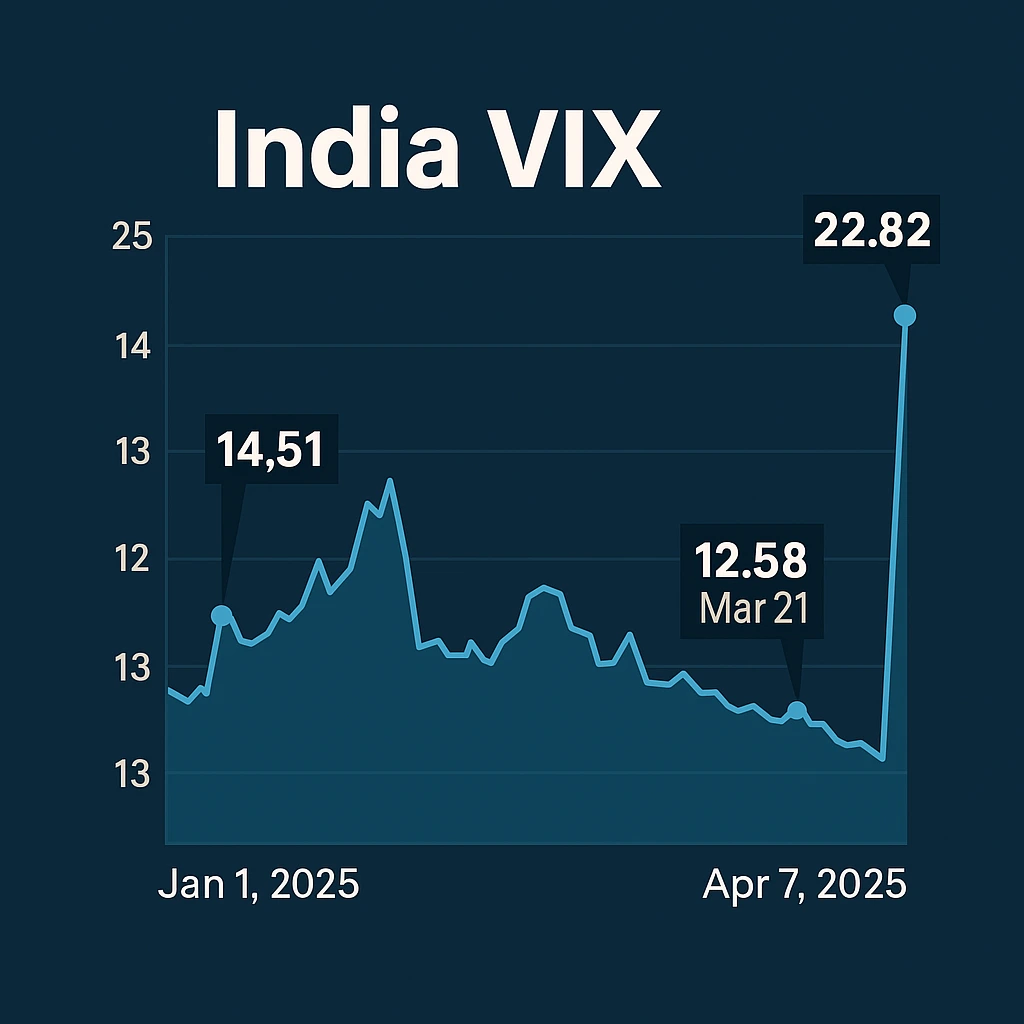
(Source: NSE)
- Historically, VIX levels above 20 have indicated extreme caution among investors.
- If VIX remains above 20 for a few sessions, expect continued choppiness in the market.
What This Means for Retail Investors
If you’re a retail investor, seeing headlines like “Sensex crashes 3,900 points” or “India VIX surges 65%” can be alarming. But it’s important to understand what this actually means for you and your investments.
First, remember that volatility doesn’t always mean losses. It simply means prices are expected to move more — in either direction. In the short term, these moves can be sharp and sudden, but long-term investors don’t need to panic.
Here are a few things to keep in mind:
- Don’t make impulsive decisions: Selling stocks out of fear can often lead to losses. Revisit your goals before taking any action.
- Volatility = opportunity: For traders, this could be a chance to profit from price swings. But for most retail investors, staying calm is usually the smarter strategy.
- Diversification is key: Spreading your investments across asset classes (stocks, debt, gold) helps reduce risk during uncertain times.
- Consider SIPs (Systematic Investment Plans): Market corrections can be a good time to continue or increase SIPs. You buy more units when prices are low.
- Review your asset allocation: Make sure your investments match your risk profile, especially during high-volatility periods.
In short, don’t let fear drive your decisions. Focus on long-term goals, and stay informed rather than reacting emotionally.
Conclusion
The sudden 150% surge in India VIX during the start of 2026 and the sharp pullback in benchmark indices on March 9 serve as a stark reminder of how sensitive our markets are to the global stage. Between the escalating US-Israel-Iran conflict and the resulting oil price shock sending Brent crude past $115, short-term volatility has officially become the new normal for the year.
But here is the most important thing to keep in mind: volatility is not the same as a permanent loss. These rapid ups and downs are a natural, if stressful, part of the equity journey. What truly determines your success is how you respond when the “fear gauge” spikes. While traders might scramble for quick exits or tactical hedges, long-term investors usually find that the best move is to stick to their original financial plan, avoid panic-selling, and look at their portfolio with a cold, analytical eye.
Indicators like the India VIX, which currently sits near 24.02, are fantastic for gauging the market’s mood, but they shouldn’t be the sole reason you enter or exit a position. Instead, use this period of high uncertainty to re-assess your risk tolerance and ensure your diversification is actually doing its job.
Market conditions may remain choppy throughout the rest of March 2026 as the geopolitical situation unfolds. However, by staying informed and maintaining a disciplined, patient mindset, you can navigate the noise and keep your long-term goals on track. After all, the best way to weather any market storm is with a clear head and a steady hand.
Disclaimer: Investments in securities market are subject to market risks, read all the related documents carefully before investing.
FAQs
What happens when VIX goes up?
When India VIX rises, it means that investors expect more volatility or large price movements in the stock market over the next 30 days. A rising VIX is usually linked to fear or uncertainty, often due to global events, economic concerns, or political instability. It does not tell you whether the market will go up or down — only that big moves are expected.
What is the ideal range for India VIX?
An ideal or normal range for India VIX is usually between 12 and 18.
- Below 12: Very low volatility (calm market)
- 12–18: Moderate, healthy volatility
- Above 20: High volatility (markets likely facing stress or uncertainty)
When VIX stays within 12–18, markets tend to be stable and predictable, which is preferred by most long-term investors.
Is high VIX bullish or bearish?
A high VIX is not directly bullish or bearish. It simply indicates that market participants expect large movements. However, spikes in VIX often happen when markets fall, so a high VIX is generally associated with bearish sentiment or panic selling.
How much VIX is good for trading?
For intraday and options traders, a moderate VIX (15–20) can create profitable trading opportunities, as price swings are strong enough to generate movement but not too wild. When VIX is too low (<12), markets are often slow-moving. When VIX is too high (>25), it may signal too much uncertainty, which can lead to unpredictable moves — risky for most traders.
Why is India VIX rising?
India VIX typically rises due to global uncertainty, sharp market corrections, policy announcements, or geopolitical tensions. In this case, it spiked because of:
- The announcement of high US tariffs
- China’s retaliatory trade measures
- Fears of a global recession
- Heavy sell-offs in Indian and global stock markets
All these factors increased fear among investors, pushing the VIX higher.


