

From less than Rs. 6,000 per barrel to almost Rs. 10,500, and then back near Rs. 8,000 per barrel. That’s the kind of wild ride the crude oil price on MCX has taken recently.
If you’ve been tracking the markets, you probably know this isn’t normal commodity movement. These sharp swings are a sign that something much bigger is happening behind the scenes.
Geopolitical tensions, supply disruptions, and strategic moves by major oil-producing nations are now pushing the crude oil price in ways we don’t usually see. What used to move slowly is suddenly reacting to global headlines almost instantly, making crude one of the most closely watched markets right now.
The crude oil price has stopped behaving like predictable background noise. As of March 2026, it has turned into a high-stakes geopolitical chessboard where every move by a global power instantly reflects on the MCX screen. War headlines, shipping disruptions, sanctions, and diplomatic signals are now driving price swings almost in real time.
For traders on MCX, the action has been intense. At one point during recent tensions, crude briefly surged toward the Rs. 10,500 mark in intraday trading before cooling down, showing just how sensitive the market has become to geopolitical developments. The Strait of Hormuz disruptions, shifting supply routes, and rising energy security concerns have pushed volatility to levels that few commodity traders expected this year.
For Indian investors, watching the crude oil price is no longer optional. It influences inflation, currency stability, transport costs, and overall market sentiment.
And if you are wondering “how to trade in crude oil in 2026,” this blog is for you.
Let’s dive in!
What is Crude Oil? Why is it Important for the World?
What is Crude Oil?
Crude oil is often called “black gold,” and there is a good reason for that. It is a naturally occurring, unrefined petroleum found deep beneath the earth’s surface or under the seabed. Over millions of years, organic matter transforms into hydrocarbons, which are then extracted and refined into fuels and various industrial products.
Even in 2026, when the world is actively pushing toward renewable energy, crude oil still sits at the centre of the global energy system. It accounts for roughly 30% of the world’s total energy consumption, making it one of the most important resources powering modern economies.
In simple terms, the world may be transitioning toward cleaner energy, but crude oil is still doing most of the heavy lifting.

Suggested Read: How Oil Price Fluctuation Affects 2026 Stock Market Volatility?
Why is Crude Oil Important for the World in 2026?
Crude oil is not just about petrol or diesel. It quietly powers a huge part of the global economy, often in ways people don’t immediately realise.
Transportation still depends heavily on it.
Electric vehicles are growing quickly, but global logistics still runs on oil. Heavy shipping, aviation, trucking, and long-distance transport rely on it because battery technology cannot yet support these sectors at scale. Globally, demand still stands at more than 100 million barrels per day.
It is the backbone of the petrochemical industry.
Many everyday products start their journey from crude oil. Plastics, fertilizers, medicines, synthetic fabrics, packaging materials, and even certain components used in solar panels and wind turbines depend on petroleum derivatives.
Oil also shapes global economic stability.
When crude prices rise sharply, inflation usually follows. The recent tensions around the Strait of Hormuz in 2026 clearly showed how sensitive the global economy is to oil supply disruptions. A sudden spike in oil prices can influence everything from food costs to the interest rate decisions made by central banks.
Industries also rely on it heavily.
Construction equipment, agricultural machinery, mining operations, and high-temperature manufacturing processes still depend on oil-based fuels.
And then there is the demand story. While consumption in developed economies is stabilising, demand in emerging economies continues to grow, especially in countries like India. As one of the fastest-growing major economies, India’s expanding infrastructure, manufacturing base, and transportation needs are pushing its crude oil consumption steadily higher.
What is Crude Oil Investing?
Before we dive into the “war rooms,” let’s clear the air on how you actually “buy” oil. Most people think of barrels in a warehouse, but for an Indian investor, it’s much more digital.
Not Your Typical Stock
You don’t buy physical oil. Instead, you take exposure through:
- MCX Crude Oil Futures: Leveraged bets on where the price is headed.
- MCX Crude Oil Options: Strategic plays to hedge risk or bet on volatility.
- Oil-Linked Stocks: Upstream producers (like ONGC) or refiners (like Reliance or IOCL).
- Energy Mutual Funds: Diversified exposure to global energy giants.
The Double-Edged Sword
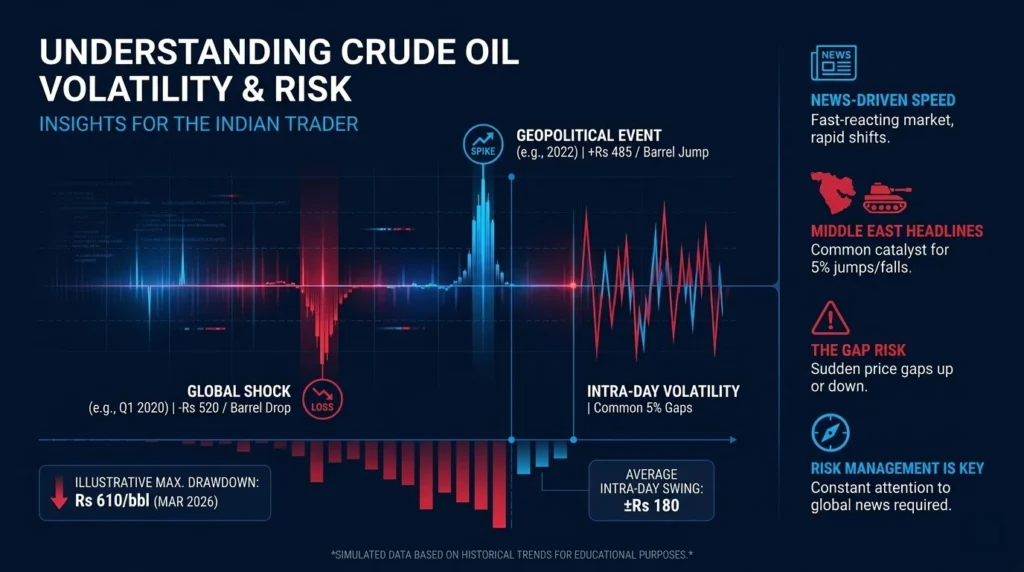
Crude oil is one of the most liquid commodities in the world, and it reacts to news incredibly fast, sometimes even faster than tech stocks.
This speed attracts many traders because it creates strong opportunities. But it also makes crude oil risky, especially for beginners.
In this market, prices do not always move slowly. A single headline about geopolitical tensions, especially in regions like the Middle East, can move prices sharply within minutes. It is common to see crude oil suddenly jump or fall by 5%, creating what traders call a gap-up or gap-down.
That is why crude oil trading can be exciting, but it also requires strong risk management and constant attention to global news.
Why Crude Oil has become the Centre of the Market Conversation
The global energy market has shifted from “fragile” to “combustible.” The recent headlines aren’t just market noise; they represent a fundamental restructuring of energy geopolitics.
The Strait of Hormuz Crisis
The immediate trigger for the current volatility is the escalating conflict in West Asia, which has brought the Strait of Hormuz to a near standstill.
- Traffic Collapse: Daily tanker movements through the strait recently plummeted from a baseline of 37 vessels to almost zero in early March.
- Strategic Chokepoint: Since roughly 20% of the world’s oil and LNG transits this corridor, the blockade has forced Brent crude to swing wildly, briefly touching $119.50 before settling near the $90–100 range.
- Production Cuts: Neighbors like Iraq and Kuwait have been forced to cut production by nearly 70% simply because they have run out of storage space while tankers remain anchored and unable to exit the Gulf.
Geopolitical Incentives: The “Agenda”
This isn’t a theory; it is a visible strategic game being played by global powers:
- Iran’s Leverage: By demonstrating “complete control” over the strait, Iran is raising the economic cost of conflict for the West.
- US Strategy: To prevent a global inflation shock, the US Treasury recently issued a 30-day waiver (valid until April 4, 2026) allowing Indian refiners to clear stranded Russian oil. This move aims to keep supply flowing without providing long-term financial benefits to Moscow.
- The Russian Factor: Russia benefits as Middle East supply vanishes, making its Urals grade more valuable to major buyers like India, which is currently managing 40–45 days of strategic reserves to weather the storm.
Impact on the Indian Investor (MCX)
For those trading on the MCX, crude oil has become the ultimate barometer of risk. As of March 10, 2026, the March contract is trading near ₹8,350/barrel, down from a panic-induced peak of ₹10,549. The 5% intraday swings we are seeing are a direct reflection of this geopolitical “chess match.”
Comparison of Fuel Prices and Taxes in India (2004-2026)
This table tracks the evolution of prices and highlights the “Stickiness Factor”-how retail prices often remain high even when the crude oil price drops globally.
| Year | Avg Petrol (₹/L) | Avg Diesel (₹/L) | Avg Crude ($/Bbl) | Total Taxes (₹/L) | Petrol Down with Crude? |
| 2004 | 33.71 | 22.74 | 37.66 | 14 | – |
| 2008 | 50.62 | 37.94 | 99.67 | 18 | – |
| 2012 | 68.57 | 53.13 | 111.63 | 23 | – |
| 2014 | 72.43 | 54.91 | 96.29 | 25 | No |
| 2015 | 60.5 | 46.09 | 49.49 | 22 | Yes |
| 2020 | 80.43 | 70.17 | 39.68 | 27 | No |
| 2022 | 95 | 86.38 | 100 | 30 | – |
| 2024 | 100 | 90 | 90 | 32 | – |
| 2025 | 104.5 | 94.2 | 82 | 34 | No |
| 2026 | 108 | 98 | 119.5 | 35 | – |
Data available is updated as of March 2026.
Key Observations for 2026
- Tax Rigeidity: Taxes currently make up nearly 35% of the pump price. This revenue is being diverted to expand the Strategic Petroleum Reserves (SPR) and green energy subsidies.
- The “Lag” Effect: When crude spiked toward $120 earlier this year, retail prices didn’t jump immediately because OMCs absorbed the cost. Consequently, when crude fell back to $90, pump prices stayed elevated to help OMCs recover those previous losses.
- Investment Impact: This trend explains why Indian OMCs (IOC, BPCL, HPCL) are currently seeing high volatility on the mcx and equity markets; their margins are trapped between high global costs and rigid domestic retail prices.

How India is Quietly Protecting Itself
India has moved beyond simple procurement to a sophisticated strategy of energy optionality. While global markets react to daily headlines, New Delhi is utilizing a multi-layered defense system to ensure domestic stability.
The 74-Day Safety Net
According to official data presented to the Rajya Sabha on March 9, 2026, India currently holds a combined national storage capacity for 74 days of crude oil and petroleum products.
- Strategic Petroleum Reserves (SPR): Managed by ISPRL, these underground caverns in Visakhapatnam, Mangaluru, and Padur hold 5.33 million metric tonnes (MMT), providing a buffer for roughly 9.5 days.
- Commercial Stockpiles: Indian Oil Marketing Companies (OMCs) maintain an additional 64.5 days of storage in tanks, pipelines, and offshore vessels.
Strategic Partnerships: The ADNOC Model
India’s partnership with the Abu Dhabi National Oil Company (ADNOC) is a cornerstone of this security. Under a unique “commercial-cum-strategic” agreement, ADNOC stores millions of barrels in the Mangaluru facility.
The Win-Win: ADNOC can sell this oil commercially during normal market conditions, but the Government of India retains the first right to use the entire stockpile during a national emergency.
Future-Proofing: SPR Phase II
To further insulate the economy, the government has fast-tracked Phase II of the SPR program. Approved under a Public-Private Partnership (PPP) model, this will add 6.5 MMT of capacity:
- Chandikhol, Odisha: 4 MMT
- Padur, Karnataka: 2.5 MMT expansion Once complete, these facilities will extend India’s import cover by an additional 12 days.
Diplomatic & Sourcing Agility
The Ministry of Petroleum has confirmed that India now sources crude from nearly 40 countries (up from 27 a decade ago). By balancing high-volume Russian imports with “near cargoes” and West African supply, India has reduced its reliance on the Strait of Hormuz to approximately 40% of its total imports.
Market Outlook: While the MCX continues to reflect global volatility, the government’s 74-day buffer and diversified sourcing mean that immediate supply shocks are unlikely to translate into fuel shortages for the Indian consumer.
What the Big Oil Powers Are Really Doing & Why Investors Should Care
Right now, the global oil market is not just about supply and demand. It has turned into a power game between the world’s biggest oil players. Their decisions are directly influencing the crude oil price, which is why markets across the world, including MCX, are reacting so sharply.
Here is a simple breakdown of what the three biggest players are doing behind the scenes.
Iran: Controlling the World’s Oil Gateway
Iran’s biggest strength is its location.
The Move: After tensions escalated in West Asia, tanker traffic through the Strait of Hormuz dropped from around 100-150 ships a day to 2-13 per day.
The Goal: About 20% of the world’s oil supply (80% of Asia’s supply) passes through this narrow route. By threatening to block it, Iran increases pressure on the global economy. This forces major powers to think carefully before escalating the conflict further.
The United States: Trying to Calm the Oil Market
The US is trying to stop oil prices from exploding and hurting the global economy.
The Move: In March 2026, the US allowed Indian refiners to buy certain Russian oil cargoes that were stuck at sea.
The Goal: The idea is simple. More oil supply means lower chances of prices spiking. Even though the US has sanctions on Russia, preventing a global inflation shock is currently the bigger priority.
Russia: Taking Advantage of the Situation
Russia is stepping in where Middle East supply has become uncertain.
The Move: Indian refiners, including Reliance Industries, secured millions of barrels of Russian crude to maintain supply.
The Goal: Russia wants to regain market share. By filling the gap left by disrupted Middle East supply, it becomes an important alternative for buyers like India.
Investor Note: These global moves are not just political news. They are the reason crude oil prices on MCX are swinging 5-7% in a single day.
In today’s market, the real battle is not about who has the most oil. It is about who controls the routes that deliver it to the world.
How Oil Stocks Reacted to the Ongoing Crisis
When crude oil prices start fluctuating, the stock market does not stay calm. It reacts quickly. According to recent market data, the Nifty 50 index has already fallen around 9% so far in 2026, showing that investors are worried about inflation, higher fuel costs, and pressure on the economy.
But the interesting part is this: not every sector is reacting the same way. Some companies are struggling, while others are actually benefiting.
Let’s break it down in a very simple way using some real-time case studies:
Refiners & Oil Marketing Companies: Feeling the Pressure
The companies that sell petrol and diesel in India have been hit the hardest.
What Happened: Shares of HPCL, BPCL, and IOC dropped sharply, falling roughly 7-10% in a single day.
Why This Happened: When global crude prices rise, these companies have to buy oil at a higher price. But they cannot immediately increase fuel prices for consumers. So they end up absorbing the cost, which hurts their profits.
One Exception: Reliance Industries did not fall as much. Since it exports refined fuel globally, it can benefit when international fuel prices rise.
Paint & Chemical Companies: Raw Material Costs Rising
Paint companies also suffer when crude oil rises.
What Happened: Stocks like Asian Paints and Berger Paints fell around 5-7% recently.
Why This Happened: Almost half of their raw materials come from crude oil derivatives. When oil prices rise, their production costs rise too.
Airlines & Logistics: Fuel Becomes Expensive
Airlines depend heavily on fuel.
What Happened: Shares of IndiGo’s parent company dropped more than 7%.
Why This Happened: For airlines, aviation fuel makes up nearly 40% of operating costs. If oil prices rise, airline profits usually fall.
The Winners: Oil Producers
Not every company loses when crude prices rise.
What Happened: Companies like ONGC and Oil India usually benefit.
Why This Happens: These companies produce crude oil. When oil prices rise, the value of what they sell also rises.
Crude Oil Futures Summary (As of March 2026)

Here’s a quick analysis of the charts for you:
Panic Spike (That Huge Upper Wick)
- The most obvious thing on the chart is the massive upper wick.
- Prices suddenly shot up to ₹10,549 intraday.
- This spike was likely triggered by panic buying after headlines about Hormuz disruptions or supply fears.
- But the market could not hold those levels.
- As soon as prices reached five digits, heavy profit booking kicked in, possibly helped by news like the US waiver allowing supply to move again.
What the Market Did Next: Sharp Correction
- After the spike, the market quickly cooled down.
- Crude is now trading around ₹8,168 on MCX.
- That is roughly a 7% drop (about ₹620) from the previous session’s close.
- Emotionally, the market has shifted from panic buying to confusion.
- Traders are now waiting for the next geopolitical headline before taking big positions.
Key Technical Signals on the Chart
Trend Change
- Since December 2025, crude had been rising slowly and steadily.
- The sudden vertical rally in March broke the normal trend, pushing the market into a parabolic move.
Liquidity Sweep
- A swing of nearly ₹2,400 in a short time means a lot of traders were caught off guard.
- Many short positions were likely wiped out during the spike to ₹10,549.
Support Zones
- The market is now hovering around ₹8,100–₹8,200.
- If this level breaks, the next major support visible on the chart is around ₹6,500, where the previous breakout started.
Summary for the Indian MCX Trader
- Right now, the market looks like it is cooling down after the panic spike.
- The extra “Hormuz premium” that pushed prices to ₹10,500 has already faded.
- The big lesson here: crude oil is extremely volatile.
- If you trade MCX crude without a stop-loss, moves like this can wipe out positions very quickly.
How to Invest in Crude Oil?
Investing in crude oil can be highly rewarding, but it is one of the most volatile commodities on the market. In 2026, the methods available to Indian investors range from simple stock purchases to complex derivative trading.
Here are the primary ways you can gain exposure to the oil market:
Direct Commodity Trading (MCX)
This is the most direct way to trade crude oil prices in India. You don’t buy physical barrels; instead, you trade contracts on the Multi Commodity Exchange (MCX).
- Futures Contracts: You agree to buy or sell oil at a set price on a future date. MCX offers a “Main” contract (100 barrels) and a “Mini” contract (10 barrels),which is more popular for retail traders.
- Options Trading: This gives you the right (but not the obligation) to buy or sell oil at a specific price. It is often used for hedging against sudden price spikes.
- Key Requirement: You need a Commodity Trading Account with a SEBI-registered broker. These trades are cash-settled in INR.
Exchange-Traded Funds (ETFs)
If you prefer not to manage complex futures contracts, ETFs are a “lighter” way to invest through your standard demat account.
- Oil & Gas Sector ETFs: Some funds like the track an index of Indian companies involved in the energy sector.
- International Oil ETFs: You can invest in some international funds, which track daily crude oil prices.
Investing in Energy Stocks
You can invest in companies whose profits are directly tied to oil prices. In the Indian market, these are categorized into two types:
| Category | Impact of High Oil Prices | Key Examples |
| Upstream (Producers) | Positive: They sell oil at higher prices, increasing revenue. | ONGC, Oil India |
| Downstream (Refiners/OMCs) | Negative: Their raw material costs go up, which can hurt margins. | HPCL, BPCL, IOC |
| Integrated Giants | Mixed/Resilient: They produce and refine, balancing the impact. | Reliance Industries (RIL) |
Sector-Specific Mutual Funds
Several “Thematic” or “Energy” mutual funds allocate their capital to global and domestic oil, gas, and renewable energy companies. This is the best route for long-term investors who want professional management rather than day-trading volatility.
Where to Invest in the Oil Market
In the oil market, one strategy does not work for everyone. Some people want steady exposure over many years, while others try to catch short-term price swings. Your approach should depend on how much risk you are comfortable with.
Here is a simple guide based on different investor personalities:
| Investor Type | Preferred Option | Risk Level | Time Horizon |
| Safety-First Investor | Integrated energy companies | Low–Medium | 5+ Years |
| Passive Beginner | Energy mutual funds / ETFs | Medium | 3–5 Years |
| Aggressive Investor | Upstream producers | High | 1–2 Years |
| Active Trader | MCX crude futures | Very High | Hours to Days |
One Important Rule for 2026
No matter what type of investor you are, do not overexpose your portfolio to oil.
A good rule is to keep your oil allocation below 5-10% of your total investments. Recent price swings – including the spike near ₹10,500 followed by a sharp correction; show how quickly this market can move.
Crude oil can create opportunities, but if you put too much money into it, it can quickly become a portfolio risk rather than a diversification tool.
In 2026, the relationship between global crude oil and Indian retail fuel prices remains a major talking point for investors. While global markets have seen massive spikes due to the 2026 Middle East crisis, Indian retail prices have stayed relatively rigid, primarily due to the “tax cushion” maintained by the government to fund energy security projects.
Top Oil Stocks to Invest in 2026
Displayed in the table below are some of the top oil stocks in India that you can check out, given your investment plans:
| Name of the Stock | Market Cap (in Cr.) | CMP | P/E Ratio | Div. Yield |
| O N G C | 305700.74 | 269.45 | 8.45 | 5.07 |
| Oil India | 71700.89 | 474.50 | 10.93 | 2.38 |
| Aegis Vopak Term | 27838.29 | 192.50 | 218.81 | 0 |
| Deep Industries | 2867.52 | 346.25 | 21.43 | 0.55 |
| Antelopus Selan Energy Ltd | 2,084 | 593 | 31.5 | 0 |
| Prabha Energy Ltd | 2,041 | 149 | 0 | 0 |
| Hind.Oil Explor. | 2272.6 | 149.60 | 15.45 | 0 |
| Dolphin Offshore Enterprises (India) Ltd | 1,890 | 472 | 37.3 | 0 |
| Jindal Drilling | 1558.87 | 537.90 | 8.68 | 0.08 |
| Gujarat Natural Resources Ltd | 1,249 | 97.2 | 172 | 0 |
| Asian Energy | 1200.49 | 267.15 | 32.4 | 0 |
| Ganesh Benzoplast Ltd | 549 | 76.2 | 6.73 | 0 |
Data available is updated as of 10.03.26.
Future Outlook for Oil
The future of the crude oil market in 2026 is expected to be defined by extreme price sensitivity and a fundamental restructuring of energy geopolitics. Market participants can anticipate continued high volatility on the MCX, driven by real-time reactions to headlines regarding shipping chokepoints, such as the Strait of Hormuz, and the strategic maneuvers of global powers.
While the world continues to transition toward renewable energy, the reliance on crude oil for aviation, heavy shipping, and petrochemicals ensures it will remain a primary pillar of global consumption, maintaining demand at over 100 million barrels per day.
For the Indian domestic market, the future involves a dual-layered reality of government-led stability and market-driven risk. Investors can expect the government to continue expanding its Strategic Petroleum Reserves, including the fast-tracking of SPR Phase II, to provide a 74-day safety net against supply shocks.
However, retail fuel prices are expected to remain “sticky” due to rigid tax structures intended to fund these energy security projects.
This creates a landscape where upstream producers may see revenue growth from high prices, while downstream refiners and fuel-sensitive sectors like aviation and paints will likely face ongoing margin pressure.
Bottom Line
If there is one thing 2026 has taught investors, it is this: crude oil is no longer just a commodity. It is a global signal.
Every time the crude oil price moves on MCX, it is reflecting something bigger happening in the world. A shipping disruption, a diplomatic move, a production cut, or a sudden geopolitical escalation. Oil is now reacting to events almost in real time.
For investors, this makes crude both exciting and dangerous.
On one side, the volatility creates opportunities. Sharp price swings mean traders can capture quick moves, and investors can position themselves in sectors that benefit when oil rises.
But on the other side, oil can also be unpredictable. As we saw with the sudden spike toward ₹10,500 and the rapid fall back near ₹8,000, markets can move faster than most people expect.
The smartest approach is not to chase every headline. Instead, understand the bigger picture: how oil affects inflation, currencies, industries, and global politics.
If you respect the volatility, manage your risk, and keep your exposure balanced, crude oil can be a powerful addition to your portfolio.
Because in 2026, the oil market is not just about energy.
It is about economics, geopolitics, and opportunity; all moving at the same time.
Disclaimer: Investments in securities market are subject to market risks. Read all the related documents carefully before investing. The securities are quoted as an example and not as a recommendation.
FAQs
How do I start investing in oil?
You can start investing in crude oil in India in several ways. The most common methods include trading crude oil futures or options on MCX, investing in energy sector mutual funds or ETFs, or buying shares of companies linked to the oil industry. Beginners should start small, understand how crude oil prices move, and diversify their investments.
Which oil stock is best to buy now?
There is no single best oil stock to buy right now because performance depends on crude oil prices, company operations, and global demand. Investors usually look at companies involved in oil production, refining, or energy infrastructure. Before investing, review financial performance, oil price trends, and long-term energy demand rather than chasing short-term market moves.
How much is 1 barrel of crude oil now?
As of March 2026, the crude oil price on MCX is trading around ₹8,100-₹8,200 per barrel, although prices change frequently during the day. Crude oil prices are highly sensitive to global events, supply disruptions, and geopolitical developments, which is why investors closely track real-time oil prices before making trading or investment decisions.
How can I trade in crude oil?
You can trade crude oil in India through the Multi Commodity Exchange (MCX) using futures or options contracts. To start, you need a commodity trading account with a SEBI-registered broker. Traders speculate on crude oil price movements without buying physical oil. Because crude trading involves leverage, proper risk management and stop-loss strategies are essential.


