
Options trading often looks simple when you first see it.
There’s a strike price, a premium, an expiry date, and two buttons. Buy Call or Buy Put. Clean, structured, and easy to understand on the surface.
That’s exactly where most beginners get trapped.
Because once real money is involved, options behave very differently from what theory suggests. They are not just about predicting direction. They are time-bound trades where timing, position size, and premium decay all play an equal role. Even if your view is correct, a slow move or wrong expiry can still lead to a loss.
And this gap between theory and reality is what catches most traders off guard.
Before getting into Nifty options specifically, it’s important to understand how options work at a fundamental level. Once that foundation is clear, everything else becomes easier to connect.
Let’s start from the basics.
What is Options Trading?
An option is a derivative contract. Its value is derived from an underlying asset or index. NSE describes an option as a contract between two parties in which the buyer receives a right for which a premium is paid, while the seller accepts an obligation in return for receiving that premium.
For beginners, the easiest way to remember this is:
- A call option is generally used when you expect the market to rise.
- A put option is generally used when you expect the market to fall.
- The amount you pay to enter the trade is called the premium.
- The predefined level linked to that contract is called the strike price.
- The contract remains valid only up to its expiry date.
One more beginner point is essential here. If you are buying an option, your maximum loss is usually limited to the premium paid, ignoring charges. But if you are selling or writing an option, the risk can become much larger. That is why option buying is generally easier to explain to a beginner than naked option selling.
Suggested Read: Top LPG Stocks to Invest in 2026: Who Really Benefits When LPG Becomes a Big Theme
Difference Between Call Option and Put Option
A call option and a put option are opposites in basic market view, but they behave under the same larger principles of time, price movement, and premium.
Options Trading: Key Terminologies
Here’s a clean, beginner-friendly table format you can directly use:
| Term | Definition |
| Underlying Asset | The asset on which the option is based. Example: A stock or index like Nifty 50. |
| Call Option | A contract bought when you expect the market to go up. |
| Put Option | A contract bought when you expect the market to go down. |
| Strike Price | The predefined price level of the option contract. |
| Premium | The price you pay to buy an option. This is your maximum loss (for buyers). |
| Expiry Date | The last day the option contract is valid. |
| Lot Size | The fixed quantity in which options are traded (e.g., Nifty = 75 units in 2026). |
| In-the-Money (ITM) | Option already has intrinsic value. |
| At-the-Money (ATM) | Strike price is closest to current market price. |
| Out-of-the-Money (OTM) | Option has no intrinsic value. |
| Intrinsic Value | The actual value of the option if exercised immediately. |
| Time Value | The extra value due to time left before expiry. Decreases as expiry approaches. |
| Implied Volatility (IV) | Market’s expectation of future price movement. Higher IV usually means higher premium. |
| Open Interest (OI) | Total number of outstanding option contracts. |
| Volume | Number of contracts traded during a session. |
Quick takeaway: If a beginner understands this table well, they can confidently read an option chain and avoid most early mistakes.
Suggested Read: F&O Trading in Volatile Markets: How to Use Greeks (Delta, Theta, Vega) Effectively in 2026
Why Options Feel Different in Theory vs Real Trading
Many traders entering the world of options often feel confused when what they learned in theory doesn’t match how things actually play out in real markets.
See the image below for a quick reference:
What Are Nifty Options?
Nifty options are derivative contracts whose value is derived from the Nifty 50. These contracts give the buyer a right, but not an obligation, to buy or sell the index at a predetermined price within a specified time, while the seller assumes the corresponding obligation in exchange for a premium.
Now in simple terms.
When you trade Nifty options, you are not betting on a single stock. You are taking a view on the overall market.
For beginners, this feels easier. You track one index instead of multiple companies, and you are less exposed to sudden stock-specific news.
For experienced traders, the attraction is different. Nifty options offer deep liquidity, tight spreads, and flexibility to build strategies around time, volatility, and short-term moves.
But both need to respect the same thing.
- Nifty options are not low-risk.
- Leverage can amplify losses.
- Expiry can work against your timing.
- Premium can decay even if your view is right.
That’s why traders often face this situation. Right direction, but still a loss.
Nifty options simplify access to the market, not the risk.
Suggested Read: Intraday Trading Guide 2026: Best Indicators, VWAP Strategies & Time Frames for NSE Stocks
Why Nifty Options Matter So Much in 2026
If you’re new to the market, Nifty options are usually one of the first things you come across. And if you’ve been trading for a while, chances are you’re already spending a good part of your time here.
They are linked to the Nifty 50, which represents 50 of the largest companies in India. So when you trade Nifty options, you’re essentially taking a view on the overall market, not just a single stock.
The National Stock Exchange of India introduced Nifty index options in 2001, and over time, they’ve become one of the most actively traded instruments in the country. In 2026, with rising retail participation, this is where a lot of action is concentrated.
For beginners, the appeal is straightforward.
Experienced traders, on the other hand, value Nifty options for a different reason. Liquidity is deep, spreads are tight, and there are multiple expiries to structure trades around short-term moves or broader market views.
But both groups run into the same trap at some point.
A lower premium does not mean lower risk.
For beginners, this shows up as quick losses in short-term trades. For experienced traders, it often comes from overconfidence in timing or position sizing.
Because in options, multiple factors are always in play. Time decay keeps reducing value. Volatility shifts pricing even without big moves. Strike selection and expiry timing can change outcomes completely.
This is especially true in short-dated contracts, where everything happens faster and mistakes are less forgiving.
That’s why Nifty options matter so much today.
They offer access, flexibility, and scale. But they also demand discipline, whether you’re placing your first trade or your hundredth.
At the end of the day, they are not about finding easy profits. They are about understanding how risk works and learning how to manage it consistently.
Suggested Read: How to Start F&O Trading in 2026? Unlock the Confidence to Trade Like a Pro
How Nifty Option Contracts Work in 2026
When you open the options chain, it can feel overwhelming. But what you’re really looking at is a live pricing system reacting to three things at once. Market direction, time left to expiry, and volatility.
The National Stock Exchange of India provides multiple expiries for Nifty 50 options. Weekly for short-term trades, monthly and beyond for broader views.
Now let’s walk through it like a real trade.
Step 1: Reading the Options Chain
Assume Nifty is at 22,000.
Call Side Snapshot (Buyers expecting upside)
| Strike | Premium (Rs.) | Interpretation |
| 21,900 | 180 | Already valuable. Has intrinsic value |
| 22,000 | 120 | ATM. Most sensitive to movement |
| 22,100 | 100 | Needs upside move |
| 22,200 | 70 | Cheap, but requires strong move |
Notice how premiums fall as strikes go higher. That’s because probability of profit reduces.
Step 2: Entering the Trade
You buy 22,100 Call at Rs. 100 Lot size = 75 Total capital used = Rs.7,500
At this moment:
- You need Nifty to move above 22,100
- You need it to move fast enough
- And you need enough time left for the move
Step 3: Market Starts Moving
Case A: Fast Move (Ideal)
| Time | Nifty | Premium | What’s Happening |
| Entry | 22,000 | 100 | You enter |
| +30 mins | 22,120 | 140 | Delta kicks in |
| +1 hr | 22,200 | 180 | Strong move + momentum |
Profit = (180 − 100) × 75 = Rs.6,000
Here, direction, timing, and momentum all worked together.
Case B: Slow Move (Common Trap)
| Time | Nifty | Premium | What’s Happening |
| Entry | 22,000 | 100 | You enter |
| +2 hrs | 22,050 | 90 | Time decay starts |
| +4 hrs | 22,100 | 95 | Direction right, but slow |
Result: Minimal gain or even loss
This is where beginners get confused. “Market went up, why didn’t I make money?”
Because speed matters.
Case C: No Move (Worst for Buyers)
| Time | Nifty | Premium | What’s Happening |
| Entry | 22,000 | 100 | You enter |
| End of day | 22,010 | 70 | Time decay eats premium |
Loss = (100 − 70) × 75 = Rs.2,250
Even without a big move against you, you lose money.
What You’re Actually Trading
For beginners
It feels like you’re trading direction.
For experienced traders
You know you’re trading a combination of:
- Direction (Delta)
- Time decay (Theta)
- Volatility (Vega)
That’s why the same trade can give three different outcomes.
The Real Takeaway
Options don’t just reward being right. They reward being right at the right time and with the right structure.
That’s the shift every trader remembers once they’ve spent enough time in the market.
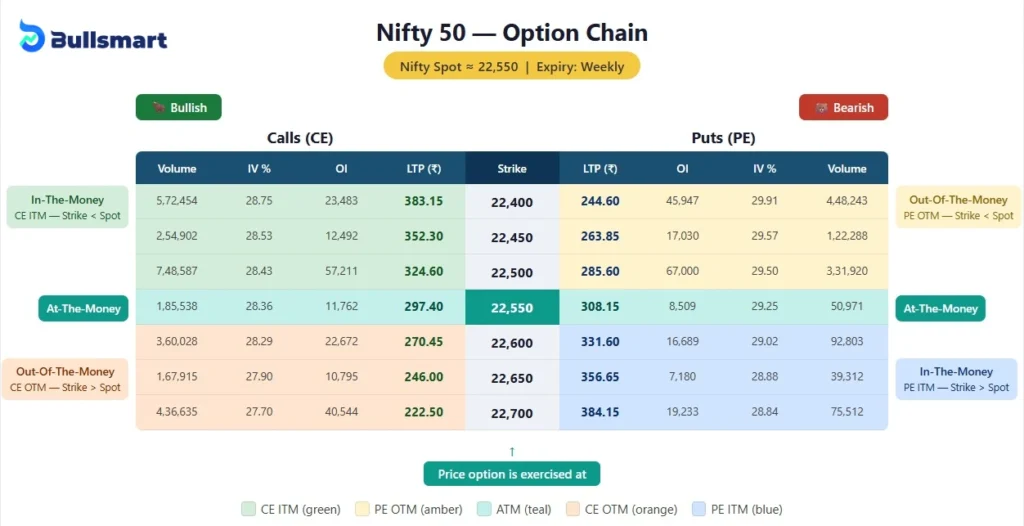
How to Read the Nifty Option Chain as a Beginner
You don’t need to master complex strategies on day one. But you do need to learn how to read the option chain properly. That’s your dashboard.
The National Stock Exchange of India provides an official option chain for Nifty 50, and that’s the best place to start.
Step 1: Start With the Market Level
First, check where Nifty is trading.
If Nifty is at 22,000, everything revolves around that number. Without this, strike prices are just random numbers.
Step 2: Understand the Layout
| Calls (Left) | Strike Price | Puts (Right) |
| 180 | 21,900 | 160 |
| 120 | 22,000 | 110 |
| 100 | 22,100 | 90 |
| 70 | 22,200 | 60 |
- Calls are on the left
- Puts are on the right
- The middle is your strike price
The strike closest to current price is called ATM.
Step 3: Read What the Premium Is Telling You
- Higher premium = higher probability or existing value
- Lower premium = cheaper, but needs a stronger move
This is where beginners get trapped. Cheap does not mean good.
Step 4: Check Volume and Open Interest
- Volume shows current activity
- Open Interest (OI) shows existing positions
Useful for context, not as guaranteed signals.
Step 5: Always Check Expiry
Weekly options move fast.
Monthly options move slower.
Many beginners jump into near-expiry trades without realizing how quickly premiums can fall.
What Usually Goes Wrong
- Picking a strike just because it is cheap
- Ignoring how little time is left
- Assuming direction alone will give profit
In reality, cheap options often need a big move in a short time.
Simple Way to Think About It
For beginners
You’re learning to read the screen.
For experienced traders
You’re reading positioning, probability, and timing.
The option chain is not just data.
It’s a live reflection of what the market expects and how fast it expects it to happen.
A Simple Example of Buying a Nifty Put
Now let’s flip the view.
Assume Nifty is around 22,000, and the trader expects the market to fall over the next few sessions. So they buy a put option on the Nifty 50.
They pick a 22,000 Put and pay a premium of ₹110.
Lot size = 75
Total cost = ₹8,250
Now let’s see how this plays out.
What Happens After You Enter
| Scenario | Nifty Move | Premium | Outcome |
| Sharp fall | 21,800 | ₹190 | Strong profit |
| Small fall | 21,950 | ₹105 | Little to no gain |
| No movement | 22,000 | ₹80 | Loss due to time decay |
| Market rises | 22,150 | ₹50 | Faster loss |
What’s Actually Happening Here
If the market falls fast and decisively, your put gains value quickly.
But if the fall is slow or small, time decay starts eating into your premium. Even though your direction is right, your profit may not show up.
And if the market doesn’t fall at all, the option loses value. Faster if expiry is near.
The Real Learning
For beginners
It feels like a simple bet. Market down means profit.
For experienced traders
You know it’s about:
- Speed of the move
- Time left in the contract
- Structure of the trade
That’s why options are not just direction trades.
They are structured bets where how the market moves matters just as much as where it moves.
Why Most Beginners Lose Money in Options Trading
If you’re getting into options, this is something you should hear early.
According to Securities and Exchange Board of India data, about 91% of individual F&O traders lost money between FY22 and FY24. Total losses crossed ₹1.8 lakh crore.
So what’s going wrong?
Let’s break it down simply.
- Chasing “cheap” options without understanding probability: Many beginners get attracted to low premiums and buy far out-of-the-money options. It feels like a small bet with big upside. But in reality, these options have a low chance of success and lose value quickly due to time decay.
- Getting pulled into expiry-day excitement: Weekly options move very fast, which makes them look exciting and profitable. But the same speed works both ways. If the trade is wrong, losses happen just as quickly, often before you can react.
- Entering trades without a clear plan: Trades are often taken based on tips, social media, or fear of missing out. When the market moves against them, traders either keep adding to the position emotionally or hold on, hoping for a reversal that may never come.
- Underestimating the impact of position sizing: Taking “just one lot” feels manageable. But repeated small losses across multiple trades slowly build into a significant drawdown.
- Mistaking activity for skill: Constantly watching option chains, tracking open interest, and reacting to every price move can feel like being in control. But without a structured approach, it’s just noise. Real edge comes from consistency, not constant action.
For beginners
It feels like the market is unpredictable.
For experienced traders
You realise most losses don’t come from the market.
They come from how you approach it.
How to Approach Your First Nifty Options Trade (Call or Put)
If you are about to place your first options trade, slow down.
This is not like buying a stock.
In stocks, you can be early and still be right later.
In options, you can be right and still lose money.
That is the reality most beginners discover after their first few trades.
So your first trade should not be about making money.
It should be about understanding how options actually behave.
Step 1: Be clear about your view
Before placing the trade, ask yourself:
- Do I think Nifty will go up or down?
- Do I expect a strong move or just a small move?
If you think the market will go up, you look at a call option.
If you think the market will go down, you look at a put option.
If you are unsure, do not trade.
Many beginners enter trades just because the market is moving or someone suggested a level. That usually ends badly.
Step 2: Do not chase cheap options
This is where most first trades go wrong.
You will see options trading at very low prices and feel they are safer because less money is involved.
That is not true.
Most of these options are cheap because the probability of them working is low.
For your first trade, stay close to the current market level.
Choose an at-the-money or slightly nearby strike.
These options behave more realistically and help you understand movement better.
Step 3: Respect expiry
Expiry is not just a date. It is one of the biggest factors in options.
If you choose an option that is about to expire, the premium can fall quickly even if the market does not move much.
For your first trade, avoid very short-term expiry like same-day or next-day.
Give your trade some time. Even a few extra days can make a big difference in how the option behaves.
Step 4: Decide your loss before you enter
This is non-negotiable.
In option buying, your maximum loss is the premium you pay.
So ask yourself honestly:
Am I okay losing this entire amount?
If the answer is no, reduce your position size or do not take the trade.
Most beginners think they will exit before losing the full premium. In reality, hesitation and hope often delay exits.
Step 5: Start small
Your first trade is not a test of skill. It is a learning experience.
Trade one lot. Nothing more.
You are trying to understand:
- How fast the premium moves
- How it reacts when the market moves slightly
- How it behaves when the market does nothing
Many people lose money early because they size up too quickly without understanding the instrument.
Step 6: Watch what actually happens
Once you enter, observe without overreacting.
You will likely see one of these:
- The market moves in your direction quickly and the premium rises
- The market moves slowly and the premium barely changes
- The market stays flat and the premium drops
This is where the biggest realization comes in.
Options are not just about direction.
They are about speed, timing, and expectations already priced in.
Step 7: Exit with a plan
Before entering, decide:
- At what profit will I exit?
- At what loss will I exit?
Do not wait endlessly for the trade to turn.
Do not hold till expiry just because the premium has already fallen.
Do not average just to feel better about the position.
Most losses in options do not come from wrong views. They come from poor exits.
What your first trade will actually feel like
To be honest, your first trade will not feel smooth.
You may:
- Exit too early and see profit left on the table
- Hold too long and see profit turn into loss
- Get the direction right but still lose money
- Feel confused about why the premium is not moving as expected
This is normal.
Options are a different learning curve.
One-line takeaway
Options theory teaches direction. Practical trading is about direction, timing, speed, and discipline.
Types of Risks Involved in Options Trading
Options trading is often seen as a controlled-risk instrument, especially for buyers. But in reality, multiple risks operate at the same time. Understanding these early can help you avoid costly mistakes.
- Time Decay Risk (Theta Risk): Options lose value as they approach expiry. Even if the market does not move against you, the premium can still fall simply because time is passing. This is one of the biggest reasons beginners lose money despite having the right view.
- Directional Risk: Options are still dependent on market direction. If the market moves opposite to your expectation, the option value drops. For example, a call option loses value if the market falls, and a put loses value if the market rises.
- Volatility Risk (IV Risk): Option premiums are influenced by implied volatility. If volatility drops after you enter a trade, the premium can fall even if the market moves slightly in your favour. This often confuses beginners.
- Liquidity Risk: Some option strikes may have low trading activity. This can make it difficult to enter or exit at desired prices, leading to slippage and unexpected losses.
- Expiry Risk: As expiry approaches, option prices become more sensitive and unpredictable. Small market moves can lead to large premium changes, increasing the risk of sudden losses, especially in short-term trades.
- Leverage Risk: Options allow you to control a larger position with a smaller amount of capital. While this can amplify profits, it can also amplify losses if the trade goes wrong.
- Execution Risk: Delays in placing or exiting trades, incorrect order types, or emotional decision-making can impact outcomes. In fast-moving markets, execution quality matters more than expected.
Risk management rules every beginner should follow
Risk management is not the boring part of options trading. It is the part that decides whether a beginner survives long enough to learn.
Risk only a small portion of capital on one trade.
Never assume a low premium automatically means a low-risk trade.
Avoid revenge trading after a loss.
Be very careful on expiry day because option premiums can change rapidly.
Keep a written trade journal.
Understand all trading costs and charges before you begin.
Most importantly, accept that many option-buying trades can result in small losses. If those losses are unmanaged or repeated without a real setup, they can compound quietly. SEBI’s study is a strong reminder that the retail F&O experience has been loss-making for the overwhelming majority of traders.
Common mistakes beginners should avoid
- Do not buy an option only because someone else said it will “fly”.
- Do not treat open interest as a guaranteed prediction.
- Do not jump across too many strikes and expiries at once.
- Do not hold a losing option blindly just because the premium has already fallen a lot.
- Do not assume one profitable trade means you have mastered options.
And do not forget the most basic point: Nifty options are structured products with expiry, lot size, and premium dynamics. They are not simple substitutes for buying a stock.
Suggested read: Mutual Funds or Stocks: The Best Starting Point for Beginners in 2026
Final Thoughts: This Is Where Most Traders Wake Up
If there’s one thing options trading teaches you early, it’s this. The market is not here to reward opinions, it rewards precision. You can study calls and puts, understand strategies, even get direction right. But the moment real money is involved, everything feels different. Suddenly, time starts working against you, premiums don’t behave the way you expected, and decisions become emotional instead of logical.
That’s the shift every trader remembers.
The traders who struggle are not always wrong about the market. They are usually early, oversized, or impatient. And the ones who improve are not chasing big wins. They are learning how to manage small losses and stay consistent.
So if you’re starting out, don’t try to crack options in your first few trades. Focus on understanding how they move, how they decay, and how they react to time and volatility.
Because once you truly understand that, your approach changes. And in options trading, that’s what makes all the difference.
Disclaimer: Investments in securities market are subject to market risks, read all the related documents carefully before investing.
FAQs
How to do option trading for beginners?
Start small and treat the first few trades as learning, not earning. First understand strike price, premium, expiry, lot size, and how time decay works. Watch the option chain, paper-trade a few setups, and begin with one small buy-side trade only if you can afford to lose the full premium. SEBI also offers derivative-learning material for investors.
Can I start option trading with 5000 rupees?
Technically, sometimes yes in a limited way, because some option premiums can fit that budget. But practically, ₹5,000 is very tight once you consider lot size, brokerage, taxes, and the fact that option buyers can lose the full premium. For Nifty, the lot size is 75, so even a modest premium can push required capital above that amount.
Is option trading better than stocks?
Not universally. Stocks are usually simpler to understand because there is no expiry and less pressure from time decay. Options offer flexibility and defined-risk buying strategies, but they are more complex and less forgiving. So “better” depends on your goal, experience, and risk tolerance. For most beginners, stocks are easier to learn before moving into options.
Can I make money in option trading?
Yes, it is possible, but it is not easy or consistent for most beginners. SEBI’s updated study found that 91% of individual traders in equity F&O incurred losses between FY22 and FY24. So the more realistic answer is this: money can be made, but only with strong risk control, discipline, and realistic expectations.


