
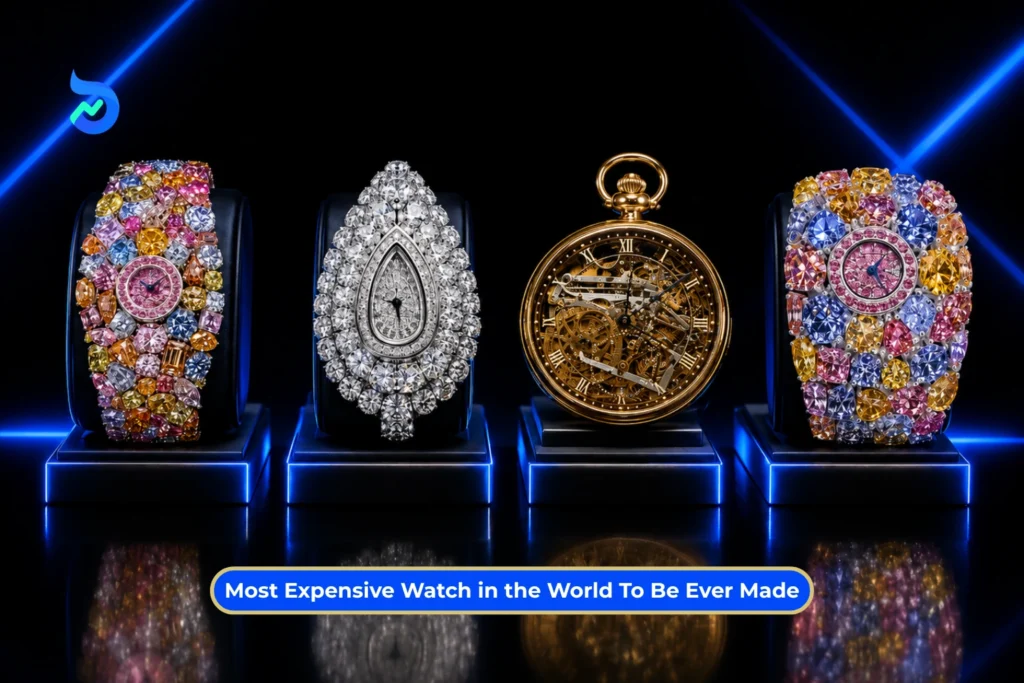
Imagine casually wearing Rs. 450 crore on your wrist.
Not around your neck. Not parked in your garage. Not locked inside a vault.
On your wrist.
That is the insane world of the most expensive watches, where one tiny timepiece can cost more than hundreds of premium Mumbai homes. The most expensive watch in the world is valued at around $55 million, which roughly translates to Rs. 450 crore+, depending on the exchange rate.
And the craziest part? At this level, a watch is not really a watch anymore.
It is a diamond-loaded status symbol. A miniature engineering miracle. A collector’s trophy. A celebrity flex. A piece of history that can make billionaires raise their paddles at auctions.
Some watches are covered with rare diamonds. Some have movements so complicated that master watchmakers spend years building them by hand. Some become legendary because one powerful name wore them. And some become so rare that owning them is almost like owning a private museum on your wrist.
In this blog, we will explore the most expensive watches in the world in 2026, why Patek Philippe and Richard Mille dominate this luxury universe, and how India’s own Titan story connects watchmaking, wealth, and watch stocks in a very different way.
Let’s clock it!
Are Expensive Watches a Good Investment?
This is the question many readers will naturally ask: if someone buys an expensive watch, is it actually a smart investment?
The honest answer is: sometimes, but not always.
Some watches do gain value over time, especially rare Patek Philippe models, certain Rolex sports watches, and special limited editions. But most watches do not behave like that. Many lose value after purchase, just like luxury cars.
Here are the main things that decide whether a watch can hold or grow in value:
- Brand strength: Watches from brands like Patek Philippe and Rolex usually have stronger collector demand than many other brands. The brand name matters a lot in resale.
- Limited supply: If very few pieces were made, the watch becomes harder to find. That can increase demand among collectors.
- Condition: Scratches, polishing, replaced parts, or poor servicing can reduce the value. Collectors usually prefer watches in original and well-maintained condition.
- Original papers and box: The bill, certificate, box, and service records help prove the watch is genuine. A watch with complete paperwork is usually easier to sell.
- Story or ownership history: If a watch belonged to a famous person, its value can rise sharply. Paul Newman’s Rolex Daytona is the best example. It became valuable not just because it was a Rolex, but because of who owned it.
A luxury watch can become an asset. But it has to be the right watch, bought at the right price, with the right paperwork, condition, and demand.
Top 11 Most Expensive Watches in the World in 2026
Here is a simple list of the most expensive watches in the world, based on reported values, auction results, and market estimates.
These are not all the same type of price. Some watches were actually sold at auction. Some are reported values. Some are estimated prices.
| Watch | Price / Value | INR Approx. | What makes it unique |
| Graff Diamonds Hallucination | $55 million | Rs. 450 crore | 110 carats of rare coloured diamonds |
| Graff Diamonds The Fascination | $40 million | Rs. 330 crore | Diamond watch with transformable jewellery design |
| Breguet No. 160 Marie Antoinette | $30 million | Rs. 250 crore | Historic watch linked to Marie Antoinette |
| Chopard 201-Carat Watch | $25 million | Rs. 200 crore+ | High-jewellery watch with 201 carats of diamonds |
| Patek Philippe Henry Graves Supercomplication | $24 million | Rs. 200 crore | 24 complications, auction legend |
| Jacob & Co. Billionaire Watch | $18 million | Rs. 150 crore | 260 carats of emerald-cut diamonds |
| Paul Newman Rolex Daytona | $17.75 million | Rs. 145 crore | Rolex made priceless by provenance |
| Patek Philippe Ref. 1518 | $11.1 million | Rs. 90 crore | Rare perpetual calendar chronograph |
| Vacheron Constantin 57260 | $8 million | Rs. 65 crore | 57 complications, extreme mechanical complexity |
| Hublot Big Bang Diamond | $5 million | Rs. 40 crore | Diamond-heavy celebrity luxury watch |
| Richard Mille RM 56-02 Sapphire | $2 million+ | Rs. 16 crore | Transparent sapphire case and extreme engineering |
Source: LuxuryProperty.com
Suggested Read: Most Expensive Phones in the World
Top Publicly Listed Watch Companies in India
For readers searching for watch stocks or watch company stocks, India has a small but interesting listed universe.
These companies are not all pure-play watchmakers. Some manufacture watches, some retail luxury watches, and some make watch components.
Check out the watch stocks of India:
| Company | Market Cap (Rs. Cr.) | Current Price (Rs.) | P/E | Dividend Yield (%) | ROCE (%) | ROE (%) |
| Titan Company Ltd | 3,87,266 | 4,362 | 75.2 | 0.25 | 25.8 | 37.7 |
| Ethos Ltd | 6,452 | 2,411 | 67.2 | 0.00 | 9.82 | 7.77 |
| KDDL Ltd | 3,522 | 2,863 | 39.5 | 0.52 | 11.2 | 8.94 |
| Timex Group India Ltd | 4,873 | 483 | 61.5 | 0.00 | 92.8 | 116 |
| Sonam Ltd | 217 | 54.2 | 29.6 | 0.00 | 14.1 | 10.9 |
Source: Screener
Data added is updated as of 18.06.2026.
Suggested Read: The Most Expensive Games Ever Made: GTA 6 Budget, Rare Collectibles & What It All Means
What Is Happening in the Watch World in 2026?
The watch market in 2026 is sending mixed signals. The broader market is under pressure, but the top end of luxury is still strong.
Here are the key trends:
- Swiss watch exports are slowing: Swiss watch exports declined in 2025, both in value and volume. This means fewer watches were shipped compared with the previous year.
- The top-end luxury market is still strong: Even though the broader market is cautious, wealthy buyers are still spending on rare and high-value watches. According to sources, Rolex raised prices on gold watches for the second time in 2026, showing strong demand among rich buyers.
- Gold is changing watch economics: Because gold prices have risen sharply, some older vintage gold watches are being melted down when their gold value becomes higher than resale value. This shows that not every luxury watch becomes collectible.
- Younger buyers and women are becoming important: The expensive watch market is no longer only about older male collectors. Younger buyers and women are becoming a bigger part of future luxury watch demand.
- Collectors are becoming more selective: The easy “buy and flip for profit” phase has cooled. Serious collectors are now looking more carefully at rarity, brand history, condition, and long-term value.
In simple words, 2026 is a mixed year for watches. The mass luxury market is cautious, but rare watches from strong brands are still standing out.
Suggested Read: Most Expensive Alcoholic Beverage in the World
What Makes Luxury Watches So Expensive?
Before looking at the list, it helps to understand why some watches can cost more than a bungalow, a luxury apartment, or even a private jet. The price is usually not about one thing. It is a mix of engineering, rarity, materials, brand value, and human effort.
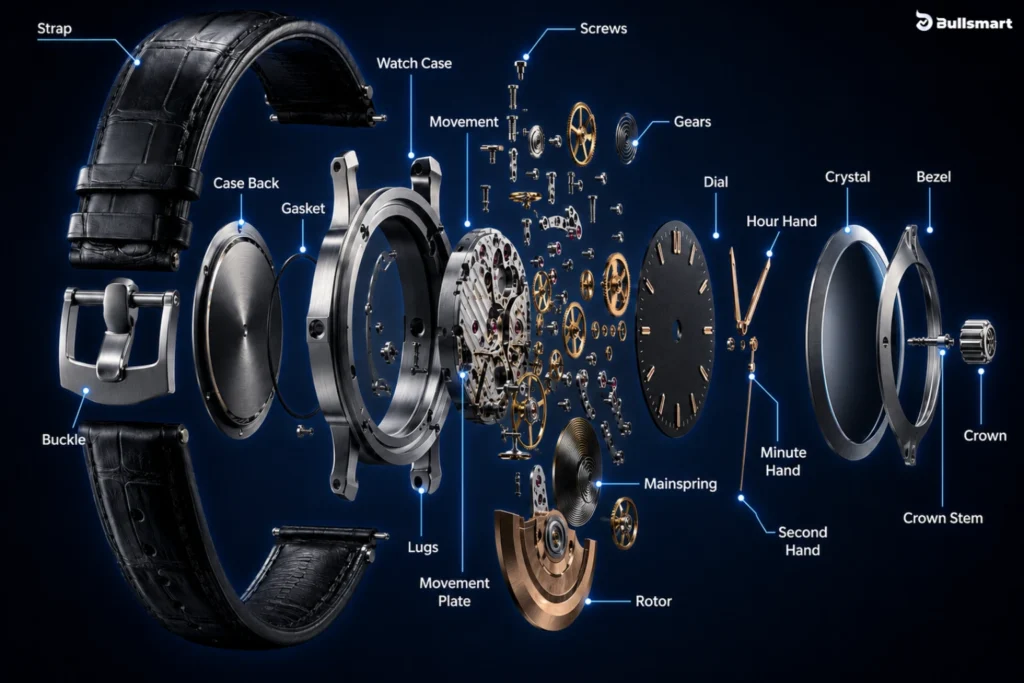
- Complications make the watch harder to build: In watchmaking, a “complication” means any feature beyond basic timekeeping. A date window, moon phase, stopwatch, alarm, or calendar is called a complication. The more complications a watch has, the harder it becomes to design and assemble. Some high-end watches have 20 or more complications, all working mechanically without a battery.
- Tourbillon, a tiny rotating cage inside the watch: A tourbillon is a small rotating mechanism inside a mechanical watch. It was invented to reduce the effect of gravity on accuracy. Today, it is admired less as a daily-use feature and more as a sign of extreme watchmaking skill.
- Rarity increases demand: Some luxury watch brands make only a small number of pieces. When supply is low and demand is high, prices rise quickly. This is why limited-edition watches from brands like Patek Philippe and Richard Mille can become extremely expensive.
- Materials can be rare and difficult to work with: Expensive watches often use platinum, rare diamonds, sapphire crystal cases, titanium alloys, gold, or Carbon TPT, a layered carbon material used in high-performance engineering. Some of these materials are not just costly, they are also difficult to shape and finish.
- Hand assembly takes months or years: A luxury watch is not just made by machines on a factory line. At the highest level, watchmakers spend months or even years assembling, polishing, adjusting, and testing one piece. That human skill adds huge value to the final watch.
Suggested Read: Most Sold Bikes in India & What Makes Them So Popular
Most Expensive Watch Ever Sold at Auction: Why Patek Philippe Is So Valuable
The Graff Hallucination is the most expensive watch by reported value. But if we talk about a watch that was actually sold at auction, the record belongs to Patek Philippe.
The Patek Philippe Grandmaster Chime Ref. 6300A-010 sold for $31 million at Christie’s Only Watch auction in Geneva in 2019. That made it the most expensive watch ever sold at auction.
But why do Patek Philippe watches become so expensive? Here’s the simple answer:
- It is one of the oldest luxury watch brands: Patek Philippe was founded in Geneva in 1839. That means the brand has been making watches for almost 200 years. For buyers, that history creates trust.
- People see it as a watch to pass down: Patek’s famous line says, “You never actually own a Patek Philippe. You merely look after it for the next generation.” In simple words, the brand wants people to see its watches as something that can stay in a family for decades, not just something you buy and replace.
- The Grandmaster Chime made auction history: This watch was made specially for the Only Watch charity auction. It was also the only Grandmaster Chime made of stainless steel. That made it extremely rare. It has 20 special features beyond showing time, two dials, and a case that can be flipped. Basically, it is a tiny mechanical machine that can do many things without electronics or a battery.
- The Henry Graves Supercomplication showed what Patek could do: This pocket watch was completed in 1933 and has 24 special features beyond basic timekeeping. It sold for about $24 million at Sotheby’s. It is still remembered as one of the greatest mechanical watches ever made.
- Ref. 1518 is valuable because very few exist: Ref. 1518 is a vintage Patek Philippe wristwatch from the 1940s. It had a stopwatch and a calendar that could adjust for different month lengths and leap years. Very few were made, which is why collectors value it so much.
- The Nautilus made Patek popular with modern luxury buyers: The Nautilus was launched in 1976 as Patek’s luxury sports watch. It looked simpler than many complicated watches, but its design, steel case, and limited availability made it a global status symbol. In 2026, the Nautilus turns 50, so it is getting fresh attention again.
The surprising part is that Patek does not need diamonds to create record prices. Its value comes from age, rarity, skill, trust, and the idea that the watch can outlive its owner.
Richard Mille: The New-Age Brand That Made Watches Look Like Machines From the Future
Richard Mille is much younger than Patek Philippe. It was founded in 2001, but it has already become one of the most expensive and recognisable luxury watch brands in the world.
Unlike traditional luxury watches, Richard Mille does not try to look classic or quiet. Its watches look bold, sporty, and futuristic.
Here is why Richard Mille watches are so expensive:
- It sells modern luxury, not old-world elegance: Patek Philippe is known for history and tradition. Richard Mille is known for speed, sport, technology, and bold design. Its watches are made for people who want their watch to stand out.
- The design looks like high-performance machinery: A Richard Mille watch often looks like something inspired by a race car or Formula 1 machine. The case is usually big and curved. The inner parts are visible. The overall look is technical, not simple.
- The materials are difficult to work with: Richard Mille uses materials like titanium, sapphire crystal, and advanced carbon composites. These materials are not just expensive. They are also difficult to shape, polish, and assemble.
- The RM 56-02 Sapphire shows why the price is so high: The Richard Mille RM 56-02 Sapphire has a transparent sapphire case. According to Richard Mille, making the case alone requires 40 days of continuous machining, 24 hours a day. That is one reason why the watch costs so much.
- Sports made the brand famous: Rafael Nadal wore Richard Mille watches while playing professional tennis. That sent a clear message: this was not a delicate watch meant only for a safe. It was a luxury watch that could survive real movement and impact.
- Celebrities made it a status symbol: Richard Mille is often seen on athletes, musicians, actors, and business tycoons. It has become a watch for people who want luxury that is loud, modern, and instantly recognisable.
In simple words, Patek feels like old family wealth. Richard Mille feels like a modern billionaire luxury. Both are expensive, but they speak very different languages.
Patek Philippe vs Richard Mille: Heritage vs Modern Luxury
Patek Philippe and Richard Mille are both expensive, but they are expensive in completely different ways.
| Factor | Patek Philippe | Richard Mille |
| Founded | 1839 | 2001 |
| Core appeal | Heritage, complications, legacy | Futuristic design, sport, engineering |
| Buyer emotion | “This will outlive me” | “This is impossible to ignore” |
| Design style | Elegant and traditional | Bold and technical |
| Famous watches | Grandmaster Chime, Nautilus, Henry Graves Supercomplication | RM 56-02 Sapphire, RM UP-01 Ferrari, RM 27 Nadal |
| Status signal | Quiet wealth | Loud modern wealth |
Patek Philippe feels like a family heirloom. Richard Mille feels like a hypercar for the wrist. Patek is about tradition. Richard Mille is about performance and attention.
Both brands prove the same thing in different ways: at the highest level, watches are not bought only for time. They are bought for identity.
Beyond Patek and Richard Mille: Other Brands Worth Knowing
Patek Philippe and Richard Mille get most of the attention, but the list of the world’s most expensive watches has many other names worth knowing.
- Graff Diamonds is not a traditional watchmaker in the same way Patek is. It is a jewellery house. That is why the Hallucination and Fascination are better understood as diamond jewellery that also tells time. The Hallucination uses more than 110 carats of rare coloured diamonds and is valued at around $55 million.
- Vacheron Constantin is one of the oldest and most respected Swiss watchmakers. Its Reference 57260 is famous because it has 57 complications. It took eight years of research and the work of three master watchmakers. This is the type of watch that only a handful of people in the world can truly understand.
- Jacob & Co. brings a very different flavour. It is bold, flashy, diamond-heavy, and deeply connected with celebrity culture. The Billionaire Watch, with hundreds of carats of diamonds, is built to be noticed.
- Breguet brings history. The Marie Antoinette watch is linked to royalty and is one of the great stories in watchmaking. It took decades to complete and is remembered as one of the most ambitious watches of its era.
- Chopard and Hublot show another side of expensive watches: jewellery-led luxury. These watches are less about quiet mechanical heritage and more about diamonds, visibility, and spectacle.
The Titan Story: How India Built Its Own Watch Brand From Hosur
After reading about watches worth hundreds of crores, it is worth coming back to India. Because India has its own powerful watch story: Titan.
The Graff Hallucination was built for billionaires. Titan was built for a changing India. One represents extreme luxury. The other represents aspiration, access, and the belief that Indians deserved a world-class watch brand of their own.
Before Titan, Buying a Good Watch Was Not Easy
Before Titan entered the market, India’s watch world was limited. For many families, a good watch meant buying an HMT when available or waiting for a foreign watch from an NRI relative.
Watches were mostly seen as practical products. They helped you check time. They were not yet strong fashion statements, lifestyle products, or emotional gifts.
That is the gap Titan entered.
Titan’s Growth Timeline: From Watches to a Lifestyle House
Titan’s journey did not stop at watches. Over four decades, it moved from timepieces into jewellery, eyewear, fragrances, bags, sarees, accessories, and newer jewellery formats.
| Year / Period | What Happened |
| 1984 | Titan Watches was established as a joint venture between Tata Industries and TIDCO. |
| 1987 | Titan released its first major print campaign, helping watches become desirable lifestyle products. |
| 1988 | Titan’s watch factory in Hosur was inaugurated. |
| 1990 | Titan opened its first company-owned showroom in Mumbai. |
| 1992 | Titan entered a joint venture with Timex and also launched the Raga collection for women. |
| 1993 | Titan expanded outside India into Europe, followed by the Middle East and Asia Pacific. |
| 1994 | Titan introduced rugged sporty watches through the PSI 2000 range. |
| 1996 | Tanishq was launched, taking Titan into jewellery. |
| 1998 | After the Timex partnership ended, Sonata helped Titan strengthen its affordable watch segment. |
| 2002 | Titan Edge was launched as an ultra-slim watch, showing Titan’s design and engineering capability. |
| 2005 | Fastrack became a stronger youth-focused fashion and accessories brand. |
| 2007 | Titan EyePlus entered the organised eyewear segment, and Zoya expanded Titan’s premium jewellery presence. |
| 2009 onward | Helios helped Titan enter multi-brand premium watch retail. |
| 2010s | Titan expanded further into brands such as Skinn, Mia, Taneira, CaratLane, and other lifestyle categories. |
| 2024 | Titan marked 40 years with the 40 Years of Joy collection. |
| 2026 | Titan expanded its House of Titan portfolio further with beYon, a lab-grown diamond jewellery brand. |
Today, Titan’s portfolio includes 16+ brands across watches, jewellery, eyewear, fragrances, bags, sarees, and accessories.
Titan Was Born From an Indian Manufacturing Dream
Titan Watches was established in 1984 as a joint venture between Tata Industries and the Tamil Nadu Industrial Development Corporation, also known as TIDCO.
Its factory was set up in Hosur, Tamil Nadu. This mattered because Titan was not simply importing watches. It was trying to build a serious Indian watch company from the ground up.
At that time, building a modern watch brand in India required patience, approvals, technical know-how, and confidence that Indian consumers were ready for something new.
Quick fact: Titan’s journey has also been documented in the book Titan: Inside India’s Most Successful Consumer Brand by Vinay Kamath. In 2026, the story reached a wider audience through Made In India: A Titan Story, a six-episode series on Amazon MX Player.
Titan Changed the Meaning of a Watch in India
Titan’s biggest contribution was not just that it made watches. It changed how Indians felt about watches.
Before Titan, a watch was mostly functional. After Titan, a watch became personal.
It could be:
- A first salary purchase
- A graduation gift
- An anniversary present
- A wedding memory
- A gift from parents
- A style statement for young professionals
Titan understood something very simple but powerful: Indians do not buy watches only to check time. They often buy them to mark a moment.
That emotional understanding helped Titan become part of Indian homes, not just Indian wrists.
Titan Built Watches for Different Types of Indians
Another smart move was that Titan did not remain one single watch brand for everyone. It built different brands and collections for different customers.
- Fastrack spoke to younger buyers with bolder, more casual styles.
- Raga focused on women and brought a more elegant, jewellery-like design language.
- Sonata made watches more affordable for mass-market buyers.
- Xylys went after the premium segment.
- Titan Edge showed how slim and refined an Indian watch could be.
- Nebula brought gold watches into Titan’s portfolio.
This helped Titan cover many price points and many life stages. A student, a first-job professional, a wedding shopper, and a premium buyer could all find a Titan watch that made sense to them.
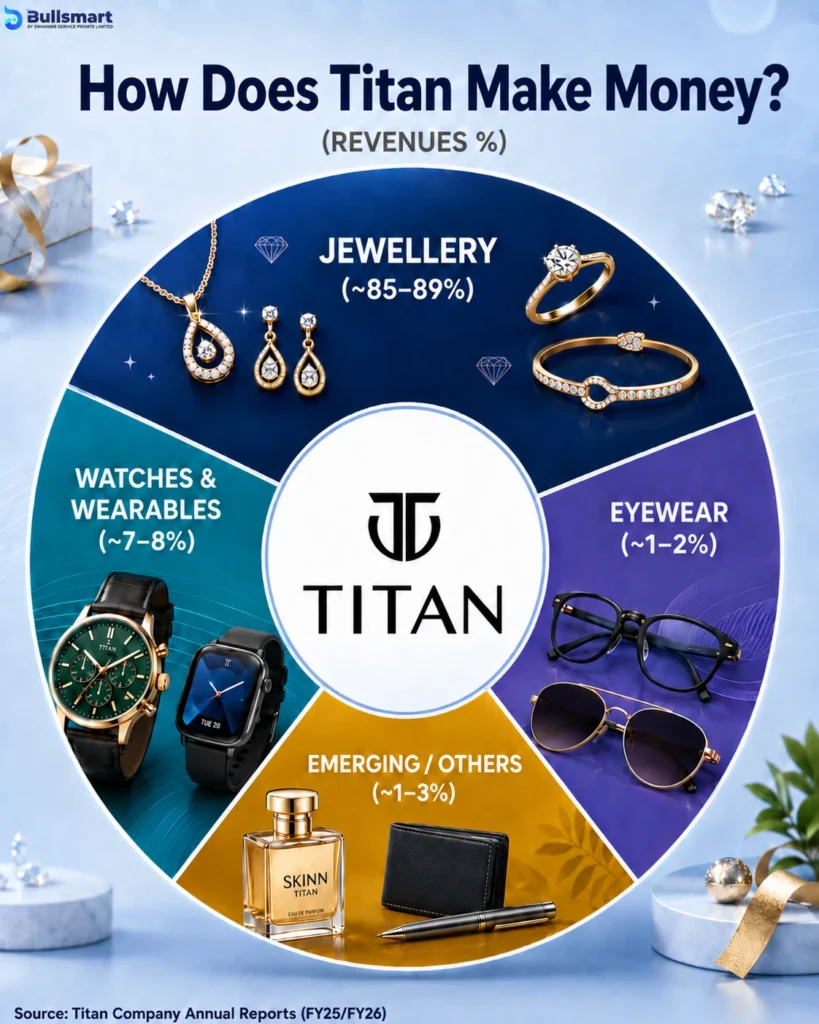
Titan’s Market Presence in Numbers
Titan’s scale goes far beyond watches. Its total assets grew from around Rs. 5,868 crore in 2015 to over Rs. 60,000 crore in 2026, showing how the company expanded across watches, jewellery, eyewear, fragrances, sarees, bags, and accessories.
Its market capitalisation is also around Rs. 3.8 lakh crore, making Titan one of India’s largest consumer companies by stock market value. This gives context to brands like Fastrack, Raga, Sonata, Titan Edge, Xylys, Nebula, and Helios.
They are not just separate watch labels, but part of a much larger consumer business built across price points, age groups, and lifestyle categories.
Final Thought: Why Watches Still Matter
The world’s most expensive watches are not really about checking the time. A phone can do that better. These watches are about something else: craft, rarity, memory, wealth, engineering, and human obsession.
Some, like the Graff Hallucination, are jewellery masterpieces. Some, like the Patek Philippe Grandmaster Chime, are mechanical achievements. Some, like Paul Newman’s Rolex Daytona, are valuable because of the story attached to them. And some, like Richard Mille, show how modern luxury can look more like a racing machine than a traditional watch.
Then there is Titan, which brings the story closer to home. It reminds us that a watch can also be democratic, emotional, and deeply Indian.
Whether a Rs. 450 crore watch is worth it is a question only the buyer can answer. But one thing is clear: watches still carry meaning. They mark time, but they also mark ambition, memory, status, and legacy.
Disclaimer: Investments and trading in the securities market are subject to market risks, read all related documents carefully before investing or trading.
The information provided in this blog is for educational and informational purposes only and should not be considered investment advice, stock recommendation, or a solicitation to buy or sell any securities. References to luxury watches, companies, brands, or watch stocks are for general awareness and content explanation only. Past performance, brand value, market reputation, or product popularity does not guarantee future returns. Investors should assess their financial goals, risk appetite, and consult a qualified financial advisor before making any investment decision.
FAQs
What’s the most expensive watch in the world in 2026?
The Graff Diamonds Hallucination is often listed as the most expensive watch in the world, with a reported value of around $55 million. However, the most expensive watch ever sold at auction is the Patek Philippe Grandmaster Chime, which sold for about $31 million in 2019.
Which brand is more expensive, Patek Philippe or Richard Mille?
Both are extremely expensive, but in different ways. Patek Philippe usually dominates auction records and collector value, while Richard Mille is known for very high retail prices, limited production, and modern luxury appeal.
Is Titan a luxury watch?
Titan is not usually placed in the same ultra-luxury category as brands like Patek Philippe, Rolex, or Richard Mille. However, Titan does have premium and luxury-style offerings, including Nebula, Edge, Xylys, and its 40 Years of Joy Collection. So, Titan is best seen as a mass-premium Indian watch brand with select premium and high-end watchmaking pieces.
Is Titan better than Rolex?
Titan and Rolex serve very different buyers. Titan is better for affordable, stylish, and accessible watches in India. Rolex is better known globally for luxury, durability, resale value, and collector demand. So, Titan is not “better” than Rolex in luxury positioning, but it can be a better practical choice for everyday Indian buyers.