
The current economic developments in China’s equity market are not just a local story. They are influencing global markets, including India, in meaningful ways. When China announced fresh stimulus measures, markets reacted positively at first. Investors hoped this would revive growth, stabilize real estate, and boost business confidence. For a brief period, optimism returned.
But as the weeks passed, that excitement began to cool. Traders and global investors started questioning whether the Chinese government would follow through with strong, sustained fiscal support. When confidence weakens, capital moves quickly, and that shift does not go unnoticed in other emerging markets like India.
The result has been visible in foreign investment flows, stock market volatility, and changes in portfolio strategies. For Indian investors, this situation presents both risk and opportunity. On one hand, global liquidity shifts can create short-term pressure. On the other, evolving valuations across markets can open new entry points.
Understanding what is happening in China helps make sense of the broader market movements.
Let’s break it down and see how it connects to India’s investment landscape.
China’s Economic Slowdown and Its Impact on Indian Markets
The China equity market surged in early October following the government’s announcement of stimulus plans aimed at boosting consumption and stabilizing the real estate and equity markets. However, this rally fizzled as traders began to question whether Beijing would implement the necessary fiscal policies to sustain this momentum.
While some investors have increased their exposure to Chinese equities, others remain sceptical, waiting for more concrete actions from the Chinese government.
The result of this uncertainty has been a noticeable shift in investment patterns. For example, foreign institutional investors (FIIs) withdrew over Rs 40,500 crore from Indian stocks last week, contributing to a 4.5% decline in the Nifty index.
A significant portion of this liquidity has moved to Chinese markets, where valuations appear more attractive after a period of underperformance.
Comparison of India and China Equity Market
Investments in India and China Equity Market have grown significantly over the years, making both countries attractive to global investors.
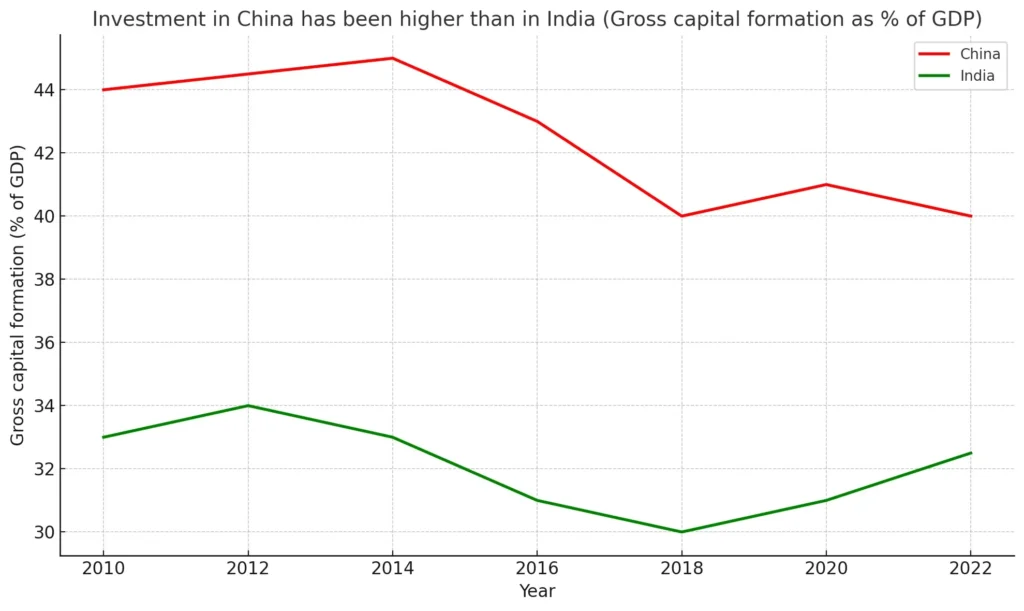
Historically, India’s stock market has outperformed China’s, despite the latter’s larger economy. Since the global financial crisis of 2008, Indian stocks have consistently delivered better returns than their Chinese counterparts, with Indian equities growing four times faster than Chinese ones over the past decade.
This is largely due to China’s over-reliance on stimulus and investment-driven growth, which has led to inefficiencies and excess capacity across industries.
In contrast, India has maintained a more disciplined approach to capital allocation, resulting in higher returns on investment.
Here’s a brief comparison for you:
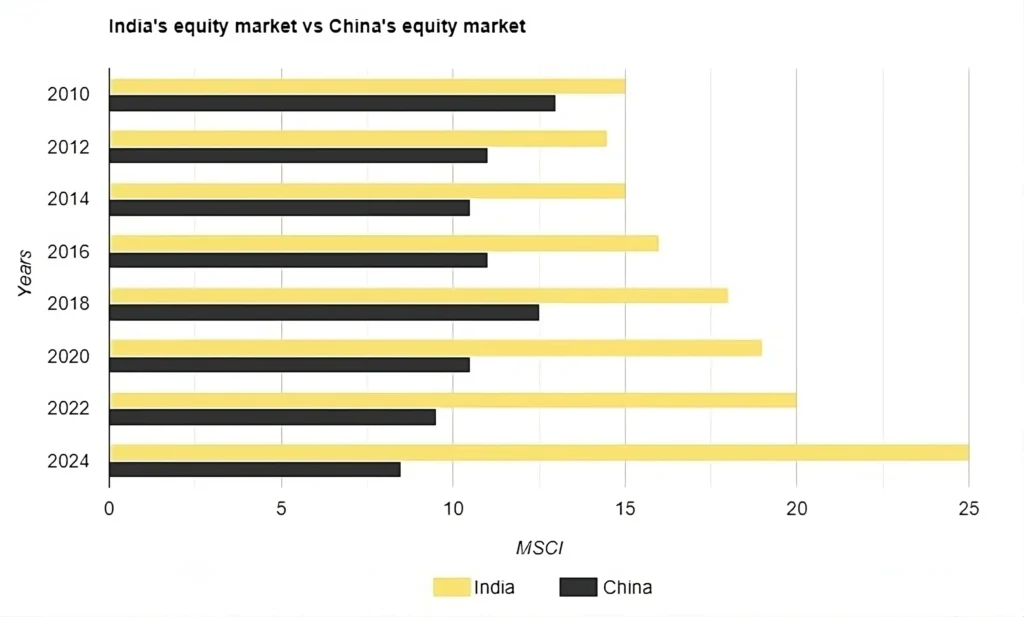
However, the resurgence of China’s market has drawn investor attention back to its potential, particularly in sectors like technology, electric vehicles, and real estate. The renewed interest in China is starting to divert funds away from Indian markets, posing a challenge to Indian investors and companies.
Key Concerns for Indian Investors
For Indian investors, the situation in China presents both risks and opportunities. The liquidity shift towards Chinese markets could lead to short-term volatility in Indian equities.
Moreover, rising oil prices, the surge in new IPOs, and the appetite of retail investors in India have contributed to concerns about overstretched valuations in the Indian market.
Nevertheless, India’s long-term growth story remains strong. Global investors continue to see India as the most scalable emerging market, offering opportunities for sustained growth.
While China’s economic recovery has garnered attention, many experts caution against short-term trading in the China equity market due to volatility.
What Should Indian Investors Do?
For Indian investors, it is important to maintain a balanced and diversified portfolio. While the China equity market may offer attractive valuations and growth potential, India’s stable economic fundamentals and disciplined capital management still provide a compelling investment case.
Investors may consider exposure to both markets through Mutual Funds and ETFs to capitalize on growth opportunities while mitigating risks.
The economic situation in China will continue to influence global markets, including India’s, but strategic diversification and long-term thinking will help investors go through these volatile times.
Suggested Read – SEBI approved Jio Financial Services and Blackrock collaboration
Bottom Line
At the end of the day, global markets are more connected than ever. What happens in Beijing does not stay in Beijing. It finds its way into Mumbai, into FII flows, into Nifty charts, and into investor sentiment. The recent shifts between India and China are a reminder of how quickly capital moves when valuations and policy signals change.
Yes, short-term volatility can feel uncomfortable. Liquidity moving toward China may create temporary pressure on Indian equities. But markets are cyclical, and capital often chases opportunity before returning to fundamentals.
India’s long-term story has not changed. Strong domestic consumption, structural reforms, digital growth, and a growing investor base continue to support its trajectory. China may offer tactical opportunities, but India remains a strategic one.
For investors, this is not about choosing sides. It is about staying diversified, avoiding emotional reactions, and focusing on long-term wealth creation. Exposure across geographies, sectors, and asset classes can help smooth the ride.
In a globalized world, patience and discipline matter more than prediction. Stay informed, stay diversified, and let your strategy guide you through the noise.
Disclaimer: Investments in securities market are subject to market risks, read all the related documents carefully before investing.


